Everyone Is Still Talking. You Already Moved.
Forty minutes into the meeting and you've checked out. Not because you're rude. Because you solved it at minute six, and the other thirty-four minutes have just been people describing their anxiety to each other in business language.
You know this one in your body before you can put words to it: the leg that starts bouncing, the pen that starts flipping, the almost physical itch of watching people plan something that would take less time to just try. You've gotten good at hiding the restlessness. Mostly.
Here's what you don't say out loud. When the alarm goes off, literally or otherwise, and everyone else freezes, something in you goes quiet and clear. The server crashes, the deal falls apart, the kid wipes out on the bike: you're already moving, and you feel better than you have all week. Then you feel a little guilty about feeling better.
You've read the instructions exactly never, or after the third failed attempt, whichever came first. You've caught glasses out of the air before your brain registered they'd fallen. You can feel a room shift half a second before it actually shifts. And somewhere along the way, people started describing you with words like impulsive, shallow, unfocused, usually the same people whose plans you rescued in real time.
The "where do you see yourself in five years" question makes you feel like a fraud, because the honest answer is you have no idea, and pretending otherwise feels like lying about a stranger.
You're not broken. You're running a different operating system, and nearly every productivity book on the shelf was written by someone running the other one.
Your Wiring: The Brain That Samples Instead of Simulates
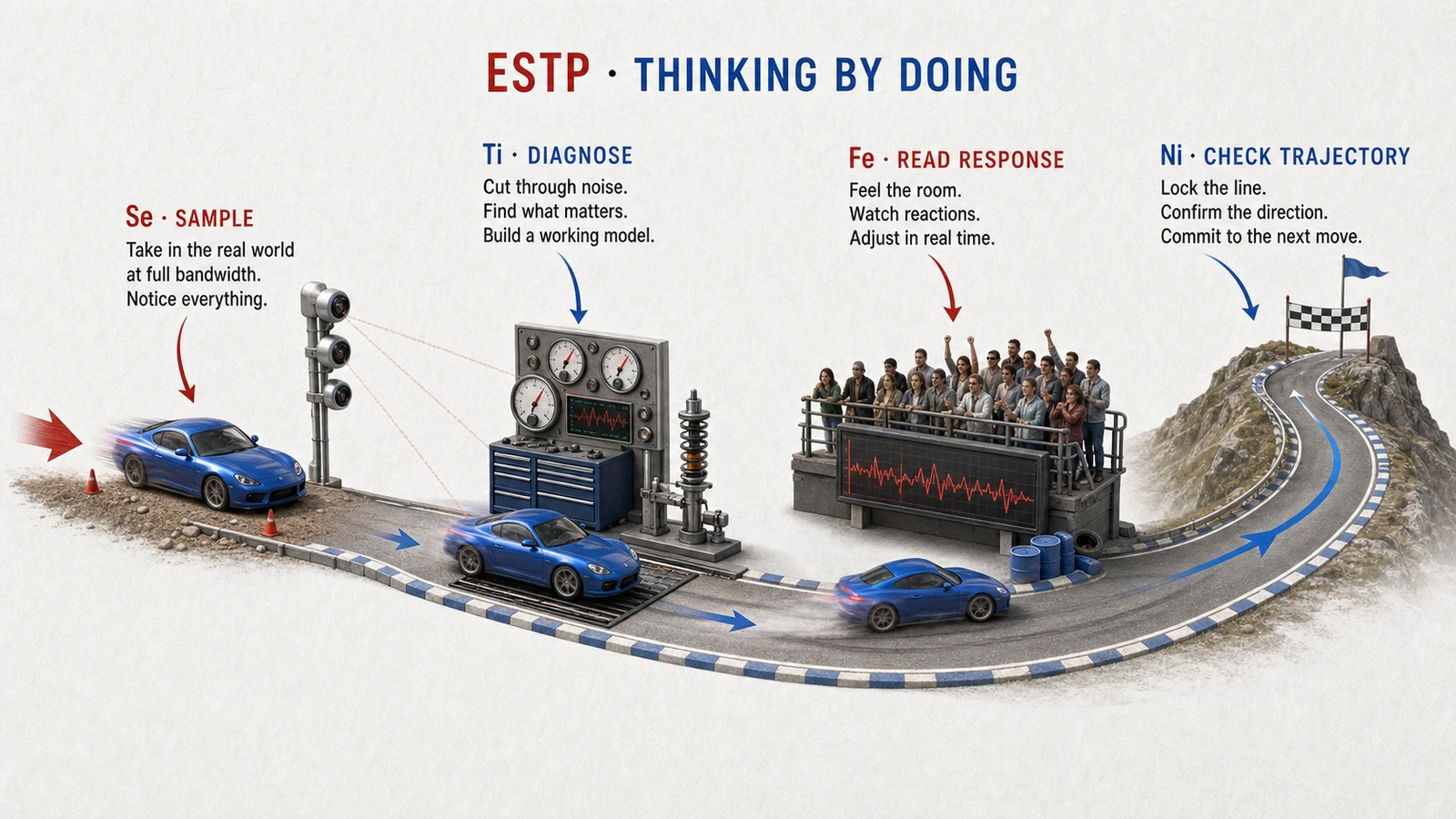
In cognitive-function terms, ESTP means extraverted sensing paired with introverted thinking. Strip the jargon and the stack describes something simple and genuinely rare: maximum bandwidth for live sensory input, wired directly into a real-time logic engine.
Most people, facing a decision, run an internal simulation first. They imagine outcomes, rehearse scenarios, consult mental models built out of theory. You sample instead. You poke the actual thing and watch what actually happens, and your Ti sorts the results into a working model on the fly. Action isn't what you do instead of thinking. Action is your thinking, in its native format. The prototype is your hypothesis. The test drive is your literature review.
That maps onto real psychology in at least three places.
First, reward sensitivity. Jeffrey Gray's research, later refined by Philip Corr, showed that brains differ measurably in how strongly they respond to reward cues versus threat cues. Your profile leans heavily approach-dominant: reward signals and opportunity light you up far harder than the average brain, while potential-loss signals barely register above a whisper. That asymmetry is why you say yes fast and worry later, and why worry-first advice just slides off you.
Second, sensation seeking. Marvin Zuckerman spent decades establishing it as a stable, largely heritable trait: some nervous systems genuinely under-respond to mild stimulation. If you sit at the high end, ordinary environments deliver a signal too weak to reach your working range. This is the part almost nobody ever told you: your need for intensity is calibration, not a character flaw. A high-sensation-seeking brain stuck in a beige cubicle isn't lazy. It's starved.
Third, arousal and performance. The Yerkes-Dodson law describes an inverted U: too little arousal and performance sags, too much and it shatters. Your curve sits shifted to the right. The stimulation level that would overwhelm your ISTJ coworker is the level where you finally come online. Which reframes something people have shamed you for your whole life.
Risk, for you, is clarity, not recklessness. When the stakes turn real, your arousal climbs into its optimal band, the noise drops out, and the world resolves into signal. That's why you negotiate best when the deal might actually die, drive best in bad weather, and think best on stage. Recklessness is a different thing entirely, something that shows up later, when a stakes-hungry brain has no legitimate stakes left to chase. Hang onto that thought; we'll come back to it in the shadow section.
One honest caveat before we go further. The MBTI instrument itself has well-documented psychometric problems: forced either-or categories laid over traits that are actually continuous, and mediocre test-retest reliability near the boundaries. What makes a profile like this one useful isn't that ESTP is some biological category. It's that the pattern maps onto validated constructs: Big Five extraversion, trait sensation seeking, reward sensitivity. Read this as a description of a reinforcement profile, not a horoscope, and it earns its keep.
And a word about school. School grades simulation: sit still, work in the abstract, defer the payoff, show your reasoning before you're allowed to touch anything. Kinesthetic intelligence, the ability to think through your hands and body, to read a physical situation instantly, to learn by contact, was never on the report card. You may have spent twelve years being graded in your second language and quietly concluded you weren't smart. You were fluent the entire time. The test was just in the wrong format.
The Dream Life You Are Actually Built For
Standard dream-life advice starts with a vision exercise: close your eyes, picture your life in ten years, write it out in vivid detail. For you, that produces either nothing or pure fiction. The person you'd be in ten years is a stranger, and planning their life feels like writing a novel about someone you've never met. Research on reward discounting explains why: some brains devalue distant outcomes steeply, and yours is one of them. Distant rewards don't motivate you because, neurochemically, they barely register as rewards at all.
So stop designing a destination and start designing conditions instead. The ESTP dream life isn't a place you eventually arrive. It's a set of running conditions that keep your nervous system inside its working range.
Work with live feedback and real variance. The pattern behind every career where ESTPs flourish, emergency medicine, sales, skilled trades, entrepreneurship, litigation, professional kitchens, coaching, field operations, isn't the industry. It's the loop: act, see the result, adjust, act again, with real consequences attached. Mihaly Csikszentmihalyi's flow research identified clear goals, immediate feedback, and a balance between challenge and skill as the preconditions for the deepest engagement people ever report. Notice that this is basically a description of your preferred environment. You don't need to engineer flow the way other types do. You need to stop taking jobs that make it impossible.
Mastery you can feel in your hands. Your version of mastery is embodied: the perfect weld, the closed deal, the clean deadlift, the improvised save. Abstract expertise with no physical or performative surface will never feel like progress to you, no matter how prestigious it looks on paper. Choose crafts where the skill lives in the body and shows up under pressure.
Novelty as infrastructure, not indulgence. Other types treat variety as a treat. For your wiring it's maintenance. Build regular novelty into the structure of your life, rotating projects, travel, new physical skills, before your brain builds it in for you without asking.
Relationships that move. You bond shoulder to shoulder, not face to face. The friendships that last have a shared activity running through them: the gym partner, the fishing trip, the business you almost started together. Two hours of seated feelings-talk drains you, not because you lack depth, but because your connection channel runs through shared action. Design accordingly, and stop apologizing for it. Your ISTP cousins share this wiring with a quieter finish; the ESFP shares your live-wire presence with a warmer one.
Autonomy means permission to act. For you, autonomy isn't flexible hours. It's the absence of approval layers between spotting the move and making it. A well-paid role where every action needs a sign-off is a cage with decent catering. Weight this heavily in any career decision, because it predicts your daily experience better than title or salary ever will.
A Productivity System That Fits Your Brain
The systems that keep failing you, annual goals, elaborate task hierarchies, gentle habit nudges, were designed for brains that find comfort in structure and distance. Yours finds fuel in stakes and proximity. Build around three words: sprints, stakes, scoreboards.
Plan in seasons, not years. Replace the five-year plan with a 12-week season. Twelve weeks is close enough to feel real and long enough to actually build something. Each season gets one primary campaign, a revenue target, a certification, a physique block, a product launch, chosen because it genuinely excites you, not because it audits well on paper. Direction beats destination: you need to know the compass heading, not the exact address.
Run 1 to 2 week sprints inside the season. Your motivation shows up in surges, so build the container to match. Each sprint gets a defined finish line and a visible result: celebrate it, log it, pick the next one. Chronic, open-ended projects are where ESTP motivation goes to die quietly.
One scoreboard per sprint. Edwin Locke and Gary Latham's goal-setting research found that specific, difficult goals reliably outperform vague ones, but for you the operative word is visible. Pick one number per sprint, calls made, sessions trained, units shipped, and put it somewhere you physically see it. A scoreboard turns work into a game, and your dopamine system, which fires on anticipation far more than on completion, will chase a number it can actually watch move.
Write tasks as physical actions. Your task list should read like stage directions, not a strategy memo. Not "explore partnership opportunities." Instead: "call Jim, 2pm." Not "work on fitness." Instead: "5x5 squats at 6." Abstract tasks require a translation step before your body can execute them, and that translation step is exactly where they stall out for weeks. Peter Gollwitzer's implementation intentions research, the if-then format, works unusually well for you precisely because it pre-converts intentions into concrete, triggered actions.
Move before you manage. Train early. Physical output isn't a wellness accessory for your type, it regulates the arousal baseline everything else depends on. Skip it for a week and watch your focus, patience, and judgment degrade together.
Review like an athlete, not an accountant. One twenty-minute weekly review, framed as film study: what worked, what didn't, what's the next play. Athletes watch tape without moralizing about it. Skip the journaling-about-feelings format reviews usually come wrapped in. Keep it tactical and short, or you'll skip it entirely.
Accountability through rivalry, not guilt. A gentle accountability buddy who asks how you're feeling about your progress will bore you straight into noncompliance. What works is a rival, a bet, or a public commitment, someone who will genuinely enjoy watching you lose. Engineer that pressure on purpose. It's productive stress, and for your wiring it's the cheapest performance enhancer you'll ever find.
Neuro Hacks for ESTPs
Six tactics tuned to your specific failure modes, each with the mechanism attached.
1. The Game Clock. Put a visible countdown on anything you're avoiding: 25 minutes, phone timer, no exceptions. The mechanism: artificial deadlines create artificial stakes, and stakes push your under-aroused brain into its Yerkes-Dodson working range. A boring task with a clock running is a genuinely different event for your nervous system than the same task without one.
2. Body-First Booting. When you can't start mentally, start physically instead: twenty push-ups, a fast walk around the block, cold water on your face, then sit down and begin within ninety seconds, before the arousal fades. The mechanism: movement raises catecholamines and shifts you out of simulation mode and into sampling mode. This is behavioral activation stripped to its core: action generates the state that action was waiting for.
3. The Bet Ledger. Keep a running list of small wagers with a friend or a rival: fifty dollars says I ship this by Friday. The mechanism: a bet adds social stakes and loss framing to a task that had neither, recruiting both your reward system and your competitive streak at once. The money is irrelevant. The scoreboard between you two is everything.
4. The Stranger Test. Before committing to any goal, ask yourself: does this feel like my project, or like fiction about a stranger? If it's fiction, don't abandon the goal, shrink the horizon until it snaps into first person. "Become someone who owns rental property" is a stranger's story. "Make three agent calls this week" is yours. The mechanism: with steep temporal discounting, distant rewards barely register at all. Proximity isn't a compromise here, it's the correct dose.
5. Walk-and-Solve. Take any stuck problem, the awkward email, the pricing decision, the difficult conversation, out on a walk, and talk it through out loud if you can. The mechanism: for a Se-Ti stack, cognition runs noticeably better with sensory input flowing, and research on embodied cognition keeps finding that movement changes what thinking is even available to you. Your best ideas have never once arrived at a desk. Stop expecting them to start now.
6. The Boredom Alarm. Treat sustained boredom as instrument data, not a mood to push through. When flatness lasts more than a few days, don't grind through it, schedule sanctioned intensity within 72 hours instead: a competition, a hard physical challenge, a high-stakes work sprint. The mechanism: this is preventive maintenance against the escalation spiral described below. Feed the sensation-seeking system on purpose, or it will feed itself.
The Shadow Side: The Escalation Spiral
Every type has a burnout signature. Yours doesn't look like exhaustion. It looks like a life getting faster and stranger for no visible reason.
It starts with flatness. The job got predictable, the relationship turned routine, the season has no real campaign in it. For most people that reads as mild discontent. For a high-sensation-seeking nervous system, it's closer to sensory deprivation, genuinely aversive, and invisible from the outside, because your life still looks fine on paper.
Then the escalation starts, quietly. The trades get spicier. The overtakes happen later and later. Another drink becomes the default. You pick a fight you didn't need to pick, buy something you didn't need to buy, flirt with a line you didn't need to flirt with, and each one delivers a hit of the aliveness your ordinary days stopped supplying. None of these individually are the actual problem. They're the symptom. The problem is that your life went flat and your brain started self-prescribing intensity, unsupervised, in whatever form was closest at hand.
The private shame here is real, and worth naming: you've probably been called an adrenaline junkie, self-destructive, or immature by people who watched the escalation without ever seeing the starvation underneath it. Here's the more accurate read: you were never chasing destruction. You were chasing signal, in an environment that had quietly stopped providing any.
Catch it early by watching for the cluster: persistent boredom plus irritability, contempt creeping into how you talk about routine people, ordinary tasks needing to be spiced up just to be tolerable, and a growing gap between how alive you feel on your best days versus your median ones.
The recovery move is counterintuitive: re-stake, don't sedate. The standard burnout advice, rest more, slow down, meditate, treats an over-aroused system, and yours is under-aroused. Applied to you, it just deepens the deficit. Instead, within 72 hours of noticing the cluster, reintroduce legitimate stakes: sign up for the competition, book the hard trip, commit publicly to the deadline, start the training block. Pair it with one honest sentence, naming the flatness out loud, to yourself or someone you trust, takes surprising heat out of it. Then rebuild the season structure, because the spiral got in through a schedule that had no campaign in it to begin with.
The Responder
Here's the reframe worth keeping: you're not a planner who keeps failing. You're a responder, one of the people evolution kept around for the moments when the plan meets reality and loses.
The world fetishizes plans because plans are legible. But every plan eventually collides with a burst pipe, a collapsing deal, a real emergency, and in that moment the room turns to the person whose thinking runs at the speed of events. That's always been you.
Build a life with real stakes, near horizons, visible scoreboards, and daily contact between your body and the world, not because you lack discipline, but because that's the environment your particular brain was built to win in.
Everyone else is still talking. Go.