You Were About Ten the First Time an Adult Dropped Something Important and You Caught It
You probably can't name the date, but you remember the moment. A permission slip nobody signed, a bill sitting unpaid on the counter, a plan everyone assumed somebody else was handling. You noticed. You fixed it. Nobody threw a parade, but somewhere in that small, satisfied click, a contract got signed that nobody ever read out loud: you are the one who makes sure.
You've been the one who makes sure ever since.
You silently re-plan other people's projects during the meeting where they're still describing the problem. You'd drafted the follow-up email in your head before the group even agreed one was needed. Someone says "let's just play it by ear" and something in you goes off like a smoke alarm chirping in a room everyone else insists is smoke-free. You physically cannot watch a dishwasher get loaded badly. "It's fine, I'll just do it" has left your mouth in a tone that was somehow both a complaint and a sigh of relief, because doing it yourself is annoying, sure, but watching it get botched is worse.
Here's the part you don't say out loud: you carry a quiet contempt for people who can't seem to run their own lives, you're a little ashamed of that, and you don't fully believe you're wrong either.
What it's costing you is the real problem. Let's take the machine apart.
Your Wiring: The Te-Si Stack
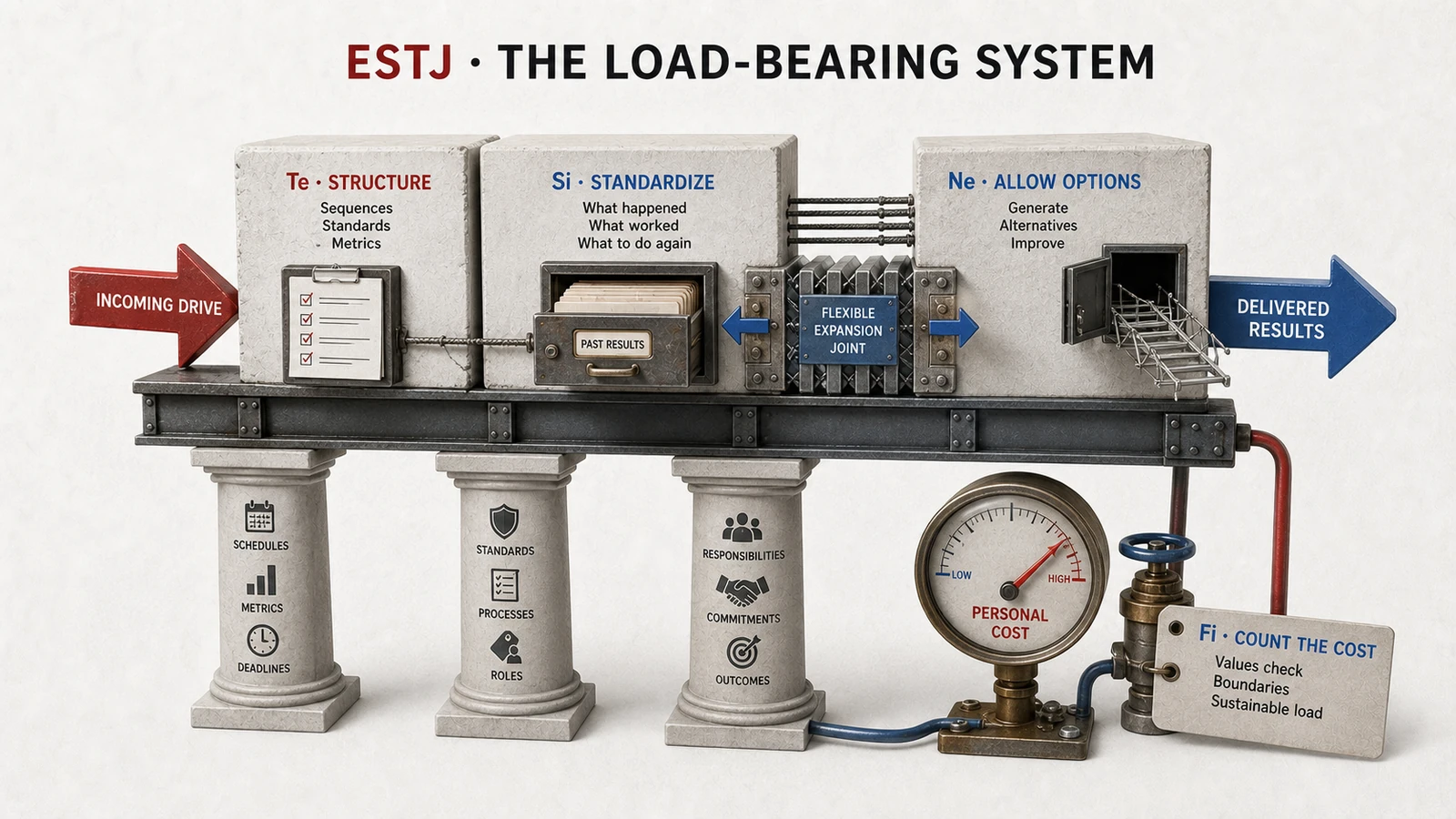
In the language of cognitive functions, the ESTJ leads with Extraverted Thinking, a mind built to organize the outside world: sequences, standards, metrics, who owes what by when. Right behind it sits Introverted Sensing, a detailed internal archive of what actually happened and what actually worked. Te sets the bar. Si remembers exactly who missed it last time, and how, and how many times before that.
A quick honesty check, because you'd trust nothing less: the MBTI instrument itself has real psychometric problems. Test-retest reliability is shaky, and human traits run on a continuum, not sixteen tidy boxes. What makes a profile like this one useful is that it maps onto things that actually replicate: the ESTJ pattern looks a lot like very high Big Five conscientiousness, both the industriousness side and the orderliness side, stacked with high assertiveness and a distinctive threat-and-reward wiring that reinforcement sensitivity research describes well. Treat the four letters as a compression format, not a birth certificate.
So what does the science say about a brain built like yours?
Closure is a drive for you, not a preference. Psychologist Arie Kruglanski spent decades studying what he called the need for cognitive closure, and found that people vary enormously in how much ambiguity they can stomach. High-closure minds want an answer, want it locked in, and experience an open question as something close to physically uncomfortable. You're almost certainly at the far end of that spectrum, which is exactly why "we'll figure it out as we go" never sounds flexible to you. It sounds like a plan to have no plan, delivered with confidence.
Open loops physically intrude on you, too. The Zeigarnik effect, the well-documented tendency for unfinished tasks to keep tapping on your shoulder long after finished ones go quiet, hits harder in a mind that treats loose ends as danger instead of trivia. Your brain files the unhandled thing under "unresolved, therefore threat," not "later."
And completion is your reward drug. Where some brains chase novelty, yours pays out on resolution. The checked box, the closed ticket, the reconciled account: each one delivers a genuine neurochemical hit. That's why you can spend a Saturday running errands that would flatten a poet and end the day content, and why an unfinished list at six in the evening can sour a day that was, by any outside measure, a good one.
Put those three pieces together and the almost moral weight you attach to inefficiency stops being strange. Your brain fuses competence with integrity, so a broken process reads as a broken promise: proof that someone, somewhere, didn't take the thing seriously. Someone else's chaos leaks straight into your own threat system and becomes your unfinished business.
Underneath it all sits the part you like examining least: control is a safety strategy, not an aesthetic. Somewhere early, you learned that the world holds together when you hold it together, and it drops things when you don't. Order was always armor, not tidiness.
The Dream Life You're Actually Built For
This is exactly where generic dream-life advice fails you. Quit the grind, drift for a while, follow your bliss, "let go of control": that's your nightmare with better lighting. Give you two unstructured weeks on a beach and by day four you'll be reorganizing the resort's supply closet and drafting a proposal to fix the town's traffic pattern.
You actually want control over fewer things, chosen more carefully. Build your life around that one sentence and most of the rest falls into place on its own.
Here's what a genuinely fulfilling shape looks like for your wiring:
Jurisdiction, not just responsibility. You know one specific flavor of misery intimately: being accountable for an outcome you have no authority to fix. The dream life inverts that completely. It's a domain that's unambiguously yours, a business, a department, a household system, a community institution, where your standards are the standards and your decisions actually stick. This tracks with what research on job control generally finds: demanding work paired with real authority tends to build people up, while demanding work with no authority just grinds them down.
Running something real, at scale. You were built to run something with actual stakes, somewhere the trains genuinely need to arrive, where your competence compounds into an institution other people can lean on, not to spend a lifetime perfecting your own inbox. Where an ENTJ wants new territory to conquer, you want to govern well: take something that already matters and make it excellent, durable, and fair.
Numbers you can watch move. Decades of goal-setting research from Edwin Locke and Gary Latham show that specific, measurable goals beat vague ones for almost everybody. For you, that finding is closer to oxygen than to a nice-to-have. Abstract impact doesn't feed your reward system. You need to see the number climb, the building stand, the team hit its date.
People who don't need managing. You show love through logistics: the renewal you quietly handled, the appointment you booked, the problem you fixed before anyone else even noticed it existed. Your dream life includes a handful of people whose competence you never have to backstop, not because you can't carry others, but because not being anyone's project manager for one evening is about as close to rest as you get.
One more thing worth saying plainly: ESTJs rarely drift into the wrong life. They catch their way into it. Responsibility kept landing in your hands, because you're the one who makes sure, and you kept catching it, and two decades later your life is a tower of other people's dropped balls, flawlessly juggled. So the real dream-life question is blunter, and more useful, than "what do I want to do?": which of these responsibilities did I actually choose, and which did I merely catch?
A Productivity System That Fits Your Brain
Let's be honest with each other: you don't need a productivity system. You basically are one, and you'll out-execute everyone else on this shelf without reading a single tip. Your real problems run in a different, more expensive direction: high output aimed at the wrong targets, a structure with one single point of failure (you), and a calendar that fills with everyone else's urgent business before your own important business gets a vote.
1. The weekly review, plus one new question. You probably already run a version of this; ESTJs tend to invent it independently. Keep it, but add a single portfolio-level question to the top every week: what am I currently doing that someone else should own? Write the answer down. This is the one question your wiring will never ask on its own, because catching things feels like winning, not like a cost.
2. A quadrant-two budget you actually protect. Run your week through the Eisenhower matrix and you'll spot your personal distortion fast: quadrants one and three overflow, and a good chunk of quadrant three is somebody else's urgency wearing a disguise. Block two to four hours a week, in advance, for work that's important but not urgent, on responsibilities you actually chose. Treat that block like payroll. It goes out first, never from whatever happens to be left.
3. Deep work, because meetings ate your building time. Your Te loves a meeting the way a general loves a map table, but your real leverage still comes from long, uninterrupted stretches of hard thinking. Cal Newport's approach to deep work and time blocking is nearly native to how you already think. The only real adjustment is defending those blocks for building, instead of letting instinct fill them with supervising other people.
4. Delegation with an actual verification system. "Just trust people more" is useless advice for you, because your distrust is a gap in evidence, not a mood. So close the gap with structure instead of feeling. When you hand something off, write down what "done" looks like (your Te will enjoy this part), set checkpoints around the 25 percent and 75 percent marks, early enough to catch a wrong turn, late enough that you're not hovering, and then, here's the actual trick, widen the gap between checkpoints next time if they delivered. Two checkpoints becomes one. One becomes a single review at the end. You're running a training program where trust earns down its own overhead, not just "letting go," and your inner auditor gets to stand down on evidence instead of a lecture.
5. Rest, filed as maintenance. You can't rest without a justification: a finished list, an earned weekend, a doctor's note that finally counts. Fine, don't fight the instinct, just feed it a justification it'll actually accept: rest is scheduled maintenance on your most important asset. You'd fire any fleet manager who ran trucks nonstop until the engines seized. You're the fleet. Put recovery on the calendar labeled as maintenance, and if your inner auditor wants proof, give it some: track sleep, resting heart rate, or simply output per hour in the days after real rest versus the days without it. The numbers will convince you faster than any wellness article ever could.
Neuro Hacks for the ESTJ
Six specific patches, each aimed at a specific glitch in how you're built.
1. The Closure Dump. Ten minutes before bed: write down every open loop, and next to each one, a next action and an owner, even if the owner is future-you on a specific date. The Zeigarnik pull quiets down only when your brain believes the loop is handled, not simply when a task gets finished. An owner plus a date is what "handled" means to a Te brain. Skip this step and you'll reconcile accounts in your head at two in the morning instead.
2. The Jurisdiction Check. Borrow Peter Gollwitzer's implementation-intentions format and point it at your own temper: when I feel that flash of contempt at someone's disorganization, then I ask whether this is actually in my jurisdiction. If yes, act, that's the job. If no, it's weather, not insubordination. Drilled until automatic, this one if-then will buy you more goodwill than any communication seminar could. Contempt is your most expensive reflex. It costs you people who were eighty percent competent and completely loyal.
3. The Two-Standard System. Your rigidity failure mode is applying audit-grade scrutiny to everything, which is how you end up proofreading a grocery list. Before starting any task, assign it a grade: ship standard (good enough, moving on) or audit standard (this one gets the full treatment). Deciding which one before you start turns perfectionism from a compulsion into a resource-allocation call, and that's a game your Te genuinely enjoys winning.
4. The Maintenance Log. Extend the rest reframe with actual tracking, because for a brain like yours, what gets measured gets permitted. One line a day: hours of real recovery taken, next-day output quality on a five-point scale. Three weeks in, you'll have your own dataset proving rest is a performance input, not a luxury. You've never once argued with your own spreadsheet.
5. Scheduled Spontaneity. Block ninety minutes a week with zero agenda, zero list, zero deliverable, but inside a container you actually planned ahead of time. It sounds contradictory. It's the only format your system will tolerate real openness in. The quiet, unaudited part of you that just wants things never gets airtime because it can't out-argue your to-do list. A pre-scheduled empty block already has the list's approval. Whatever shows up there, an old hobby, a phone call, genuinely nothing, is data about what you want, and that's the dataset you're shortest on.
6. The Deliberate Small Failure. Once a quarter, let one low-stakes thing run completely without you: no checkpoints, no rescue. A meeting you skip, a task you don't review. Then watch what actually happens, honestly. Sometimes it goes mildly wrong and the world absorbs it fine, which teaches your threat system that dropped balls bounce. Sometimes it goes totally fine, which is somehow even more unsettling, and more useful. Either way, you're running exposure therapy on a control system that's never once been allowed to test whether it's actually necessary.
The Shadow Side: The Rigidity Spiral
Your burnout doesn't look like burnout. That's exactly what makes it dangerous.
Other types collapse in ways people can see: they stop showing up, stop finishing things. You do the opposite. Under real overload, you don't loosen, you tighten. Standards creep upward. Delegation quietly reverses, because "it's faster if I just do it myself." Your tone sharpens. Sleep shortens, and you count that as found time. The dishwasher becomes an actual moral battleground. And here's the tell worth watching for: you'll experience all of this as everyone else getting worse. Sloppier, slower, less dependable. They're not. Your tolerance is what's gone, because your reserves are what's gone, and tightening is just what your armor does once the person wearing it is running on fumes.
You'll blow through every soft warning sign, because none of them amount to a justification to actually stop. So the tightening continues until the one auditor you can't argue with files its report: a blood pressure reading, a back that locks up, chest tightness at eleven at night that you researched online instead of mentioning to anyone, a doctor using a tone you usually reserve for other people. For a lot of ESTJs, a health scare becomes the forcing function, the first excuse to rest that actually survives their own internal audit. That's a brutal way to finally get permission.
Catch it earlier if you can. Ask yourself, in your own language: have I taken back anything I delegated this month? Has anyone I trust gone quiet or extra careful around me lately? Am I proofreading things that genuinely don't matter? When did I last sleep past my alarm? Two "yes" answers is a flashing warning light.
The actual fix is the one your instincts will fight hardest: subtract jurisdiction, don't pile on more coping tools. More discipline applied to an already overloaded system is just a faster rope. Pick one entire area of responsibility and hand it off, or shut it down completely, for thirty days, with a written definition of "done" for the handoff, obviously. Not "help with everything a little less across the board." One whole thing, gone. Your structure needs a beam pulled out, not a fresh coat of paint.
One last thing, said plainly, because you'd rather hear it straight: underneath the control is a kid who learned that being reliable was how you kept things, safety, approval, maybe even love, from falling apart. Your own feelings never got a proper channel to report through, so now they file their complaints as irritability and physical symptoms instead. It might be worth noticing, maybe during ten honest minutes of writing that nobody will ever review, that the people who actually matter to you aren't holding you to the standard you're holding yourself to. They never signed that contract. You did. At ten years old. Alone.
The Closing Ledger
You've spent your whole life being the reason things don't fall apart. That's real, and it's rarer than you probably think, and a lot of the people who roll their eyes at your standards are quietly living off the benefits of them.
But the real measure of a builder is what they build that keeps holding weight without them: systems that keep running in their absence, people who actually grew because they were trusted, a life whose order comes from good design instead of constant enforcement.
You're a builder of order, not the responsible one because nobody else would step up, and the last, hardest, most senior project on the list is building the version that doesn't need you standing underneath it.
Delegate accordingly.