You Can Read a Room in Half a Second. The Mail Is a Different Story.
There's a pile somewhere in your life. You know exactly which one.
Maybe it's physical: a small landfill of envelopes on the counter, the tax letter you turned face-down weeks ago so it would stop staring at you. Maybe it's digital: the "action required" email you've marked unread three separate times, as if un-reading it might undo it. The insurance form. The license renewal. The invoice that would take eleven minutes to send and would put real money in your account, and is now forty days overdue.
Here's what almost nobody sees. You're the person people want in the room. You clock the friend who's gone quiet at dinner before anyone else notices. You can turn a boring errand into a story people repeat for a week. Strangers tell you their whole life story in checkout lines. And underneath all of it sits a small, sour secret: you feel like a fraud, because the same person who can light up a room can't make herself fill out a nine-field form.
Somewhere behind that feeling is a report card. So much potential, if only she'd apply herself. Talks too much in class. You were seven, or ten, or fifteen, and some adult you trusted looked at the most alive kid in the building and marked the aliveness down as a flaw. You've been quietly rereading that report card ever since.
This post is about why the form is hard and the room is easy. Not the character judgment version, the actual mechanics, and what a working life looks like once you stop fighting a brain that's built for right now.
Your Wiring: The Se-Fi Stack in Plain English
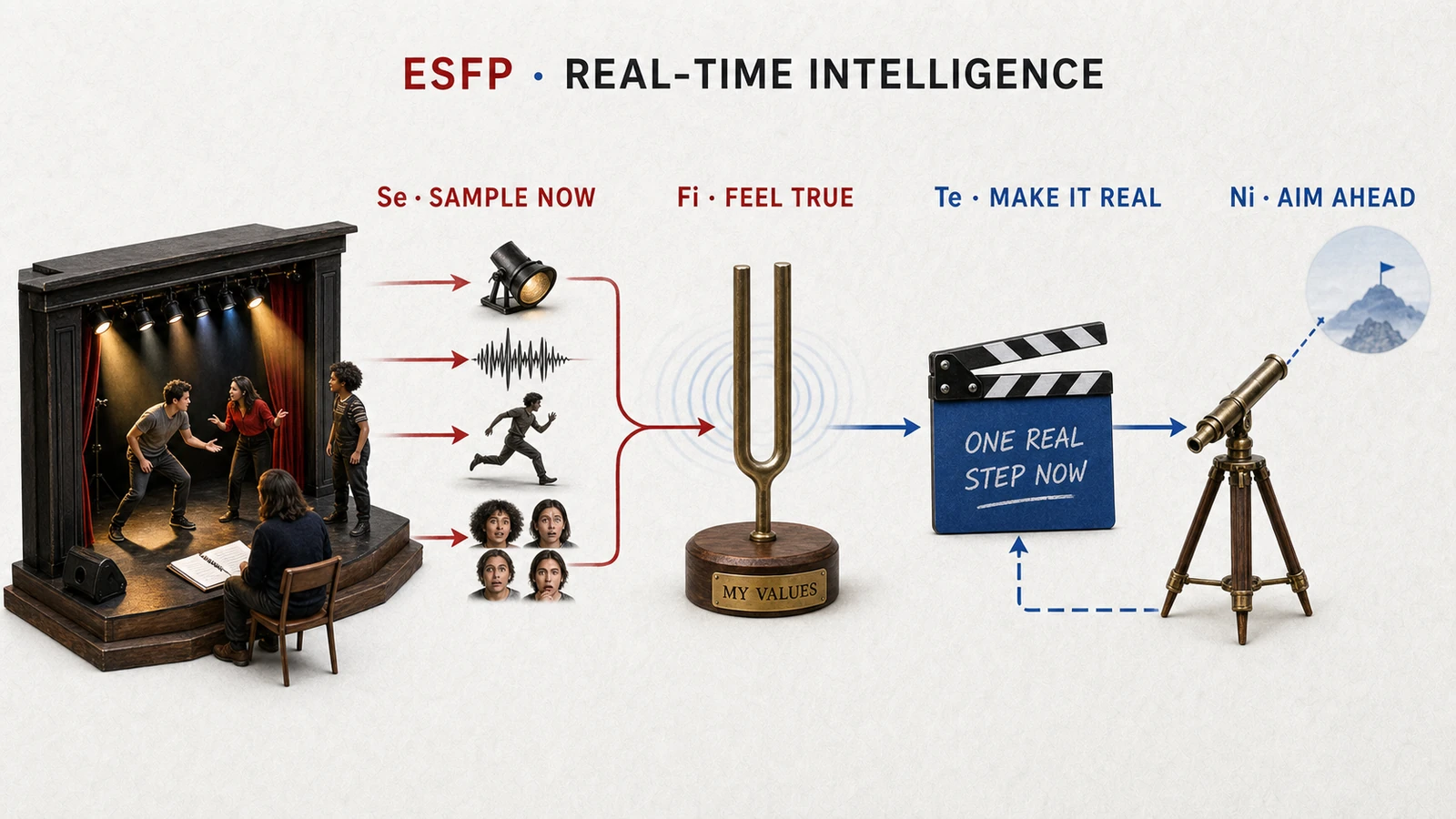
In MBTI terms, ESFP leads with extraverted sensing (Se) and backs it up with introverted feeling (Fi). Skip the jargon and here's what that actually describes: an attention system locked onto live, sensory, real-time input, paired with a private, non-negotiable sense of what matters to you.
A quick honesty check first. The MBTI test itself has real problems: shaky test-retest reliability, and it forces binary categories onto traits that are actually a spectrum. What survives the scrutiny is the pattern underneath it. MBTI dimensions map loosely onto the Big Five, and the motivational piece maps onto something with sturdier evidence behind it: psychologist Jeffrey Gray's reinforcement sensitivity theory, which found that brains genuinely differ in how hard they respond to reward versus threat. Treat "Se-Fi" as shorthand for a real, measurable profile, not a birth certificate. (Here's the full case for why type-calibrated advice works at all.)
Translate your profile into that language and you get a strongly reward-approach brain: high sensitivity to reward that's immediate, concrete, and delivered by other people, and low, almost background-noise sensitivity to threats that are distant and abstract. The present shows up in full resolution: texture, tone of voice, the exact half-second before a joke lands. The future shows up like a photocopy of a fax.
Now look at the tax letter through that lens. It's distant (due in six weeks), abstract (numbers about a year that's already over), solitary (nobody's watching you do it), sensorially flat (a form is the opposite of texture), and reward-free (do it perfectly and nothing happens). That's a miss on all five things your reward system actually looks for. Everyone discounts distant rewards to some degree; that's baked into how reward and dopamine architecture works. But steep discounters, and reward-approach brains like yours tend to be steep discounters, devalue distant things until they stop registering as real at all. The pile isn't a moral failure. It's a signal your radio can't pick up.
Then there's Fi, running quieter underneath the sparkle. You're keeping a private ledger of what's real and what's performance, what you actually care about and what you're supposed to care about. That's why "just gamify it with fake points" only half-works on you. It's also why jobs that require you to fake warmth wear you down faster than actual hard labor. And it's why joy sits so high on your list of priorities, not as a treat, but as a value. More on that shortly, because it's the most misread thing about you.
The weakest link in the whole stack is long-range, single-thread forecasting: the ten-year-vision exercise. Asking you to get excited about a retirement projection is asking a sprinter to train for a marathon that starts in 2036. Not impossible. Just the wrong tool for the job.
The Dream Life You're Actually Built For
Generic dream-life advice fails you in a specific, predictable way: it's written by and for people whose brains live in the future. Passive income. A decade of quiet, deferred gratification. The solo-laptop-on-a-beach fantasy, which sounds like paradise until you notice the word doing the heavy lifting is solo, and you'd be trading a room full of people for an inbox full of them.
Your version runs on different fuel.
Work with a live feedback loop. Every career where ESFPs actually thrive shares one thing: real-time response from real people. Teaching, bedside and emergency medicine, sales, hospitality, coaching, performing, event production, physical therapy, client-facing trades. Notice these aren't lightweight jobs. Several of them put you in charge of a human life at three in the morning. The pattern isn't low stakes, it's immediate stakes. You do the thing, a face changes in front of you, and your brain gets exactly the signal it's built to run on. Your ESTP cousins share this need for Se-driven immediacy; the difference is that your feedback has to come from a person, not just a problem.
An environment with texture and change built in. Days that look identical from the outside flatten you fast. The dream setup has motion in it: different rooms, different faces, some of the work done standing up, out loud, or moving around. If your current job is a silent screen for eight hours straight, the fix isn't a new productivity app. It's renegotiating the actual shape of your day.
People as infrastructure, not a reward for later. Self-determination theory names three needs behind lasting motivation: autonomy, competence, and relatedness. In most productivity advice, relatedness is an afterthought, something you get to once the real work is done. For you, it's the delivery mechanism for the other two. You learn faster with someone else in the room. You follow through longer when someone's expecting you. Build a life where connection only happens after the work is finished, and you've built a life where the work quietly stops happening.
Joy, budgeted like rent. Here's the reframe that actually matters: wanting joy isn't a discipline leak in your system. Fi treats aliveness, yours and everyone else's, as a terminal value, the thing other things exist to serve. Most of the culture around you treats joy as dessert, something you earn after eating the vegetables of productivity first. You've probably always suspected that's backwards. For your wiring, it is. A week with zero planned joy in it isn't a disciplined week. It's a week running on empty with tape over the gas gauge. Build the dream life the way you'd build a budget: joy as a fixed line item, not whatever happens to be left over.
A Productivity System That Fits Your Brain
The principle under everything that follows is simple: stop trying to become a person who cares about distant abstractions, and start converting distant abstractions into near, vivid, social events instead. Every tactic below is that same move, applied a different way.
Plan in day-sized pieces, and borrow the long view from someone else. Your natural execution horizon is today. Fight that and you'll produce beautiful quarterly plans that quietly die by Thursday. So split the job in two. Once a week, spend fifteen minutes with another person, a partner, mentor, friend, or coach, setting direction together. Think of it as a trailer for the week: not a task list, but two or three scenes you can actually picture. Then run each day off a card with three items on it. Three, no more. The card is your whole system; the weekly conversation is the steering wheel.
Give boring work an audience. The single highest-leverage move for your type is body doubling: doing the dreaded task next to another human, in person or on a call, while they work on their own stuff. It sounds too simple to matter. It works because it hands back exactly what admin work was missing: presence, a little social pressure, and a witness. A standing Friday "admin hour" with the same friend every week turns the pile from a private embarrassment into a shared ritual.
Act first, and let the feeling catch up. You will never feel like opening that form. The motivation shows up after you start, not before. That's the whole finding behind behavioral activation: action produces the mental state that was supposed to produce the action, not the other way around. For a brain like yours, starting is nearly the entire cost of an admin task. Once the form is open and one field is filled in, the task picks up its own momentum, and there's a weird, almost arcade-game satisfaction to finishing it. Design everything around surviving the first ninety seconds.
Make consequences vivid instead of louder. Reminders fail because a notification is just one more abstraction stacked on the pile. What actually moves you is a rendered consequence: a specific scene, played out in sensory detail. More on exactly how, below.
Treat people-time like medicine, not a reward. Protect one joy block a week, non-negotiable, not something you have to earn first. When ESFPs punish themselves by cancelling fun until the backlog clears, output drops even further, because they've just cut their own fuel line trying to fix an engine problem.
Neuro Hacks for ESFPs
Six tactics, each tuned to a failure mode you already recognize.
1. The Admin Party. Batch every dreaded task from the week into one block. Do it with a body double, good music, and a hard stop, after which something fun happens immediately. Why it works: another person in the room raises your arousal and adds gentle accountability, batching means you only pay the dread-of-starting tax once instead of nine separate times, and a hard stop puts a ceiling on the suffering, which makes the whole thing feel smaller before you even begin.
2. Consequence Cinema. When a task won't generate its own urgency, play out the actual consequence like a short scene. Not "late fee." You, at the counter, card declined, the specific stranger standing behind you in line. Thirty seconds, full sensory detail, then act. Why it works: picturing a moment in vivid, specific detail turns an abstraction into something your sensing brain can actually register, and a vividly imagined event lands as far more real to your reward system than a plain fact ever will. That flattens the discounting curve exactly where yours is steepest.
3. When-Then Wiring. For every recurring dread task, decide the trigger in advance. "When I pour Friday's first coffee, I open the tax portal before I take a sip." Write it down once. This is psychologist Peter Gollwitzer's implementation intentions research, and it's one of the most reliable effects ever measured in behavior change. Why it works: it moves the job of starting away from your motivation system, which is unreliable for anything abstract, and hands it to your cue-detection system instead, which is elite. You already notice everything happening around you.
4. The Ninety-Second Opener. The rule: you never have to finish the task. You only have to open it and complete one field, one sentence, one line. Permission to stop after ninety seconds is real, not a trick. Why it works: for a brain like yours, the dread is almost entirely loaded onto starting, and the task itself is usually neutral once you're actually in it. Most openers turn into finished tasks anyway, because stopping mid-momentum is harder than just continuing. But the permission to stop has to be genuine, or your Fi will clock the manipulation and refuse to play along.
5. Deadline Borrowing. Turn every soft, distant deadline into a hard, near, social one. "I'll send you the signed form by Thursday, ask me about it." Tell one specific person, out loud. Why it works: your reward system barely registers an institutional deadline, but it's finely tuned to an interpersonal one. A little social stakes makes a date six weeks out feel like a promise you made this morning, because now, functionally, it is one.
6. Stimulation Stacking. Pair the boring work with something you're allowed to enjoy: a playlist reserved only for admin tasks, one specific café you use only for invoicing, a fancy coffee that only shows up alongside the expense report. Researchers who study this call it temptation bundling: coupling something you should do with something you want to do. Why it works: it raises the total reward signal of the bundle high enough to clear your dopamine system's threshold, so the task stops registering as pure cost.
The Shadow Side: Performing Happiness While Quietly Drowning
Every type has a burnout signature. Yours is the hardest one to spot from the outside, because it looks exactly like thriving.
The spiral runs like this. The boring load builds: forms, emails, the money stuff nobody wants to deal with. Every unopened envelope adds a gram of dread. And your reflex under dread is the one that's worked your whole life: go where the aliveness is. So the social calendar fills up. More yeses. More plans. More sparkle. From the outside, you've never looked more fun. On the inside, you're performing energy you don't actually have, and you know it, and the knowing costs extra, because Fi is still keeping that private ledger, and the gap between the show and the truth is exactly the kind of dishonesty that wears you out fastest.
Then some small envelope turns into an emergency: the registration lapsed, the card got frozen, a deadline actually passed, and the whole pile goes off at once. The voice narrating the wreckage isn't a stranger's. It's the report card. Not serious enough. Never applies herself. What you're left holding isn't just a logistics problem. It's a shame relapse, twenty years deep.
Catch it early. The signs are specific: you flinch before opening the banking app. The unread-message badge gives you a small physical wince. You're cracking the "I'm such a mess, honestly" joke more often than usual, because the joke works like a pressure valve. You're booking plans on the exact nights you were secretly hoping would stay empty. Sleep is shrinking to fund performances that suddenly feel mandatory.
The recovery move is exactly not the one you'll be tempted to make. The tempting move is monk mode: cancel everything, purge the calendar, become a serious person once and for all. It fails within days, because you've just cut your own fuel supply to fix an engine problem, and the failure feeds right back into the shame that started the spiral in the first place.
Do this instead. First, tell one person you trust the specific, unglamorous truth. Not "I've been so busy." Try: "I haven't opened my tax letter in five weeks and it's actually scaring me." Said out loud to a kind witness, shame tends to lose most of its weight fast. Second, book one supported triage hour: someone else in the room while you sort the pile into this week, this month, and actually fine. An hour with company nearly always reveals that the monster was three ordinary tasks wearing a trench coat. Third, cancel two performances, just the two you were dreading anyway, and keep every plan that's genuine fuel. What you need is less performing and more truth, not less life altogether.
The Report Card Was Wrong
You were never unserious. You were serious about a different set of things: the mood in a room, the friend hovering at the edge of the group, whether this particular hour of being alive would end up worth remembering. Every scorekeeping system you grew up inside just happened to be measuring something else entirely.
So keep the scaffolding. The admin parties, the borrowed deadlines, the when-then triggers. Build it once and let it carry the boring load for you, because scaffolding is cheap and shame is expensive.
Just don't build a single inch of it in service of finally becoming "serious." You're the person who can make an ordinary Tuesday feel like something. That was never the defect on the report card. That was the whole point.