You know everyone's coffee order. Nobody knows yours.
You clocked the exact moment your friend's voice went flat on the group call last Tuesday. You remembered that your coworker's mother has surgery Thursday, so you already drafted the "no rush on that report" message. You planned the birthday dinner, booked the table, reminded everyone twice, bought the card, chased down the signatures, and when someone raised a glass and said "we should do this more often," you smiled warmly, because you knew that we meant you.
And here's the part you don't tell anyone. Some nights, after a day where you handled everything, the meeting that almost went sideways, the friend who needed an hour, dinner for people you genuinely love, you sit down in the quiet and feel strangely unfinished. You did fourteen things today. You can't point to a single one and say mine.
Then the darker thought, the one you'd never say at brunch: would anyone do this for me? Followed immediately by guilt for thinking it, and a mental note to check in on your sister.
If your stomach just dropped a little: hello, ESFJ. This is about the machinery underneath that feeling, and how to build a life where taking care of people stops requiring you to abandon yourself as the entry fee.
Why harmony becomes a full-time job
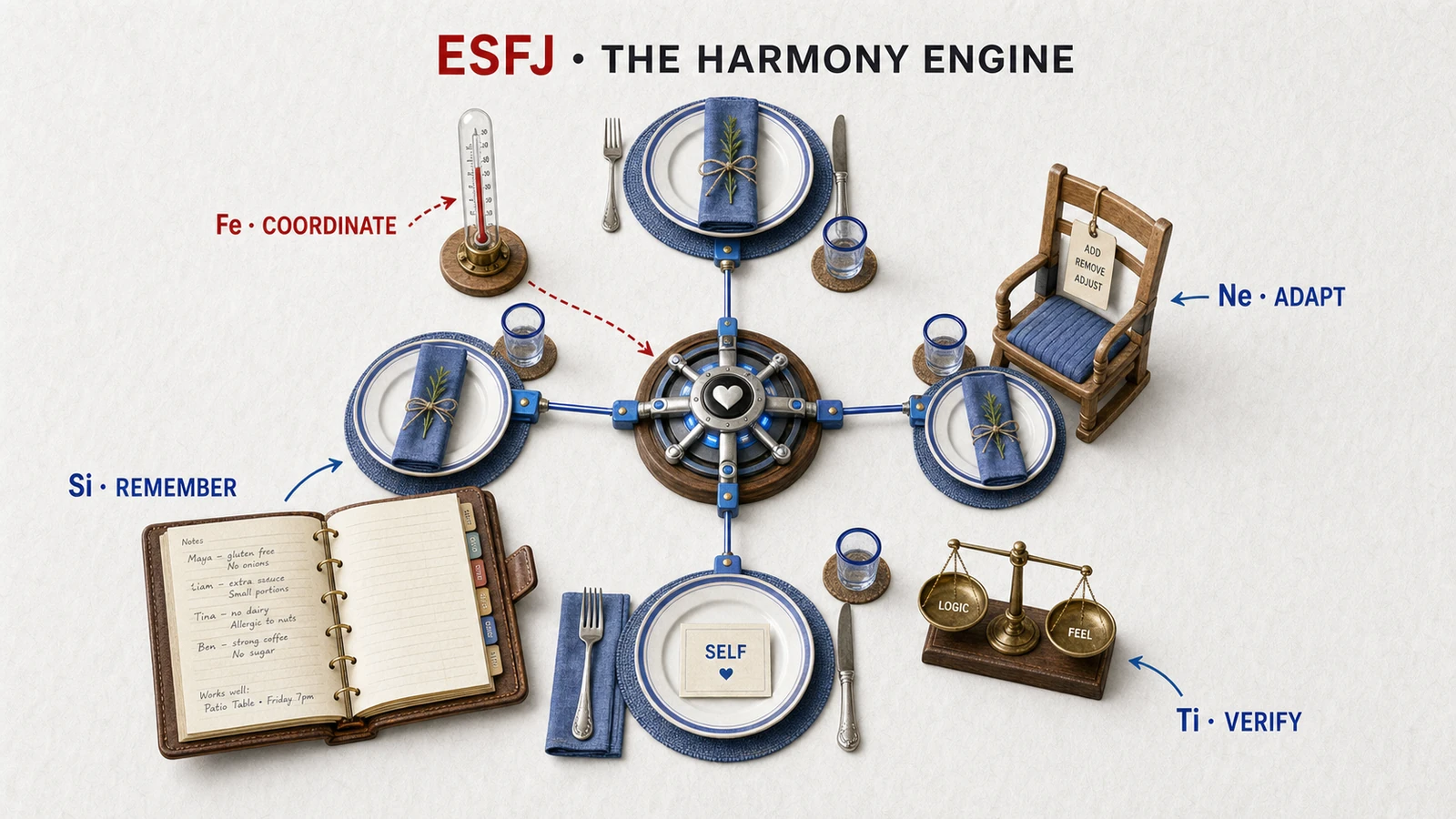
In MBTI terms, you lead with extraverted feeling (Fe) supported by introverted sensing (Si). Strip away the jargon and here's what that stack actually does all day.
Fe is a room thermometer you can't turn off. Your attention defaults outward, to the emotional state of the people around you. This isn't a decision you make. It's a background process that boots up the moment you enter a space and never fully quits. Roy Baumeister and Mark Leary famously argued that the need to belong is a fundamental human drive, on the level of hunger, not hobby. In you, that drive comes with an unusually sensitive instrument panel. Where other people get a vague sense that "things seem tense," you get a live dashboard: who's annoyed, who feels left out, who's about to say the wrong thing, and what would fix it.
Si is the archive. Your auxiliary function keeps meticulous records of how things have been done: who's allergic to what, which restaurant worked last time, what your manager actually meant by that phrasing the last three times they used it. So when Fe detects a need, Si instantly retrieves the precedent for meeting it. Detection plus retrieval, running at conversation speed. That's why your care looks effortless, why the party actually works when you run it, and why everyone calls you first.
A brief honesty break, because you of all people deserve to be treated like an adult: the MBTI instrument has real psychometric problems, forced either/or categories, mediocre test-retest reliability. Its value here is that the patterns it describes map onto constructs that are well validated: Big Five extraversion, agreeableness, and conscientiousness, plus the reinforcement sensitivity research of Jeffrey Gray and Philip Corr, which shows brains differ measurably in how strongly they respond to reward versus threat. Read "ESFJ" as shorthand for a specific reinforcement profile, high sensitivity to social reward, high sensitivity to social threat, not as a category carved into your DNA.
That profile explains the two loops that run your life.
Loop one: the applause circuit
Your reward system treats social approval much like the brain treats other primary rewards. For your profile specifically, appreciation isn't the cherry on top of a finished task, it's the completion signal. A job done and unnoticed feels unfinished, because neurologically, the reward event never actually arrived. This is why you can clean the entire house and feel nothing until someone walks in and says "wow," and why a single thank-you text can salvage an entire brutal week.
This isn't vanity. It's the same circuitry that makes you superb at care. But it carries a brutal corollary: your sense of accomplishment is hostage to other people's attentiveness, and most people simply aren't attentive. They eat the meal. They don't see the four hours behind it.
Loop two: the peacekeeping tax
The threat side of your wiring, what Gray called the behavioral inhibition system, fires hard at social danger: conflict, disapproval, someone being upset with you. So you pre-empt. You take the smaller slice, the worse seat, the inconvenient date, the extra task. You absorb the cost before anyone even notices there was a cost to split in the first place.
Each absorption is tiny. Thirty seconds here, a favor there, one swallowed preference at a time. But run the loop for years and the sum is enormous: harmony maintenance becomes a full-time unpaid job, staffed by exactly one person, with no performance reviews and no vacation policy. Your quieter sibling, the ISFJ, pays this tax invisibly at home. Your visionary cousin, the ENFJ, pays it at the front of the room. You pay it everywhere, in cash, daily.
Design a life where care moves both ways
Most dream-life advice is written by and for people who want to need nobody. "Stop caring what others think." "Cut off anyone who drains you." "Build a solo business on a beach." For your wiring, this advice isn't just useless, it's actively toxic. A life without people to care for wouldn't feel like freedom to you. It would feel like sensory deprivation.
Decades of work on Self-Determination Theory put relatedness alongside autonomy and competence as a basic psychological nutrient, not a weakness to outgrow. Your mistake was never caring too much. It was building a house where caring is the only room in it.
Here's what a life that actually fits looks like:
Work where care is the job, not the leak. Teaching, healthcare, people operations, team leadership, community and event work, client relationships that last years instead of one-off transactions. The critical filter isn't the industry, it's whether the glue work is on the org chart. In the wrong environment, your conscientiousness gets silently converted into free labor: you become the unofficial onboarder, morale officer, and birthday committee while your actual title stays frozen in place. In the right one, the thing you do compulsively is the thing they measure, value, and actually pay for.
Rhythm and ritual as infrastructure. Your Si side doesn't just enjoy traditions, it runs on them. Sunday dinners, the annual trip, the Friday close-down routine. These aren't sentimental extras. They're load-bearing walls. A dream life for you is rhythmic, not chaotic, with recurring anchors that let your archive function do what it does best.
A handful of reciprocal people, not an audience. Robin Dunbar's work on social layers suggests we can only sustain about five truly intimate bonds. You maintain warm relations with fifty. The dream-life question is whether your inner five actually contains people who ask about you and wait for the real answer, or whether you've quietly staffed your entire inner circle with people you take care of instead.
One ambition with your own name on it. This is the piece ESFJs often skip, and it supports everything else. Choose a certification, a business, a marathon, a book, or a garden that exists for your own growth. Hosting and caretaking can expand until they occupy every hour. A private ambition keeps a center of gravity that belongs to you.
Use relational anchors without becoming the reminder system
Generic productivity systems focus on starting. Many ESFJs already execute quickly, then schedule their own goals into leftover slots that never appear. The system below changes whose items go first.
1. The first-slot rule. Weekly planning starts by placing one block for your goal into the calendar before anyone else's needs are allowed in. Not Sunday-evening-if-the-laundry-is-done. First. The reason is mechanical: Fe will donate any unclaimed hour to whoever needs it, and someone always needs it. Claimed hours survive. Unclaimed hours are already gone by Tuesday.
2. Finishable task shapes. Your Si function loves closure and precedent, so write tasks as concrete, completable units: "draft the two opening paragraphs," not "work on the course." Open-ended tasks never trigger your completion circuitry, which for you (see the applause loop above) is already running on hard mode.
3. Witnesses by design, not by luck. Don't fight your need for appreciation, engineer it instead. Decide in advance who sees which effort. More on this in the hacks below, this one change alone rewrites the emotional economics of your whole week.
4. A social-load budget. Hosting, mediating, organizing, and long emotional check-ins are workouts. They carry a real physiological cost, even when you enjoy them. Cap them per week the way a runner caps mileage, and schedule the recovery window before you schedule the event itself.
5. The absorbed-cost review. Once a week, ask one question: what did I absorb this week that nobody saw? Not to litigate it, just to move it from the invisible ledger to a visible one, where you can decide deliberately which costs are actually worth continuing to pay.
Four experiments for social depletion
1. The commissioned witness. Choose one or two people and explicitly give them the job: "when I text you that I did my hour on the course, your role is to acknowledge it." Then actually send the text. Why it works: your reward system needs a social completion signal, and hoping someone notices is a variable, unreliable schedule, exactly the kind that breeds anxious checking and quiet resentment. Commissioning the witness converts it into a dependable schedule instead. It feels awkward for exactly one week. Then it feels like plumbing: unglamorous and life-changing.
2. The pre-paid no. Write the refusal sentence before the request even exists, as a Gollwitzer-style implementation intention: "if someone asks me for my protected block, then I say: I can get to that tomorrow at 2." Why it works: refusing in the moment triggers your social-threat alarm, and no amount of resolve outmuscles an alarm that's already firing. Pre-deciding moves the choice to a cold state where the alarm stays silent. You're not saying no in the moment. You're simply delivering a decision that was already made earlier.
3. The absorption ledger. For one week, write down every cost you silently eat: the rescheduled plan, the task you took because asking felt harder, the preference you quietly swallowed. Why it works: Fe hides costs at intake, so you absorb them before you consciously register absorbing anything. Resentment is that same data arriving years late, with interest attached. The ledger delivers it on time, while it's still cheap, and turns a vague heaviness into an actual list you can negotiate with.
4. The empty-room rep. Once a day, do one small act toward your own goal that no one will ever see, and log it somewhere private. Why it works: it's resistance training for the applause circuit. Each unwitnessed rep is a vote for an identity, someone whose work counts even in an empty room, and identity-based habits outlast any external reward schedule. You're not replacing the witness system. You're building a backup generator for the days it fails you.
5. The granularity upgrade. When you catch yourself saying "I'm fine" with clenched teeth, name the actual state in writing instead: depleted, unappreciated, dreading Thursday, lonely in company. Why it works: affect labeling measurably dampens the brain's threat response, naming tames. You possess an elite vocabulary for other people's feelings and roughly three words for your own. Closing that gap is one of the highest-value emotional skills an ESFJ can build.
6. The post-host cooldown. After any high-care event, the dinner party, the difficult mediation, the visit, take ninety minutes genuinely alone, scheduled before the event, treated as fully non-negotiable. Why it works: continuous social monitoring is metabolically expensive arousal, even when the event itself is joyful. Skip the cooldown repeatedly and the cost doesn't vanish. It converts into irritability, then into the 11 p.m. resentment spiral about people who didn't even do anything wrong.
Draw a reciprocity map
Your calendar can look full of connection while your support system remains strangely empty. A reciprocity map separates social volume from mutual care.
Write the names of ten people you interact with most. Give each relationship two scores from zero to two:
- Initiation: who starts contact, makes the plan, or checks in?
- Repair: after tension or distance, who moves toward the conversation?
Zero means almost always you. One means roughly shared. Two means the other person often carries that part. The number is not a verdict on anyone. It shows the shape of the relationship you are currently maintaining.
Choose one relationship with two zeroes and stop one invisible service for fourteen days. Do not cancel the friendship or stage a test. Simply leave room for the other person to initiate a plan, remember the date, or raise the unfinished conversation. Watch what happens without writing the ending in advance.
At the same time, choose one mutual relationship and invest in it directly. Ask for a specific form of support: "Can I talk through a decision for ten minutes?" Specific requests are easier to answer than hoping somebody notices the exact strain you have been hiding.
Use a hosting budget for gatherings. Decide before the event how much effort belongs to food, logistics, atmosphere, and cleanup. When the budget is spent, the plan is done. Guests usually remember whether they felt welcome, not whether every surface matched the picture in your head.
Finally, put one event on the calendar where you are only a participant. No organizing, reminding, photographing, or checking whether everybody else is comfortable. Participation is a relationship skill too. It gives other people a chance to contribute and gives you evidence that connection can survive without constant management.
The shadow side: perfect hosting, private emptiness
Every type has a burnout signature. Yours is the most deceptive one in the codebook, because from the outside it looks exactly like thriving.
The events run flawlessly. The replies are instant. The house could receive guests in ten minutes flat. Meanwhile, inside, something is hollowing out. The care starts to curdle in ways you're ashamed of: you keep score silently ("after everything I do"). Help arrives with invisible strings attached. You catch yourself managing people through helpfulness, doing so much that they practically owe you their compliance, and you hate how that sounds even as you keep doing it. A canceled plan stops being an inconvenience and becomes evidence that nobody actually loves you.
Then comes the snap: disproportionate fury over an unemptied dishwasher, tears over a forgotten small thing. Then the shame about the snap. Then the repair, which for you always means more service, over-apologizing, cooking something, fixing something, which restocks the very inventory that was crushing you in the first place. That's the whole spiral: absorb, deplete, snap, apologize, absorb harder.
Catch it early. The four reliable warning lights:
- You feel relief when plans get canceled, then guilt about feeling that relief.
- You rehearse grievances in the shower that you'll never actually say out loud.
- Your own goals have started to feel embarrassing to even mention.
- You've caught yourself in the fantasy of being sick, properly sick, because that's the only scenario where being taken care of feels legitimate.
If two or more of those are lit up, run the recovery sequence. First, name it precisely (see the granularity upgrade above): "I am depleted and feeling unseen," not "I'm just tired." Second, drain the pressure privately: fifteen minutes of expressive writing, the unsendable letter, everything you actually think, for no reader ever. Pennebaker's research keeps confirming what your instincts deny: putting the unsayable into words isn't wallowing, it's processing. Third, reinstate one first-slot goal at a trivially small size, twenty minutes, twice a week, commissioned witness attached. Fourth, and hardest: ask for specific help with something real, and let it be done wrong. The dishwasher loaded badly by someone else is worth more to your recovery than the dishwasher loaded perfectly by you at midnight.
And say the resentment out loud early, small, to the person who earned it, "I felt invisible when the dinner I planned went unmentioned," while it's still a sentence and not a case file. You're terrified this will break the harmony. It's actually the only thing that ever preserves it.
You were loved before you set the table
Here's the reframe to carry out of this article: your care is a gift, not a fee. Somewhere along the way, the wiring that makes you extraordinary at love got tangled up with a quieter belief: that the care is the price of admission, and if you stopped paying, the room would empty out.
It wouldn't. And there's exactly one way to find out: build a life where you're on your own guest list. One goal with your name on it. One witness on commission. One no, pre-paid. One place set at the table for the person who set the table.
Everyone you love will still be there. They just finally get to meet you.