The idea was perfect until you finished explaining it
Here's something you've never said out loud: the best part of every project you've ever started was the conversation where you explained it. Not the building. Not the launch. The explaining. The moment someone's eyebrows went up and you watched them realize the idea was actually good, that was the peak. Everything after was the descent.
You've also talked yourself out of ideas mid-pitch. Halfway through selling it, your own brain flagged the fatal flaw, and you finished the sentence already knowing you'd never touch the project again. The other person said "that sounds amazing," and you smiled, because how exactly do you explain that they're complimenting a corpse?
You interrupt people. Not out of disrespect. You saw the end of their sentence eight words early, the counterargument assembled itself without your permission, and holding it in feels like holding your breath underwater. You argue positions you don't hold, just to see if they survive contact. You've been called "combative" by people you were certain you were playing with, and it stung, because from the inside it was pure affection.
And somewhere, a folder, a Notion graveyard, a quiet ledger of domain renewals, sits the evidence: the podcast with three episodes, the app that's 70 percent built, the agency that existed for exactly one client. Ten ventures, give or take. Each one felt like The One at 2 a.m. And each one died in the same place. Not at a wall. On a flat, boring, perfectly passable stretch of road.
You are an ENTP. This is why that keeps happening, and what a life built for your actual wiring looks like, instead of the one you keep failing to want.
The engine: Ne-Ti, or why your brain prices everything in novelty
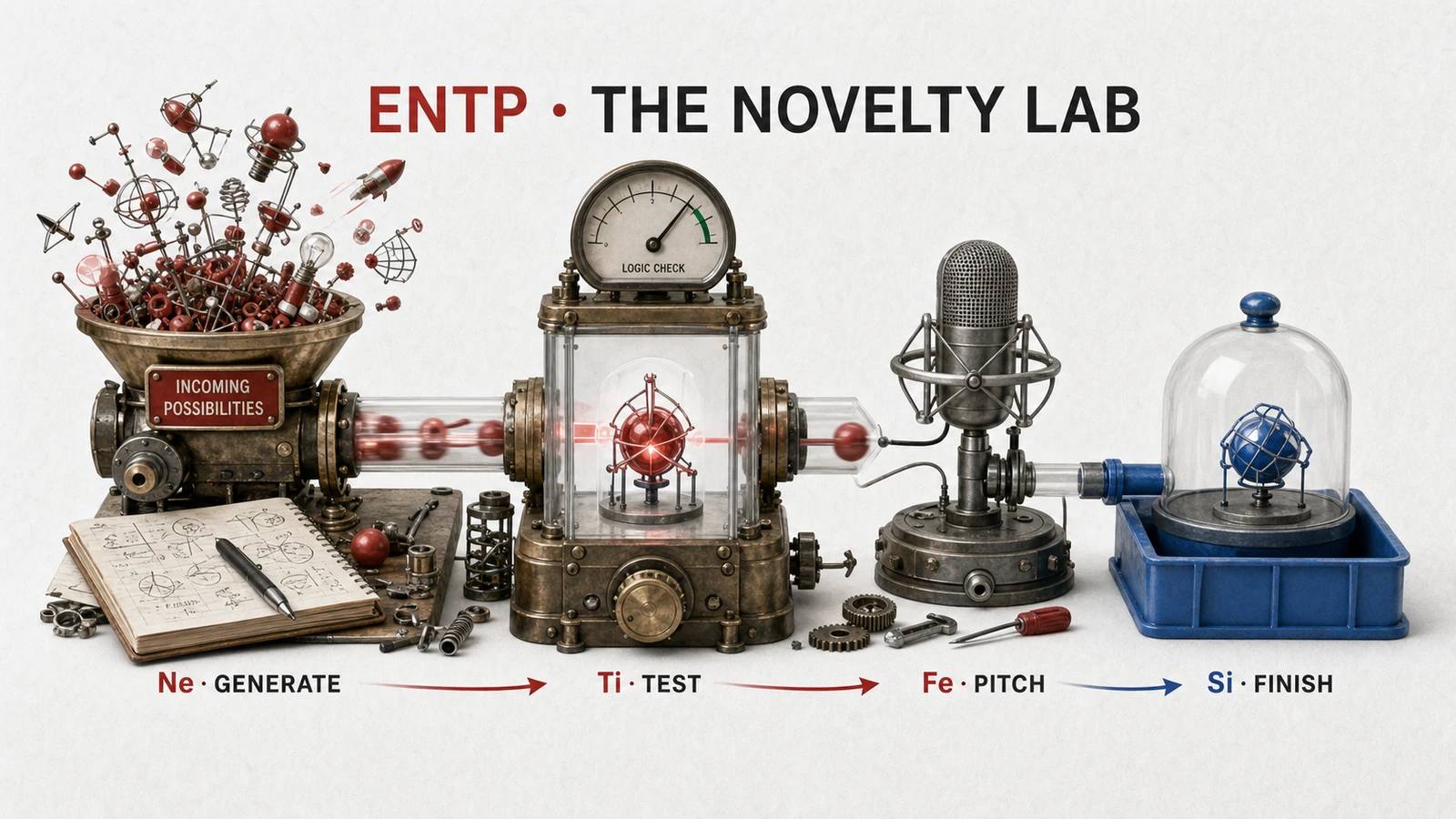
In cognitive-function language, you lead with extraverted intuition (Ne) and audit with introverted thinking (Ti). Ne is a possibility generator: every input instantly branches into implications, inversions, and one frankly unhinged combination that might just be genius. Ti is the in-house logician that stress-tests the flood, not against authority or consensus, but against internal coherence. Ne proposes, Ti prosecutes. Run that loop at conversational speed and you get a person who demolishes more ideas before lunch than most people evaluate in a month.
An honest note before we lean on this framework: the MBTI instrument has well-documented psychometric problems. It chops continuous traits into binary categories, and retest reliability is shaky. Type-based analysis is still worth your time because the ENTP profile maps cleanly onto validated constructs: very high Big Five openness, high extraversion, modest conscientiousness, and, in Jeffrey Gray's reinforcement sensitivity terms, a strongly reward-driven behavioral activation system. Think of the four letters as an address, not as biology. (For the full argument, see why type-calibrated advice works at all.)
Now the mechanism that runs your life, for better and worse.
Dopamine neurons, as Wolfram Schultz's work on reward prediction error showed, don't fire for reward itself. They fire for unexpected reward, the gap between what you predicted and what actually happened. Novelty is prediction error in its purest form. George Loewenstein described curiosity as an information gap, the itch of the space between what you know and what you want to know. A brand-new project is wall-to-wall information gaps. Will it work? What's the clever architecture? What happens if I combine it with that other thing?
Here's the trap: you close those gaps fast, because closing them is the thing you're best at. By the 30 percent mark, you've answered every interesting question the project will ever ask. What remains is execution: known work toward a known outcome. Zero prediction error. Zero information gap. Your reward system prices the remaining 70 percent at approximately nothing at all.
This is also why your boredom isn't like other people's boredom. For a high-reward-sensitivity brain, boredom is an aversive state, closer to a low-grade alarm than to neutral idle. When you say the middle of a project is "torture," you're reporting a genuine cost that differently wired brains simply don't pay, not being dramatic. Your ENFP siblings feel a version of this through meaning. Your INTP cousins feel it through theoretical elegance. You feel it through raw informational novelty, and you feel it hard.
One more piece: debate. The Ne-Ti stack treats ideas as objects, external, manipulable, disposable. You can pick up a position, wear it, attack it, and drop it without losing anything, because the idea was never you. Argument feels like play, like sparring with foam swords. The complication is that most people fuse their ideas with their identity, so your foam sword lands on them like a real one. You walk away energized. They walk away wounded. Both readings of the same event are accurate at once.
The dream life you are actually built for
Standard dream-life advice has one load-bearing instruction: find your one true passion and commit to it for a decade. For most types that's merely hard. For you it's a prison sentence with good PR, the boring middle, institutionalized.
The design error is treating "one thing" as the unit of commitment. Your actual unit is one direction with rotating vehicles inside it. ENTPs who look like they finally "settled down" didn't amputate their novelty drive. They found a direction wide enough that pivoting within it still compounds: a founder whose fifth startup uses everything the first four taught them, a writer whose beat holds a new obsession every quarter, a consultant whose whole product is their pattern library from a hundred different rooms.
That's the skill-stacking move, and it's your natural moat. Any single skill you have, someone more conscientious has gone deeper on. But the intersection, the negotiation skills next to the technical literacy next to the audience next to the four industries you've actually operated in, has no real competition, because nobody else was undisciplined enough to acquire all of it.
Concretely, the wiring thrives under five conditions:
- Zero-to-one work. Ambiguity is your home terrain: new products, turnarounds, deals, arguments no one has structured before. Maintenance and administration are where you go to die slowly.
- Short feedback loops. Months-long cycles starve the prediction-error system. You want reality answering back in days: sales, litigation, live teaching, shipping software, publishing.
- Autonomy over method. Per Deci and Ryan's Self-Determination Theory, autonomy is a universal nutrient, but you have an unusually severe deficiency response to losing it. Being told what outcome to hit is fine. Being told how to hit it is intolerable.
- A sparring circle. Not networking, sparring. Two or three people who read your challenges as intimacy and hit back just as hard. An ENTP without intellectual opposition dulls in a way that's visible to everyone but them.
- An audience. You perform because witnessed work generates stakes and reactions, and both of those register as novelty. Work done in a private vacuum gets priced in a currency your brain simply doesn't accept.
Notice what's absent from that list: prestige, stability, even income beyond sufficiency. ENTPs regularly stall out in objectively enviable senior roles because the role optimized for everything except open questions. A life with no live experiment, no argument to win, and no audience watching the attempt is, at any salary, just a well-upholstered waiting room.
A productivity system that fits (instead of one you have to fight)
Every system you've ever abandoned treated novelty as the enemy. A system that actually fits you treats novelty as the power source and builds containment around it instead. Four components.
1. Flagship plus lab. One flagship: the single project where compounding is allowed to happen, the business, the book, the body of work. Then a sanctioned lab lane: explicitly budgeted time (a weekly block, a Friday afternoon, ten percent of your week) where you can chase absolutely anything, zero guilt, zero obligation to continue it afterward. The lab is the pressure-release valve that keeps the flagship alive. ENTPs who forbid themselves side quests don't stop having them. They just have them instead of the flagship, secretly, with a side of shame.
2. The idea quarantine. New ideas arrive mid-flagship with all the subtlety of a fire alarm, and in the moment, every single one seems obviously better than what you're currently doing. So build a parking lot with a rule: any new idea gets one page, the pitch, written as seductively as you like, then it waits fourteen days untouched. Most are corpses within a week. Writing the page gives Ne its dopamine hit of articulation (which, be honest, was most of what you wanted anyway) without costing you an actual pivot. The rare survivor still alive at day fourteen has earned itself a lab slot.
3. Finish lines moved brutally close. Your instinctive scoping is calibrated to how exciting the vision is, which pretty much guarantees the boring middle will outlast your interest. Invert it: scope every deliverable to ship before the novelty runs out, two to four weeks, ugly version, real users or readers attached. The next version becomes a new decision, made by a future you with fresh information (novelty) and real feedback (stakes). You're running a chain of experiments that happens to add up into one, not building a cathedral. This is systems over goals thinking, tuned for a brain that can't metabolize distant goals at all.
4. Stakes and witnesses. Alone with a deadline, you'll renegotiate with yourself, because you can out-argue yourself, that's basically your job skill. So make the counterparty external instead: a public ship date, a paying customer, a collaborator who's blocked until you deliver. The task that's unpriceable in private becomes urgent the moment an audience is watching. That's outsourcing enforcement to a mechanism your brain actually respects.
On cadence: plan weekly, never hourly. A rigid, time-blocked day reads as a cage and triggers pure defiance, including against your own past self, who is, frankly, always trying to boss you around. A weekly contract, something like "these two things ship by Friday, you choose the sequence," preserves autonomy where you need it and applies constraint only where it actually pays off.
And one warning: designing productivity systems is itself a zero-to-one problem, which makes it catnip for you specifically. If you've rebuilt your task setup three times this quarter, that was a new venture wearing a lanyard, not planning. The system above is deliberately boring. Leave it alone.
Neuro hacks for ENTPs
Six tactics tuned to your failure modes, mechanisms attached.
1. The explanation embargo. Don't pitch a new project to anyone until you've put in ten hours of actual work on it. Mechanism: Peter Gollwitzer's research on public identity goals found that announcing an intention can actually reduce follow-through, because the social acknowledgment delivers a premature sense of completeness. For you this is doubly lethal, since the explanation is your peak reward anyway. Spend it after the work exists, as fuel, instead of before, as a substitute for the work itself.
2. The boring-middle wager. When you hit the flat stretch, convert it into a bet: money staked with a friend, a public prediction with a date attached. Mechanism: Kahneman and Tversky's work on loss aversion found that losses loom roughly twice as large psychologically as equivalent gains. Your reward system won't fire for "make progress on known work," but your threat system fires beautifully for "lose the bet in front of Marcus."
3. The question reframe. When a task reads as dead execution, forcibly reopen an information gap inside it: "what's the fastest this has ever been done?" or "can I do this in a way that makes a good story later?" Mechanism: curiosity is gap-detection, and gaps can be manufactured on purpose. You can't make yourself care about a closed question, but you can re-pose it as an open one and let the machinery do the rest of the work.
4. The novelty rotation. Keep two or three live projects, flagship plus lab items, and when attention dies on one, switch within that set instead of opening a whole new front. Mechanism: your Ne needs variety, but task-switching costs compound with the number of open contexts, not with the number of switches among a stable few. Rotate between projects. Never rotate away from all of them at once.
5. The ship-ugly sprint. The last 20 percent of any project is pure closed-question agony, so reframe it as a speed run: block one day, declare "embarrassing but live by midnight," and race the clock. Mechanism: time pressure converts execution back into prediction error, and shipping something ugly generates the one thing polishing never does: external reactions, which are stakes and novelty at the same time.
6. The ten-minute boredom sit. When the urge to abandon hits mid-session, don't switch projects. Shrink the task instead and stay ten more minutes. Mechanism: the urge is a dopamine trough, and troughs pass. A brain fed a novelty spike at every dip learns to demand spikes and loses the baseline that makes ordinary work tolerable in the first place. You're re-training your own price of admission here, not practicing discipline.
The shadow: the novelty spiral
Your burnout doesn't look like burnout. That's what makes it dangerous.
Other types burn out by grinding: more hours, more depletion, collapse. You burn out by accelerating. Stress arrives, a stalled flagship, a plateau, a birthday, and instead of resting, you reach for the one reliable euphoria you know: a new idea. It works, for about two weeks. Then it flattens, the way everything flattens, and now two abandoned things generate shame instead of one. So you reach again. Each cycle gets shorter. Nothing compounds.
And late at night the ledger opens on its own: the less-clever people from school who just finished things now have the practice, the book, the company, and you have a graveyard and a reputation for potential. "Potential" starts to sound like an insult. You begin to suspect you're a fraud whose only real skill is the pitch.
The cruelest part: the shame itself is boring and painful, so the spiral offers its own anesthetic, which is another new idea. Around and around it goes.
The early tells:
- Consumption replaces creation. Courses bought, domains registered, forty research tabs open, three books started about the thing instead of the thing itself. Input feels like progress because it's pure information gap: novelty with no boring middle attached to it.
- Arguing more, building less. Debate is your cheapest novelty source, and sparring on its own is healthy, but a spike in argument volume alongside a drop in output is the spiral's most reliable signature.
- Contempt for your past projects. When you catch yourself sneering at what last-quarter-you built, that's the spiral pre-justifying the next abandonment.
The recovery move is counterintuitive: don't rest first, and don't "start fresh." Finish something. Deliberately tiny, a two-hour scope, shipped in public within 72 hours. One completed loop breaks the pattern where a week of rest can't, because what the spiral actually damaged is your belief that finishing is even available to you. Then call your sparring partner, since isolation is spiral fertilizer. Then, and only then, go back to the flagship and shrink its next milestone until it fits your reduced tank. The long middle only cares that you didn't leave, not how you feel about it.
The closing argument
The reframe, and it's not a consolation prize:
You've spent years telling a story where you're a starter who fails to finish. Wrong frame. You're a synthesizer whose finishing muscle was never trained, because starting paid out so extravagantly that finishing never got a turn. Finishing is a mechanical skill you haven't practiced yet, not a personality trait you lack, and mechanical skills respond to reps.
And the graveyard? The ten half-built ventures were tuition. Every one left a skill in the stack, and the stack is the moat. The question was never whether you can generate the ideas. Anyone who's watched you talk for five minutes knows the engine is real. The question is what happens once the engine finally gets a drivetrain. Build the containment. Keep the lab. Move the finish lines close. Let one thing compound.
You've argued every position in the world at least once by now. Argue this one: that the most interesting experiment left, the only information gap you've never closed, is what you'd be if you actually finished something.