You hit the annual goal in October. You felt nothing by November.
Here is a moment you have never told anyone about, because it sounds ungrateful.
You closed the deal, shipped the launch, hit the number, whatever your version of the summit happens to be. And somewhere between the confirmation email and the congratulations, your mind had already moved on. Not to celebration. To the gap. The next number. The bigger arena. The system that produced this win, and how it could produce the next one twice as fast.
The victory lasted about as long as a traffic light.
You've noticed the other patterns too. You rewrite people's sentences in your head while they're still saying them. You've mentally redesigned the workflow of every slow restaurant you've ever sat in. You schedule phone calls with your own parents. You once went on vacation with a spreadsheet, and you'd defend that spreadsheet, correctly, because it produced a measurably better vacation.
And underneath all that competence sits a quieter thing you don't say out loud: you're not entirely sure who you'd be if you stopped. The plans are load-bearing. The momentum is structural. Somewhere along the way, achieving stopped being something you do and became the entire architecture of who you are.
This is a field manual for that architecture: what it's actually built for, and the specific, predictable way it fails when you run it without maintenance.
Your wiring: an execution engine aimed by a ten-year radar
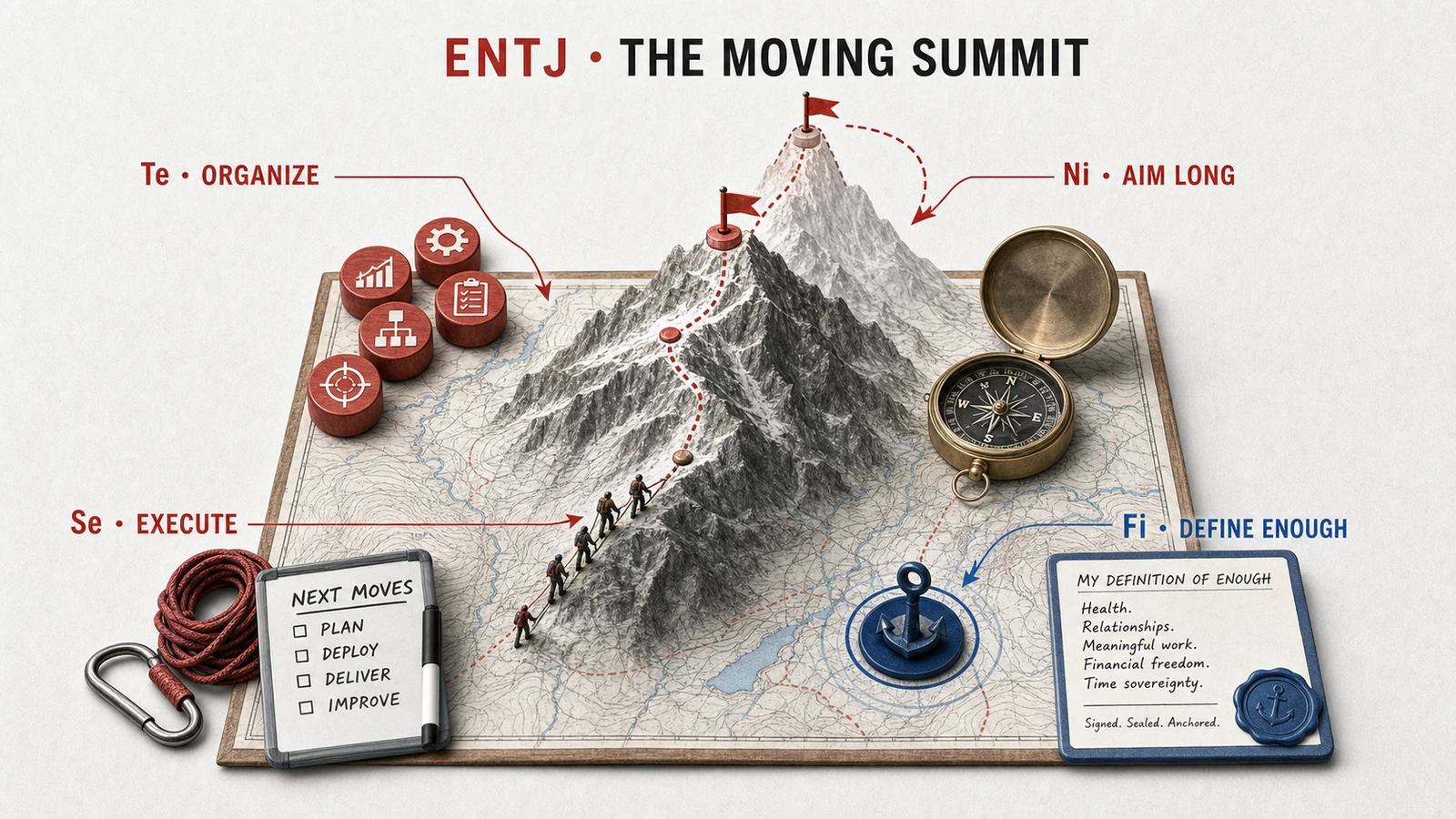
In cognitive-function language, ENTJ means extraverted Thinking (Te) leads and introverted Intuition (Ni) navigates.
Te is an ordering drive pointed outward. It experiences the world as a system, systems as having throughput, and throughput as something that can always be improved. It measures itself against external, objective results, revenue, rankings, finished things, ground taken, and almost never against internal satisfaction. That's why "just be content with what you've accomplished" has always sounded to you like advice delivered in a foreign language. Contentment isn't a metric Te knows how to read.
Ni sits underneath as the targeting system. Where your INTJ cousin leads with Ni and puts Te in its service, you run the inversion: the engine leads, and the radar just aims it. You don't experience the future as fog. You see the staircase, this quarter, this decade, and you're perpetually irritated that other people insist on discussing one stair at a time.
There's a neurochemical frame for this. Jeffrey Gray's reinforcement sensitivity theory, later refined by Philip Corr, describes two broad motivational systems: a behavioral approach system that chases reward, and an inhibition system that flinches from threat. Your profile is approach-dominant to an unusual degree. The reward circuitry runs loud, the threat circuitry barely whispers. Add one more finding from reward-prediction research: dopamine fires hardest in anticipation of a win, and for wins that are unexpected. Once an outcome becomes certain, the signal collapses.
Read that again, because it explains your entire October. The hit was in the pursuit. Arrival was, neurochemically, an afterthought. The treadmill is chemistry: dopamine rewarding the chase, not the arrival.
An honesty note, because you'd respect nothing less: the MBTI instrument has real psychometric problems, modest test-retest reliability, forced binaries drawn across traits that are actually continuous. What makes a profile like this one useful is that the pattern maps onto measurable constructs, Big Five extraversion and conscientiousness, reward-approach sensitivity, and calibrating advice to those dials demonstrably works, not that "ENTJ" is some natural category etched into your cortex. Treat this as a compression of real measurements, not a horoscope with a business plan attached.
One more piece of fine print in your stack, and it's the piece this whole article turns on. After Te and Ni come tertiary extraverted Sensing and inferior introverted Feeling. Fi, the function that reads your own emotional and physical state, is the last instrument to develop and the quietest one on your dashboard. Any louder Te priority overrules it by default. Hold that thought. The neuro hacks section is where the invoice for that finally arrives.
The dream life you are actually built for
Generic dream-life advice misfires on you completely. The standard fantasy, passive income, a beach, zero obligations, is someone else's dream. Give you two weeks of it and you'd be redesigning the resort's check-in process by Thursday and interviewing the manager by the weekend.
Self-Determination Theory (Deci and Ryan) says humans need three things: autonomy, competence, and relatedness. Your wiring maxes out the first two and chronically starves the third. So the life that actually fits looks like this:
Command of something that matters. Not necessarily a title, ownership. A domain where the outcome is yours, the scoreboard is objective, and no committee stands between your judgment and reality. ENTJs don't burn out from responsibility. They burn out from responsibility without authority.
An infinite game. Every finite goal you've ever hit has dissolved on arrival. Tal Ben-Shahar calls this the arrival fallacy, and hedonic adaptation guarantees it'll keep happening. Wanting less would just wither you. The fix is to aim the engine at a mission that can't be completed: building an institution, mastering a craft with no ceiling, developing people who go on to build their own things. Then rig the scoreboard to reward the process rather than the outcome, because the process is the only thing you actually get to keep.
A cabinet, not an audience. You accumulate admirers and direct reports easily. What you actually need is three or four peers with standing permission to tell you that you're wrong, and enough standing granted back to them that they can survive doing it. Every unchallenged ENTJ eventually builds something impressive pointed in the wrong direction.
Relationships as infrastructure, not line items. Yes, you schedule the people you love like meetings, because that's how you're built, and the people who love you would rather be scheduled than forgotten entirely. The actual problem is running that time like a meeting: agenda, outcomes, adjourn. Schedule presence instead of throughput. Book the evening, and refuse to plan what happens inside it.
A body treated as the asset it is. More on this below, because it's where your empire actually falls apart.
Notice what gates all of it: delegation. "If you want it done right, do it yourself" is a ceiling disguised as a standard. The dream life at your scale is only reachable through other people, and the compulsive efficiency that got you here, personally out-executing everyone around you, is exactly the habit that caps you now.
A productivity system that fits your brain
Your machine redlines by default, and what it needs is governance: brakes, steering, and instrumentation for someone who can't stop. Most productivity systems are engines built for people who can't start.
Quarterly campaigns, capped at three. Locke and Latham's goal-setting research confirmed what you already run on: specific, difficult goals outperform "do your best" by a wide margin. What you tend to skip is the cap. Te will happily accept unlimited campaigns. Your working memory and your recovery budget will not. Three live campaigns, ruthlessly enforced. The discipline lives in what you decline, not what you pursue.
A Monday war room, thirty minutes. Run the weekly review as an ops meeting with yourself: metrics first, then exactly three decisions, then the top three tasks for each day. The cadence matters here. Daily strategic review is churn. Quarterly is drift. Weekly is where an ENTJ actually steers.
Maker blocks defended from your own manager brain. Your instinct to stay responsive, to run the org in real time, is a manager instinct, and it'll eat the strategic work that only you can do. Block ninety-plus minutes of deep work, Cal Newport's term, in the morning, aligned with your ultradian peaks, and treat any incursion into it the way you'd treat someone rescheduling your board meeting.
The 70 percent handoff rule. If someone can do a task at 70 percent of your standard, it's theirs now. You review outcomes weekly, not methods daily. Here's the reframe that makes it palatable: delegation is a training pipeline. Seventy percent with feedback becomes ninety percent within two quarters. You doing it forever stays at a hundred percent, and caps the entire operation at the number of hours you personally have in a day.
Recovery on the dashboard. Sleep duration, training sessions, resting heart rate, tracked right next to revenue. You'd never run servers at full utilization with no maintenance window and call that strategy. Your body is the server everything else runs on.
Neuro hacks for the ENTJ brain
Six techniques, each aimed at a specific failure mode of this wiring.
1. The victory ledger. How: before opening the next campaign, spend fifteen minutes writing down the finished one, what was true twelve months ago versus what's true today, in concrete terms. Why: your anticipation-biased dopamine system deletes wins on contact. Deliberate, written recall re-registers progress that your reward circuitry never invoiced in the first place. It blunts the treadmill without slowing the climb.
2. The idle strategist walk. How: thirty minutes, no phone, no podcast, no agenda, most days. Why: Ni-style synthesis runs on the default mode network, which only comes online once task-focused attention lets go. Be honest, your best strategic reframes have never once happened at your desk. The walk is when the targeting system recalibrates itself.
3. Body-as-direct-report. How: a weekly fifteen-minute one-on-one with your own physiology. Sleep average, energy trend, resting heart rate, anything that hurts. Review it like a metrics deck, and make decisions from it. Why: inferior Fi means internal signals arrive quietly and get overruled by louder priorities. Converting them into external, Te-legible data is the only format you reliably respect. You'd fire a manager who ignored a direct report's warnings for two years straight. You are that manager.
4. Scheduled dissent. How: give one trusted person a standing mandate to argue against your current plan, and actually engage the argument before deciding. Why: approach-dominant brains systematically underweight threat signals. You can't will yourself into caution, but you can build it into the process. Think of it as outsourcing the inhibition system you were never issued.
5. The when-then shutdown. How: build an implementation intention, Peter Gollwitzer's research, aimed at stopping: "when I close the laptop at seven, then I start cooking." Why: if-then plans execute past the point of deliberation. Starting was never your problem. Stopping requires a pre-decided trigger, because in the moment, Te will always find one more task, and it'll be right that the task exists and wrong that it matters tonight.
6. The incompetence audit. How: when someone's slowness spikes your contempt, run one diagnostic before reacting: unclear outcome, missing skill, or wrong seat? Fix that variable specifically. Why: contempt is Te's error signal rendered as an emotion, and raw irritation fixes nothing on its own. Converting it into a diagnosis re-engages the problem-solving circuitry you're actually good at. And notice: this same audit applies word for word to the "underperformance" of your own body.
The shadow side: the crash you refuse to schedule
Your burnout doesn't look like burnout, and that's the trap. Nothing visibly flags. Output holds steady. What moves first is invisible.
The contempt curve rises: everyone around you seems suddenly, inexplicably slower. Sleep gets traded for throughput, filed as temporary. Workouts get cut, also filed as temporary. Conversations with the people you love compress down into logistics. And the work itself changes texture, still winning, but grimly, the way a machine wins. You catch yourself unable to remember what any of it was for, and you file that thought under "later."
Through all of it, you treat your body's limits like an underperforming vendor. You renegotiate with caffeine. You escalate with willpower. You threaten it with discipline. But this is the one vendor you can't replace, and the contract terms aren't up for negotiation. Bruce McEwen's work on allostatic load showed that chronic stress is an accumulating physiological debt across your cardiovascular, immune, hormonal, and cognitive systems, not just a feeling you push through. The body issues invoices whether or not you open them.
The emotional ledger runs the same way. Inferior Fi means deferred feelings don't disappear, they compound, unlabeled, in an account you never audit. Which is why the ENTJ crash, when it finally arrives, tends to be systemic rather than local: a health event that comes out of nowhere, a rupture in the marriage you were always about to get to. Or the strangest version of all: a flat, gray quarter where the engine simply won't turn over, and you stare at goals that would have electrified you two years ago and feel nothing at all.
Here's your earliest tripwire, and it's more reliable than any symptom checklist: the day you catch yourself resenting other people for resting.
Here's the recovery move, stated in the only dialect you actually trust. You will not meditate your way out of this, and pretending otherwise wastes a whole quarter. Instead, run recovery as a campaign, because a campaign is the frame your wiring knows how to execute. Objective: restore capacity, not extract more output. Non-negotiables: sleep first, then movement, then daylight. Scope reduction: delegate two things this week and delete one entirely. And one deliverable that will cost you more than all the rest combined: one conversation with someone you trust, where you report your actual state instead of your status. Fi starves in silence. It recovers in honest company.
The summit was never the point
You have probably suspected this since the October that felt like nothing.
The treadmill is the engine, and the engine is genuinely magnificent. Very few people can aim a decade and then go execute it. The real reframe is to audit what you're actually optimizing for, with the same rigor you'd apply to anyone else's operation.
A commander's real legacy is what keeps running without them, and who thrived while under their command. Build the empire. Just make sure the ten-year plan includes, somewhere on the dashboard, the person actually building it.
You are the constraint. You are the asset. You are, inconveniently for your spreadsheet, also the point.