You fell in love at 2 a.m. again, didn't you
Somewhere on your laptop there's a graveyard full of beautiful headstones. A half-built website for a business that was going to change everything. Forty pages of a book. A podcast with three recorded episodes and cover art you spent four hours perfecting. A language streak that died on day nine. Each one of these, at the moment of conception (usually between 11 p.m. and 2 a.m., usually right after a conversation that lit you up), felt like The One. Not a project. A destiny.
You weren't lying to yourself. That's the part almost nobody understands. The certainty was real. You could see the whole thing finished: the launch, the people it would help, the person you'd become. Then, somewhere around day five, you opened the file and found the color had drained out of it. Same idea. Same you. No pulse.
So you carry a private grief you rarely admit out loud: you know you have genuine gifts. You've watched rooms change when you walk in. Strangers have told you things they've never told anyone else. You've tossed off ideas in ten minutes that other people build careers on. And still you can't seem to convert any of it into the thing everyone else calls consistency. You've also been called "a lot" often enough that you now pre-shrink yourself in new rooms, scanning for the flicker in someone's eyes that means you got too loud, too fast, too much.
Here is the argument of this article: nothing is wrong with you. Something is wrong with the operating manual you were handed. It was written for a different brain.
Your wiring: a brain that pays out on anticipation
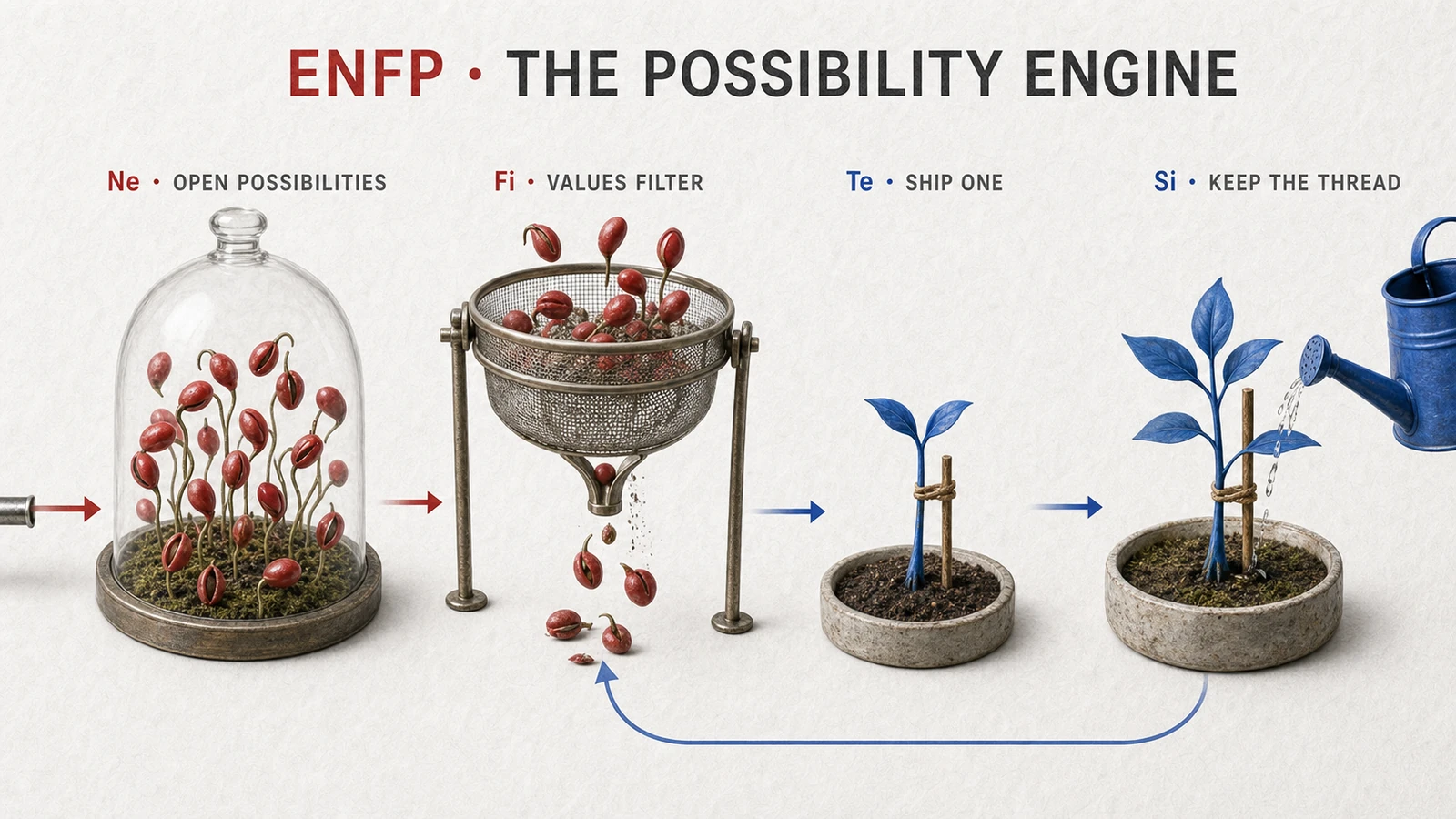
In MBTI language, you lead with extraverted intuition (Ne) and back it up with introverted feeling (Fi). Ne is an associative engine: it takes any input and instantly generates a spray of possibilities, connections, and one what-if after another. Fi is a private values compass, a quiet, non-negotiable sense of what matters and what it would be a betrayal to become.
Quick honesty pause, because you'd sniff out the omission anyway: the MBTI instrument has real psychometric problems. The types aren't stable categories, and the forced binaries oversimplify traits that are actually continuous. Type-based advice still earns its keep because these patterns map onto constructs that are validated: Big Five openness and extraversion, plus the reinforcement sensitivity research of Jeffrey Gray and Philip Corr, which shows that brains differ measurably in how strongly they respond to reward cues versus threat cues. "ENFP" is best read as shorthand for a specific, real reinforcement profile, not a Hogwarts house.
And your profile is distinctive. You're almost certainly running a highly reward-sensitive system, what Gray called a dominant behavioral activation system. Your brain fires hard at anticipated reward. Here's the catch that explains your graveyard: dopamine isn't the molecule of pleasure. It's the molecule of anticipation and prediction error. It surges for the new and the possible, and it habituates, brutally fast, to the known and the repeated.
So the 2 a.m. high is real neurochemistry: maximal novelty, maximal possibility, zero repetition. Day five is also real neurochemistry: the idea is now familiar, the prediction error is gone, and your reward system, which was doing 80 percent of the lifting, clocks out. Other brains keep going on the maintenance circuitry of habit and threat-avoidance, so stopping feels wrong to them. Your engine was never built to idle. This is also why routines feel like jail by day five: a routine's entire virtue, sameness, is your reward system's kryptonite.
It also explains why metrics feel like poison. Fi evaluates everything against meaning, and a streak counter, a completion percentage, a KPI are, to your value system, statements about nothing at all. Decades of research on self-determination (Deci and Ryan) show that external, controlling metrics can actively corrode intrinsic motivation. For most people that's a subtle effect. For you it's a demolition.
The moment a beloved project turns into a dashboard, it dies a little. You've watched this happen before and concluded you "self-sabotage." You don't. Something in you quietly checks out the moment a project stops meaning something.
Your cousin the ENTP shares the Ne engine but judges with logic, so metrics don't poison them the same way. Your cousin the INFP shares the Fi compass but leads with it, which makes them slower to start and less prone to your particular flavor of glorious overcommitment.
The dream life you're actually built for
Generic dream-life advice says find your One Thing, niche down, and compound for a decade. For your wiring, that's a recipe for quiet despair: it asks an anticipation engine to run on maintenance fuel. Here's what actually fits.
A portfolio, not a path. Your best-case life holds several concurrent involvements, a main craft, a side experiment, a community role, that you rotate between. This isn't a compromise or a failure to focus. Variety is your baseline requirement the same way silence is an INTJ's. The people you admire who "did one thing" mostly did seven things, and history just edited it down to one.
People as infrastructure, not interruption. You process out loud. Ideas don't become fully real for you until they've bounced off another human's face. A dream life for you is full of collaborators, workshop rooms, and group chats that build things, not a solo cabin and a Gantt chart. Self-Determination Theory calls relatedness a basic psychological need. For you it's also a working tool.
Meaning wired into the work itself. You'll do staggering amounts of hard work when the work is for someone, a person you can picture, a change you can actually feel. You'll do almost nothing for a number. Build your life around problems with human stakes and you'll rarely need a discipline hack. Frame everything as a target instead and you'll need every hack there is, and none of them will fully work.
Structure as riverbanks, not rails. You need less structure than most types, and more than zero: a few fixed anchor points with wide open space between them. The blank-slate freedom you fantasize about during busy seasons actually unravels you within two weeks. You've learned this on every sabbatical, summer break, and stretch of funemployment you've ever had, and forgotten it every single time.
The classic mistake is designing a dream life for the person you think you ought to be: the focused, streak-keeping finisher. Design it instead for the brain that actually showed up: a starter, a connector, a meaning-detector. Then rig the environment so finishing happens anyway. Which brings us to the system.
A productivity system that fits your brain
Four load-bearing pieces, each tied to a mechanism above.
1. Run three projects, officially. Not one (that's habituation death), and not nine (that's a sparkle crash, more on that below). Three, in different flavors: one main, one experimental, one social. When project A goes gray on day five, you rotate to B inside the system instead of abandoning the whole system to go chase novelty outside it. You're metabolizing your need for newness instead of white-knuckling it. This is systems-over-goals thinking, tuned for a novelty-driven brain: the system's job is to survive your enthusiasm cycles, not pretend they don't exist.
2. Plan weekly and loosely, commit daily and tiny. A rigidly time-blocked calendar is a building you will burn down by Wednesday. Instead, once a week, pick three or four "moves," roughly one per project. Each morning, choose that day's single non-negotiable: one concrete action small enough to finish in a single sitting. Everything else is free play, fully legal. This preserves the felt sense of choice your motivation runs on while still guaranteeing forward motion.
3. Replace dashboards with faces. Your accountability should be a person, not a chart: a weekly call with a friend building their own thing, a standing co-working session, a mentor who expects pages. Two mechanisms make this work. Social anticipation is itself a dopamine source, so you get paid for showing up and not just for finishing. And Fi treats commitments to people as sacred in a way it will never treat a commitment to a spreadsheet.
4. Keep two anchor habits. Only two. One in the morning that steadies the body, light, movement, whatever survives contact with your actual life, and one at night: a two-minute shutdown note recording where each project stands and what tomorrow's non-negotiable is. Two anchors give the day a spine without building a jail around it. The seven-step morning routine has failed, what, eleven times now? That was never a willpower deficit. It was a design error.
One warning: system-building is itself a novelty hit. Rebuilding your entire setup in a new app delivers all the anticipation of productivity with none of the productivity. You get one migration a year. You know why.
Neuro hacks for the ENFP brain
Six tactics, each aimed at a specific failure mode.
The spark file. One capture note where every new idea goes the moment it strikes, with one rule: nothing gets acted on for 72 hours. Why it works: writing the idea down gives your reward system its anticipation hit (dopamine fires at the idea of the idea) without letting it hijack your current project. Most sparks die quietly in the file within three days. The ones still glowing after that are real.
Body-double the boring middle. For any task your brain has flagged as gray, admin, editing, the last 20 percent, do it in the presence of another working human, live or on video. Why it works: another person in the room adds low-grade social arousal and gentle accountability that stand in for the missing novelty signal. It turns a dead task into a mildly social event, which your extraverted reward system will happily accept as payment.
When-then your exits. You don't abandon projects at random. You abandon them at predictable doors: the first boring stretch, the first ambiguous step, the first whiff of critical feedback. Write implementation intentions for exactly those doors: "when I feel the urge to start something new mid-project, then I write it in the spark file and do ten more minutes." Why it works: Gollwitzer's research shows that pre-deciding a response to a specific trigger removes the in-the-moment negotiation, which is a negotiation your anticipation-hungry brain always wins anyway.
Identity goals, not metric goals. Recast every target in identity language: not "publish 24 posts" but "I'm becoming someone whose ideas exist outside their own head." Why it works: Fi doesn't do numbers, it does selves. Identity framing turns each work session into evidence about who you are, which is the one currency your judging function actually values. This is the deep version of identity-based habits.
Manufacture the finish line. Anticipation needs a horizon. Give every project a public, dated, human-witnessed endpoint: a demo night, a reading, a launch with actual invitees. Why it works: it turns the distant abstraction of "finishing" into a concrete, upcoming social event, which re-engages the anticipation machinery in exactly the part of the project where yours usually goes dark.
Protect the baseline. Your highs run high enough that you chronically raid tomorrow's neurochemistry to fund them: late nights, caffeine stacking, six commitments' worth of stimulation. A spiked-and-cratered dopamine baseline makes everything feel gray, and you'll misread that grayness as "wrong project" and start over again. Sleep, sunlight, movement: boring, yes. But a steady baseline is what lets any project still feel alive on day twelve.
The shadow side: the overcommitted sparkle crash
Your burnout has a signature, and it doesn't look like other people's.
It starts at peak brightness. You're lit up, so you say yes: to the collaboration, the favor, the event, the new client, the friend's thing. Each yes is sincere. Lit-up-you can genuinely see doing all of it. Over two or three weeks the yeses silently pile up into a calendar no version of you could actually survive.
Then one Tuesday the music stops. You wake up dreading every commitment, including the ones with people you love. You go dark: unanswered texts stack up like debt, and each day of silence makes the eventual reply harder to write.
The shame shows up next. I'm flaky. I'm a fraud. I'm too much and not enough at the same time. And then comes the tell: a sudden, euphoric plan to burn it all down and reinvent yourself. New city, new career, new system, new self.
Read that last move for what it is: a starved anticipation engine grabbing the biggest novelty lever in the building. The reinvention fantasy isn't insight. It's a symptom.
Early warning signs, roughly in order: you stop replying to your favorite people first, not the annoying ones, the favorites, because they "deserve a real reply when you have the energy." Then everything on the calendar starts to feel like a performance you've been booked for. Then even small decisions start feeling impossibly heavy.
The recovery move is subtraction, not transformation. Three steps. First, cancel or postpone 30 percent of the calendar. Send the awkward messages, and relearn that almost nobody is actually angry. Second, tell one person the truth: "I overcommitted, I crashed, I'm digging out." Said out loud, private shame turns into ordinary logistics, and your nervous system can tell the difference. Third, do one small, real thing on one existing project, not a new one, and let that be the whole day's win.
The crash doesn't mean the life was wrong. It means the intake valve was open too far. It always is. That's why the system above rations your yeses before the bright weeks arrive, while you still believe you're infinite.
You were never supposed to be a metronome
Keep this reframe: consistency, for you, will never mean unbroken streaks and identical days. Held to that definition, you'll fail forever and grieve forever. There's an older, truer definition available: consistency is returning. The writer who's abandoned the book forty times and come back a forty-first is more consistent, in every way that matters, than the one who never risked loving anything that much.
You're a starter in a culture that only counts finishing. But nothing has ever been finished that someone didn't start first, and the world is quietly full of finisher-types waiting for someone like you to walk in carrying the spark. Your job was never to become a metronome. Your job is to build riverbanks strong enough that the flood goes somewhere, and to stop apologizing for being the flood.