You knew she was struggling before she did
Your coworker said "I'm fine" this morning. You caught the half-second delay before the word fine anyway. By lunch you'd already drafted a check-in text, decided it was too soon to send, and penciled in a casual walk-by of her desk for Thursday: the day her project ships, which is exactly when the drop always hits.
Then someone asked how you were doing. You gave the answer you always give: warm, quick, deflecting, immediately followed by a question about them.
Here's the part nobody sees. You run a live dashboard tracking the emotional state of every person you care about: who's drifting, who's about to quit, who needs a push, who needs permission to rest. Right now, unwritten but fully formed, you're carrying development plans for at least five people in your life. Their next move. The conversation they need to have. The potential they can't see in themselves yet.
And your own gauge? Blank. You genuinely have not checked it. Last time you found out you were exhausted, you found out the way everyone else does: crying in a parking lot over something small, wondering where that came from.
You are everyone's growth project except your own. This article is about why that's wiring, not weakness, and about building a life where the person who sees everyone finally gets seen too, starting with you seeing yourself.
Why other people's signals arrive first
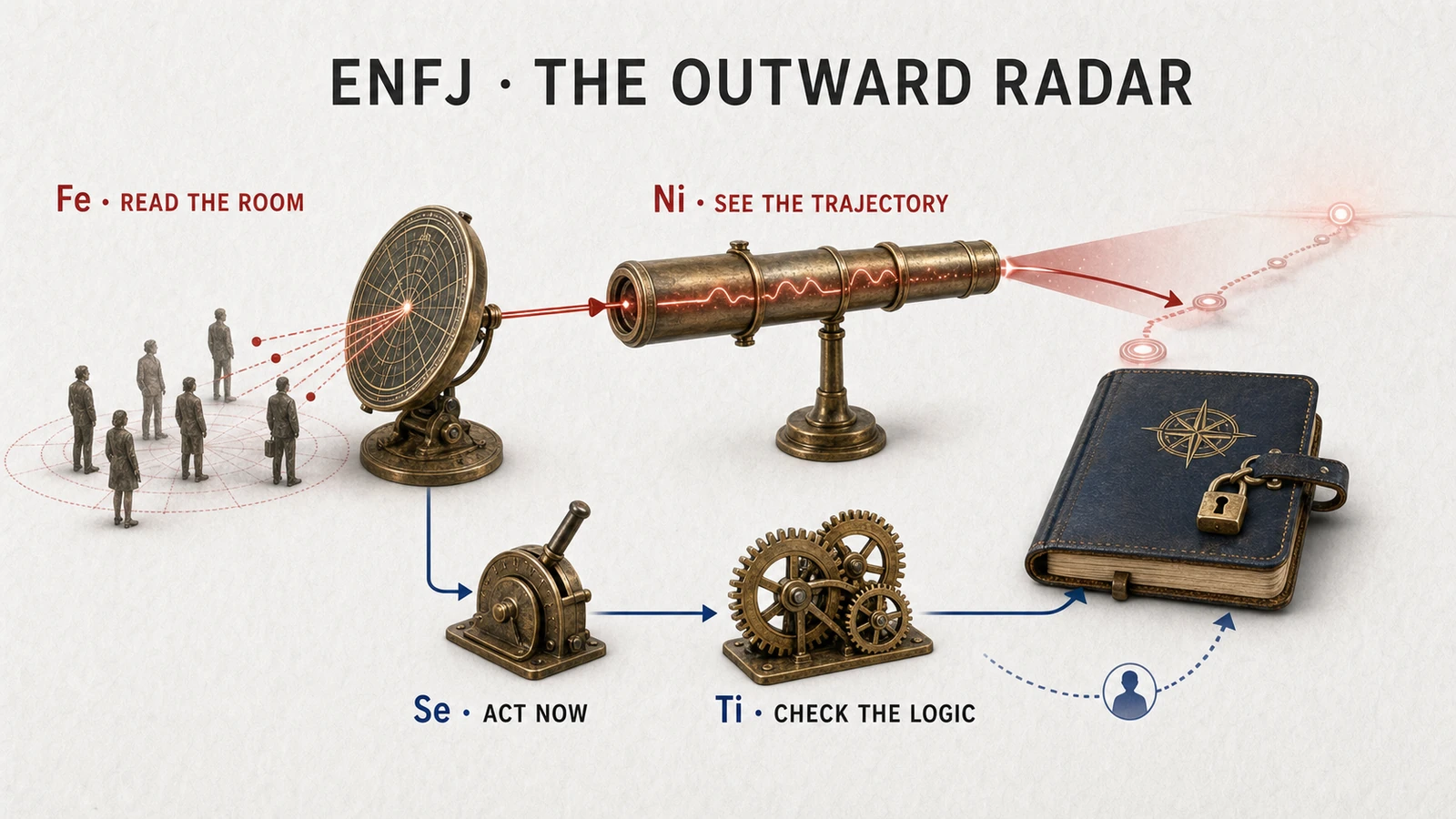
In MBTI language, you lead with extraverted feeling (Fe) supported by introverted intuition (Ni). Strip the jargon and something real is underneath.
Leading with Fe means your attention defaults outward, toward emotional data. Where another brain walks into a meeting and clocks the agenda, yours clocks the tension between the two people who arrived separately, the manager's forced brightness, the intern who clearly has something to say and isn't saying it. Cognitive scientists call this the mentalizing system: the network we use to model other people's minds. Everyone has one. Yours seems to run constantly, involuntarily, at unusually high resolution. Reading the room isn't a skill you deploy on purpose. It's a channel you can't switch off.
Ni adds the time axis underneath that. You don't just perceive who someone is, you extrapolate who they're becoming. Meet a floundering junior colleague and you'll involuntarily see the confident version of them three years out, plus the whole path between here and there. That's why everyone turns into a project: your pattern recognition runs forward through people the way an engineer's runs forward through systems. It's also why sitting near wasted potential physically bothers you.
Now for the honest caveat, because you'd respect nothing less. The MBTI instrument has real psychometric problems: type categories aren't stable biological facts, and the dichotomies flatten traits that are actually continuous. Its real value here is as a map onto constructs that are validated: what MBTI calls ENFJ corresponds roughly to high extraversion, high agreeableness, and high conscientiousness on the Big Five, paired with a reward system, in Jeffrey Gray's reinforcement sensitivity framework, that fires hardest on relational signals: gratitude, visible growth in someone you helped, harmony restored. The label is a lens, not a diagnosis.
That reward profile explains the whole paradox. Helping someone grow gives you a genuine neurochemical payoff. This isn't martyrdom, it's your brain's favorite food.
But every attention system runs on a budget, and yours spends nearly all of it on the external channel. What's left over goes to the internal channel: interoception, your sense of your own body's state. Fatigue, hunger, the early tightness of resentment arrive as quiet signals on a line you rarely check. You can detect a mood shift across a conference table and still miss that you haven't eaten in nine hours. Same brain, same mechanism, pointed in one direction.
A life with contribution and protected solitude
Generic dream-life advice fails you in a specific direction. "Follow your passion" assumes your passion is a craft. Yours is people, and the advice never accounts for that. "Optimize your mornings, protect your solitude, build your empire" describes a fortress, and a fortress with only you inside it isn't a dream, it's a punishment. But the opposite reading, that your dream life is simply helping everyone, is exactly the trap this article exists to spring you from.
The real design has four load-bearing walls.
Developing people as the actual job. Right now you probably do mentoring, morale repair, and career conversations in the margins of a job description that never mentions them. Teaching, coaching, leading teams, clinical work, talent development, and community building can make that strength visible and accountable. Human growth is deeply rewarding for many ENFJs, and a role built around it can reduce the conflict between what you do and who you are.
Reciprocity as an entry requirement, not a hoped-for bonus. Robin Dunbar's research on friendship maintenance found that close relationships survive on invested time, and your instinct is to invest in everyone at intimacy-level depth. That math never closes. The dream-life version is a small inner circle where care flows both ways, plus a deliberate demotion of the relationships where you're the therapist, the planner, the one who remembers birthdays, while the other person just rides along. You don't need more people. You need more people who ask you the second question.
One goal with no beneficiary but you. This is almost certainly the wall that's missing. Trace any goal on your current list honestly and it serves someone: the team, the family, the friend group, the community. Self-Determination Theory names three core needs: relatedness, competence, and autonomy. Your relatedness tank is overflowing while your autonomy tank sits bone dry. The dream life includes something you do because you want it, that helps no one, that you might not even mention to anyone. A language. An instrument. A stupid, glorious, useless mastery of something just for you.
Solitude with a purpose. Your Ni, the long-range pattern sense, needs unstructured alone time to consolidate, the same way the brain's default mode network needs idle time to integrate experience. This isn't solitude as recovery from people. It's solitude as the workshop where your best insight about everything, including people, actually gets built.
Build a system around people, not pressure
Your productivity problem was never discipline. You execute beautifully, for other people. The system below is built around your actual failure mode: commitments made in the heat of someone else's need, and self-directed goals that quietly dissolve because nobody is waiting on them.
Start the week with the mirror question. Your Sunday planning instinct opens with what does everyone need from me this week? Flip the first ten minutes instead: what did I want, before anyone asked? Write that answer down first, and schedule it first. Anything you schedule after the empathy channel opens will end up being for other people. The only real estate that's actually yours is what you claim before you check the dashboard.
Run a commitment budget. Decide in advance, in cold blood, how many yes-slots exist per week: favors, extra meetings, emotional-labor calls, events attended out of loyalty. Three is a reasonable start. Once the slots are gone, the answer is no, regardless of how the request makes you feel in the moment. This works because it turns a thousand separate willpower battles (each one fought against your own empathy, which always wins) into a single policy decision made back when nobody's face was in front of you.
Never answer live. Over-commitment isn't really a calendar failure. It's the physical inability to watch disappointment land on someone's face in real time. So remove the real time. Your default response to every request becomes: "let me check and get back to you tomorrow." Overnight, the disappointment you imagined shrinks down to its actual size, and you end up answering from your budget instead of from your mirror neurons.
Give your solo goals the structure your social goals get for free. When you promise another person something, delivery is basically automatic, because the accountability is built into their face. Your private goals don't have a face, so borrow one: use implementation intentions, Gollwitzer's when-then format, and give the goal a fixed time and trigger ("when I close my laptop Tuesday at 6, then I do my 30 minutes"). Better still, find an accountability partner for you specifically. You play that role for half your address book and almost certainly don't have one of your own.
Track energy in and energy out. For two weeks, mark each significant interaction with a quick plus or minus: did it fill you up or drain you? You already keep this ledger instinctively for everyone else's energy. Running it on yourself is how you find out which "friendships" are actually unpaid client relationships.
Five experiments for relational overload
Six tactics tuned to your specific failure modes, each one with the mechanism attached, because you deserve to know why it works and not just be handed homework.
1. The tomorrow rule. Covered above, but it earns its place on this list too: no yes leaves your mouth while the asker is standing in front of you. Mechanism: disappointment-aversion is a real-time, face-driven phenomenon. Answering asynchronously bypasses the empathy circuit entirely and routes the choice through your prefrontal cortex instead, where your actual priorities live.
2. The interoception alarm. Set three alarms a day, say 10, 2, and 6, and answer one question each time: what is my body doing right now? Jaw, shoulders, stomach, energy level, one word for the feeling. Mechanism: attention is trainable, and the skill you've already mastered for reading other people transfers inward if you point it there. Research on emotional granularity shows that naming a state precisely changes how the brain processes it, but you can't name what you never check.
3. The reciprocity ledger. For two weeks, log care given and care received, relationship by relationship. Who asked about you? Who remembered your thing? Mechanism: the slow resentment leak, that bitterness you feel and then immediately shame yourself for feeling, is really just suppressed data. Writing it down turns vague, guilt-laced bitterness into information you can actually use: rebalance the relationship, renegotiate it, or quietly downgrade your investment. Resentment you can read is a boundary waiting to be drawn. Resentment you suppress is a slow leak that eventually floods the basement.
4. The secret goal. Maintain one goal you never announce to anyone, ever. Mechanism: your Fe wiring has outsourced your reward system, so progress only feels real once someone reacts to it. A goal with no audience forces that loop to close internally instead, which is exactly the autonomy muscle rebuilding itself. It'll feel pointless for about a month. That feeling of pointlessness is the diagnosis, not a sign to quit.
5. The scheduled disappointment. Once a week, deliberately let someone down in a small, safe way: decline an invitation without inventing an excuse, leave a message unanswered until morning, or say "I can't take this on" and then, here's the hard part, add nothing else. Mechanism: exposure. Your nervous system predicts that disappointing people ruptures relationships, and every small disappointment that doesn't end in catastrophe generates a prediction error that recalibrates the alarm downward. You're not practicing being cold. You're teaching your threat system the actual price of a no, which is almost always nothing at all.
6. The offload page. End the day with ten minutes of unfiltered writing about whatever interactions are still circling your mind: the friend you're worried about, the tension you absorbed in that meeting, the thing you wish you'd said. James Pennebaker's research on expressive writing found that translating emotional load into language measurably loosens its grip. You carry other people's weather home with you every day. The page is where you get to set it down, so your bed doesn't have to carry it instead.
The three-column care audit
ENFJs often track everybody else's state so automatically that "How am I doing?" becomes the last question in the room. A care audit makes that hidden allocation visible. Use one sheet of paper and draw three columns:
| I chose this | I was asked | I silently assumed |
|---|---|---|
| Work you offered because it mattered to you | Work another person clearly requested | Work you picked up because discomfort appeared |
Review the last seven days. Include emotional labor, reminders, introductions, conflict smoothing, planning, and the message you rewrote five times so nobody would feel bad. The third column usually explains the exhaustion. It contains responsibilities that were never assigned, negotiated, or even noticed.
Choose one item from that column and run a consent check before doing it again:
- Name what you observed. "You seem stressed about the deadline."
- Ask whether help is wanted. "Would it help if I reviewed the plan, or do you want space?"
- Offer a bounded action. "I can look at it for twenty minutes after lunch."
- Let the answer stand. A no is useful information, not a request to find a subtler way to rescue the situation.
This keeps your empathy intact while adding a missing boundary: other adults retain ownership of their problems. It also produces cleaner relationships. People can accept, decline, or propose a different form of support instead of unknowingly receiving help that later turns into resentment.
Add a second weekly check called the reciprocity question: Who initiated care for me without being prompted? Do not use it as a secret scorecard. Use it to notice where support already flows both ways and where you are maintaining closeness alone. One honest conversation is more useful than another month of compensating silently.
The shadow side: smiling depletion
Every type has a burnout signature. Yours is the most invisible one, because it's disguised as thriving.
An exhausted ENFJ doesn't withdraw. You get more helpful. More organized, more available, more relentlessly warm, because helping is both your competence and your anesthesia, and because the dashboard says four people need you this week and has never once displayed your own name. From the outside you look like the strongest person in every room, right up until the day you break. Everyone says the same thing afterward: but you seemed fine. You did. Seeming fine is the one skill you never stopped practicing.
Learn the early markers, because your body files reports even when your attention won't:
- Irritation at the people you love, for needing you, followed instantly by shame for feeling it. This is the resentment leak reaching the surface.
- The disappearing fantasy. Nothing dramatic, just a recurring image of a hotel room in a city where nobody knows you and nobody can find you. That fantasy isn't selfishness. It's your psyche requesting the solitude you keep denying it.
- Somatic invoices. The jaw. The stomach. The 3 a.m. waking. Interoceptive signals escalate until they're loud enough that even an outward-pointed attention system can't ignore them.
- Care going through the motions. You're still doing everything for everyone, but the warmth has gone mechanical, and you're terrified someone will notice.
Recovery begins with subtraction. Your instinct will be to add self-care to the list: a yoga class, a morning routine, one more obligation with your name on it, performed as diligently as everything else and just as depleting. Cancel three things instead. Then do the genuinely hard part: tell two people the unperformed truth. Say the actual sentence: I am running on empty and I need help. You've spent your whole life being the one who reads the room. Recovery begins the first time you let the room read you back.
If this shadow pattern feels close to home, your quieter mirror type, the INFJ, runs the same collapse inward instead of outward, and the ESFJ shares your allergy to disappointing people with a more present-tense focus. The mechanics rhyme across the whole Fe family.
The person who sees everyone
Here is the reframe to keep.
Your care was never the problem. The world doesn't need you to become colder, more boundaried in spirit, less moved by what other people are becoming. That perception, the room read in seconds, the potential spotted years early, is rare and it's real, and the people you've helped grow will carry your fingerprints for the rest of their lives.
But you were never supposed to earn your place by being needed. The dashboard you run for everyone else has always had one missing panel, and the work of your next season is installing it: your name, your own gauges, a goal that serves no one but you, a no that requires no apology, a circle that asks you the second question.
Everyone's growth project except your own, that was the old paradox. Here's the better one: you're the person who develops people, and it's time you finally included the one you've been standing in all along.