The most famous study you half-remember
The marshmallow test is one of the most cited psychology experiments of the 20th century. Walter Mischel's lab at Stanford ran it starting in 1972: preschoolers were offered one marshmallow now, or two if they could wait about 15 minutes. Decades later, Mischel reported that the kids who'd waited had better SAT scores, lower BMI, more education, and fewer substance-abuse problems.
The cultural takeaway became: self-control is a fixed trait, visible by preschool, that predicts your whole life.
That takeaway is mostly wrong.
What the original study actually showed
Mischel and his colleagues tested 90 children at Stanford's campus nursery school, a high-income, mostly white, mostly faculty-children sample, and followed up with them at intervals over the next 40-plus years.
The headline finding, that kids who waited had better outcomes, was real. It also came with some fine print:
- The sample was small and unusually homogeneous.
- Early follow-ups didn't control for parents' income, education, or cognitive ability, all of which were tangled up with the result.
- The effect size was more modest than the famous version suggests. That eye-catching 200-point SAT gap shrinks a lot once you control for those other factors.
The cultural narrative, "grab the marshmallow and you're doomed," was never actually in the data. The data showed a correlation, not a sentence.
The 2018 replication
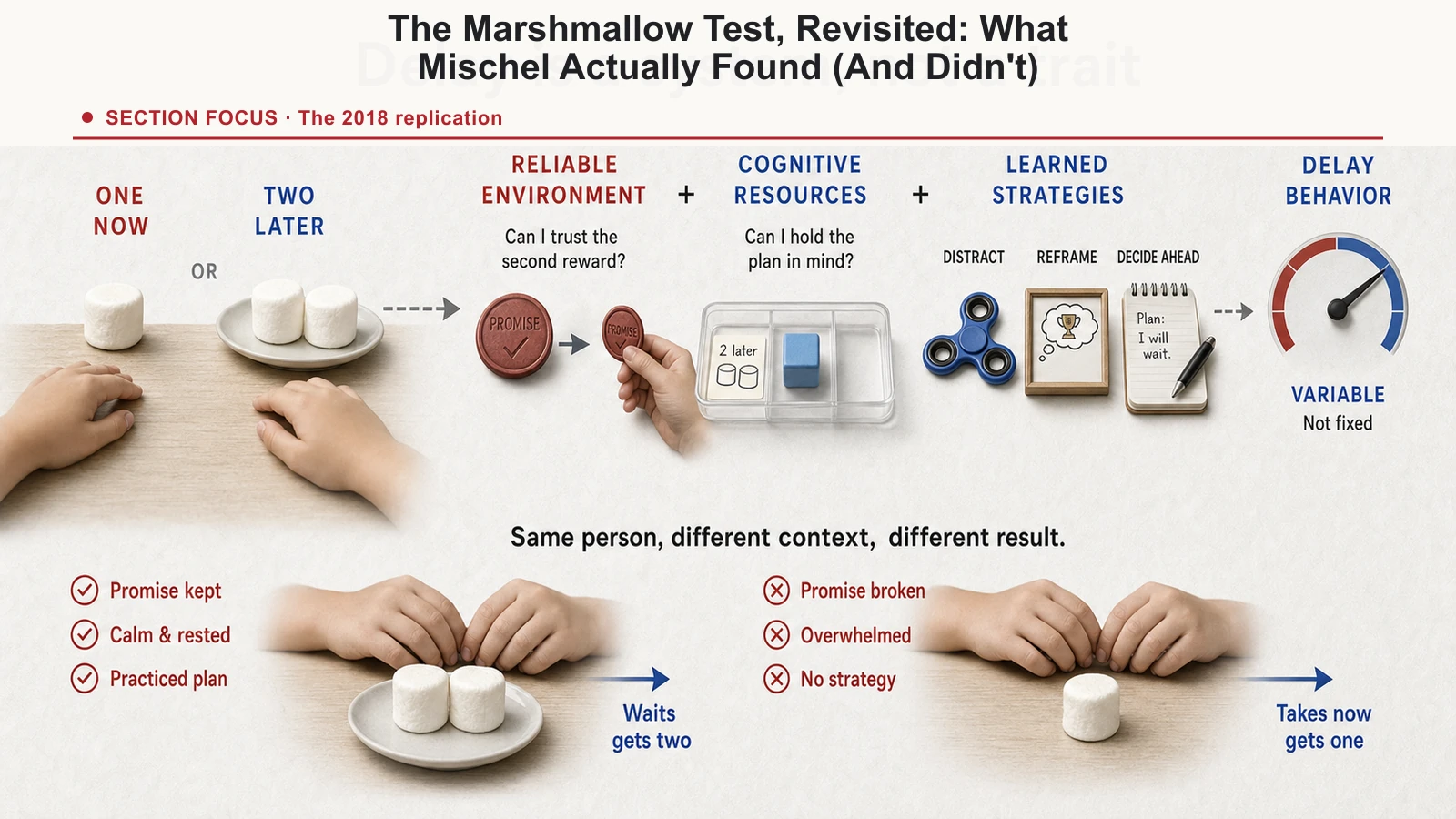
A team of researchers ran the most rigorous replication of the marshmallow test to date, publishing in 2018. They tested 918 children, ten times Mischel's original sample, drawn from a much more economically and racially diverse population, and controlled for variables the original study couldn't.
Three findings stood out.
The marshmallow effect was about half the size of the original. Kids who waited still did somewhat better on average, but nowhere near as dramatically as the famous numbers implied.
Most of the remaining effect traced back to family background. Once the researchers controlled for parents' income, education, and home environment, the link between delay and later achievement shrank a lot further.
Context mattered more than anyone expected. Kids from less-resourced backgrounds may face more reasons to doubt that a promised reward will arrive. Waiting becomes a worse bet when the environment is unreliable, and taking the available reward can be rational.
Put together, the marshmallow test looks less like a pure measure of self-control and more like a mix of how reliable the world this kid lives in actually is, and how well a four-year-old understands the task.
What Mischel himself said

The popular framing, "self-control is destiny," was never how Mischel himself described his own work.
His 2014 book on the subject is explicit that:
- Delay is learnable, not fixed.
- Specific strategies make a big difference: distracting yourself, distancing yourself from the reward, reframing the wait as a game.
- Context shapes performance enormously.
- The childhood test is one data point. It's not a life sentence.
Mischel ran follow-up experiments where he taught kids these strategies directly and watched their wait times jump from 30 seconds to 15-plus minutes, in the same children. The capacity turned out to be elastic all along.
The learnable strategies
The delay strategies with real evidence behind them:
1. Hot vs. cool processing. Think about the reward in "cool" terms (its shape, its color, a mental picture of it) instead of "hot" terms (its taste, how much you want it right now). Cool framing takes the edge off the craving.
2. Distraction. Anything that occupies your attention lowers how much you want the thing you're waiting for. Singing, looking away, thinking about something else entirely.
3. Distancing. Imagine yourself watched from the outside. "If I were watching myself right now, what would I want me to do?" That little bit of distance dulls the impulse.
4. Implementation intentions. Decide in advance. "When the marshmallow's in front of me, I'll look at the wall." Deciding ahead of time takes the willpower demand off the moment itself.
All four are trainable. None of them are personality.
What delayed gratification actually predicts
The 2018 replication didn't prove delayed gratification is meaningless. It showed something more precise:
- Delayed gratification does correlate with later outcomes.
- Part of that correlation is a real self-regulation effect.
- Part of it is a proxy for family resources, which also shape how easy delay is in the first place.
- The whole effect is smaller and more conditional than the famous version suggested.
Practically, that means:
- Adults can train delay through implementation intentions, distancing, and better environmental design.
- Kids can be taught delay by coaching specific strategies, not by being labeled "low self-control."
- Environment matters enormously. Making the right choice easy and the wrong choice hard does more than sheer willpower ever will.
Test the environment before testing your character
Delayed gratification changes when the environment changes. Run a small audit around one temptation instead of turning the result into a personality diagnosis.
Track five episodes using these fields:
| Cue | Immediate option | Delayed option | Trust | Friction |
|---|---|---|---|---|
| Phone lights up | check now | finish ten minutes of work | high | phone within reach |
Trust asks whether the delayed reward is believable. "Finish this section and take a break" works only if breaks are actually allowed. A history of moving the finish line teaches you to take the immediate reward while it is available.
Friction asks how many movements separate you from each choice. A distracting app under your thumb competes against a distant benefit that requires sustained effort. Change that geometry: move the phone, block the site for twenty minutes, open the working document, and define the exact stopping point.
Run the same task under two conditions and compare starts, interruptions, and output. This tests environmental design rather than moral strength.
Repair trust with small promises. If you plan a break after twenty minutes, take it. If the reward is dinner after sending one email, do not add four hidden tasks. Reliable self-agreements make waiting rational again.
This interpretation fits the later marshmallow research better than a fixed willpower score. Behavior reflects the child, the reward, and the world around both.
What this means for productivity
Three takeaways worth keeping:
1. Stop treating self-control as a fixed trait. It's part capacity, part skill, part environment, and environment is where you actually have the most control.
2. Environmental design beats willpower. Leave your phone out of the bedroom. Lay out your gym clothes the night before. Block distracting sites. These are all versions of "get the marshmallow out of the room," and they work because they cut down how much in-the-moment delay you need in the first place.
3. The strategies are trainable. Cool framing, distancing, implementation intentions: all of these measurably improve delay capacity, and the gains stick around.
Put distance between cue and choice
The Habits and Focus systems are built around environmental design and pre-commitment, not white-knuckle willpower in the moment. Focus mode is the "marshmallow not in the room" move in software form: distracting tabs simply aren't available while it's running. Implementation intentions are baked into the habit-stacking flow ("after I [X], I will [Y]").
The AI coach helps surface the right strategy for the right failure mode. Struggle to stop checking social media? The system asks what you've already tried and suggests the evidence-backed alternatives, without the "you just lack self-control" framing. Delay is treated as a teachable skill with specific techniques, not a character flaw.
Design the wait before testing willpower
The marshmallow test is famous, real, and oversimplified, all at once.
The original effect was modest. The 2018 replication shrank it further. Delayed gratification matters, but it's mostly about environment and learnable strategies, not destiny.
If you grabbed the marshmallow at age four, that doesn't predict your life. If you struggle to delay gratification right now, that's not destiny either. The strategies that improve delay are well documented and genuinely learnable.
The real advantage is in environmental design, not raw willpower. Get the marshmallow out of the room.