The old split
Chest Monday. Back Tuesday. Legs Friday. If that pattern sounds familiar, you're running what everyone still calls the "bro split," a leftover from bodybuilding magazines in the 1970s and 80s:
- Monday: Chest
- Tuesday: Back
- Wednesday: Shoulders
- Thursday: Arms
- Friday: Legs
- Weekend: Rest
Each muscle gets trained once a week. The session is brutal, the pump is real, and for a natural lifter, the growth signal is leaving a lot on the table.
The mechanism
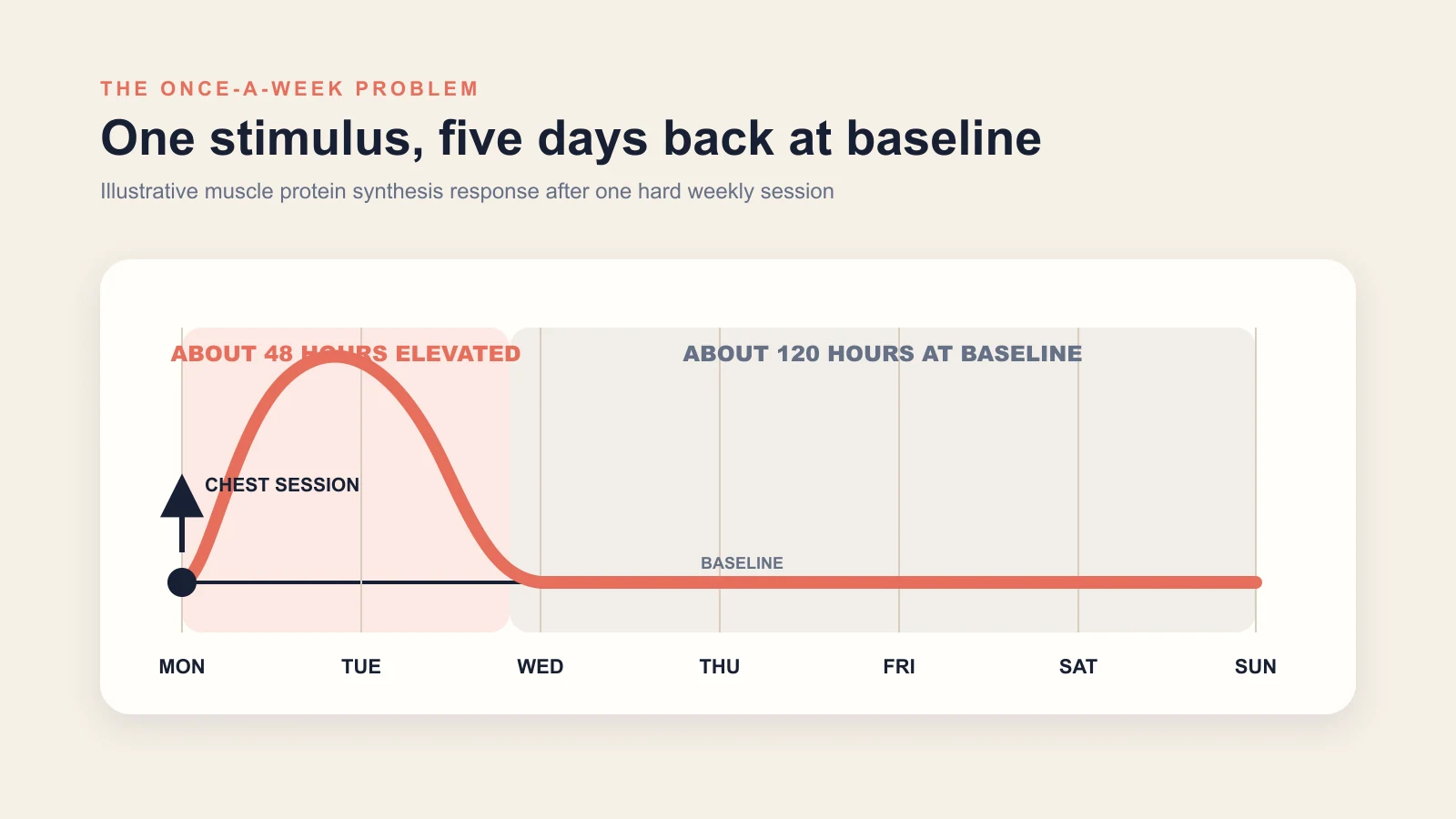
Muscle protein synthesis, the actual building process, stays elevated for roughly 48 hours after a hard training session. After that, it drops back to baseline.
The bro split gives each muscle exactly one 48-hour growth window a week. The remaining 120 or so hours sit at baseline, with no growth signal running at all.
Train the same muscle twice a week and you get two 48-hour windows: 96 hours of elevated synthesis. Three times a week gets you 144 hours.
You can't keep muscle protein synthesis elevated permanently (recovery has its limits), but moving from one stimulus a week to two or three produces meaningfully more growth at the exact same total weekly volume.
The evidence
A widely cited 2016 meta-analysis pooled 10 studies on training frequency. At matched weekly volume, the results were consistent: training a muscle twice a week beat training it once, and training it three times a week added a small amount more on top of that, though that data was thinner.
A later follow-up study comparing higher and lower frequencies at matched volume found the extra gains taper off somewhere around two to three sessions a week for most practical purposes.
The takeaway holds up: 2-3 times per muscle per week is the sweet spot. Once a week leaves growth on the table. Four or five times a week runs into diminishing returns and a much higher recovery cost.
The practical splits
Upper/Lower (4 days a week):
- Mon: Upper
- Tue: Lower
- Thu: Upper
- Fri: Lower
Each muscle gets hit twice a week, with Wednesday and the weekend off.
Push/Pull/Legs, run twice (6 days a week):
- Mon: Push (chest, shoulders, triceps)
- Tue: Pull (back, biceps)
- Wed: Legs
- Thu: Push
- Fri: Pull
- Sat: Legs
- Sun: Off
Each muscle hits twice a week, at a higher total volume than upper/lower. It's demanding on recovery, so sleep and nutrition need to be solid.
Full body, 3x a week:
- Mon, Wed, Fri: All major muscles
Each muscle gets trained three times a week, but at a lighter load per session. Good for beginners and anyone short on time, with the side benefit of extra technique practice.
Why the bro split persists
Three reasons, honestly:
- Cultural inertia. Every magazine and YouTuber someone learned from probably ran a bro split.
- The "destroy and recover" feeling. Wrecking one muscle for 90 minutes straight feels productive, even addictive.
- It works fine at very high volumes. Once you can handle 20+ sets per muscle a week, cramming it into one day starts to work. By that point, though, you're probably further along than most natural lifters ever get.
For a natural, intermediate lifter (most people reading this), 2-3x frequency is the better answer. The bro split survives because the workouts feel hard, not because the muscles grow faster.
Spread the volume, don't multiply it
A common mistake when switching off a bro split: not redistributing the volume.
Bro split chest day: 20 sets of chest in one workout. Switch to upper/lower and try to "keep the same volume each session," and you'd end up doing 20 sets of chest on each upper day, 40 sets a week total. That's well past what most lifters can actually recover from.
The correct switch: keep the weekly total at 20 sets, split 10 and 10 across the two upper days. Now each session is 10 hard sets, recoverable within 48-72 hours, and the weekly dose stays right where it should be.
When frequency doesn't matter
For absolute beginners, frequency barely matters. Almost any program with progressive overload works for the first 6-12 months. The frequency conversation becomes important once you're intermediate or advanced, when every variable starts to count.
If you can only train 2-3 days a week total, full body is the right call, since it hits each muscle 2-3 times a week without needing four or more training days.
What TaskCoach.AI does with this
Habits and Calendar can hold your weekly training pattern in place. Calendar keeps the actual session slots, and Habits shows your weekly hit rate for each workout type. Once the pattern becomes automatic, usually somewhere in the 8-12 week range, the system fades into the background and the bar just keeps moving.
The bottom line
2-3 times per muscle per week beats once a week, at the same total volume.
Upper/lower over four days, push/pull/legs over six, or full body over three: pick whichever one actually fits your schedule and recovery.
The bro split isn't wrong, exactly. It just leaves growth on the table. For a natural lifter at intermediate volumes, changing your frequency is one of the most effective single changes you can make.