The list lies by omission
A to-do list can only answer one question: what exists? It can't tell you what's actually in motion, what's been stuck for three weeks, or where work is quietly piling up, and those are exactly the questions that decide whether you finish anything.
A kanban board answers all three at a glance. Its columns encode state (Backlog, Todo, In Progress, Done), and cards physically pile up wherever work gets stuck. Four cards jammed in one column is a bottleneck diagnosis you didn't need a meeting to find.
That visibility is nice to have. But it isn't the reason kanban makes you faster. Math is.
Little's law: the uncomfortable equation
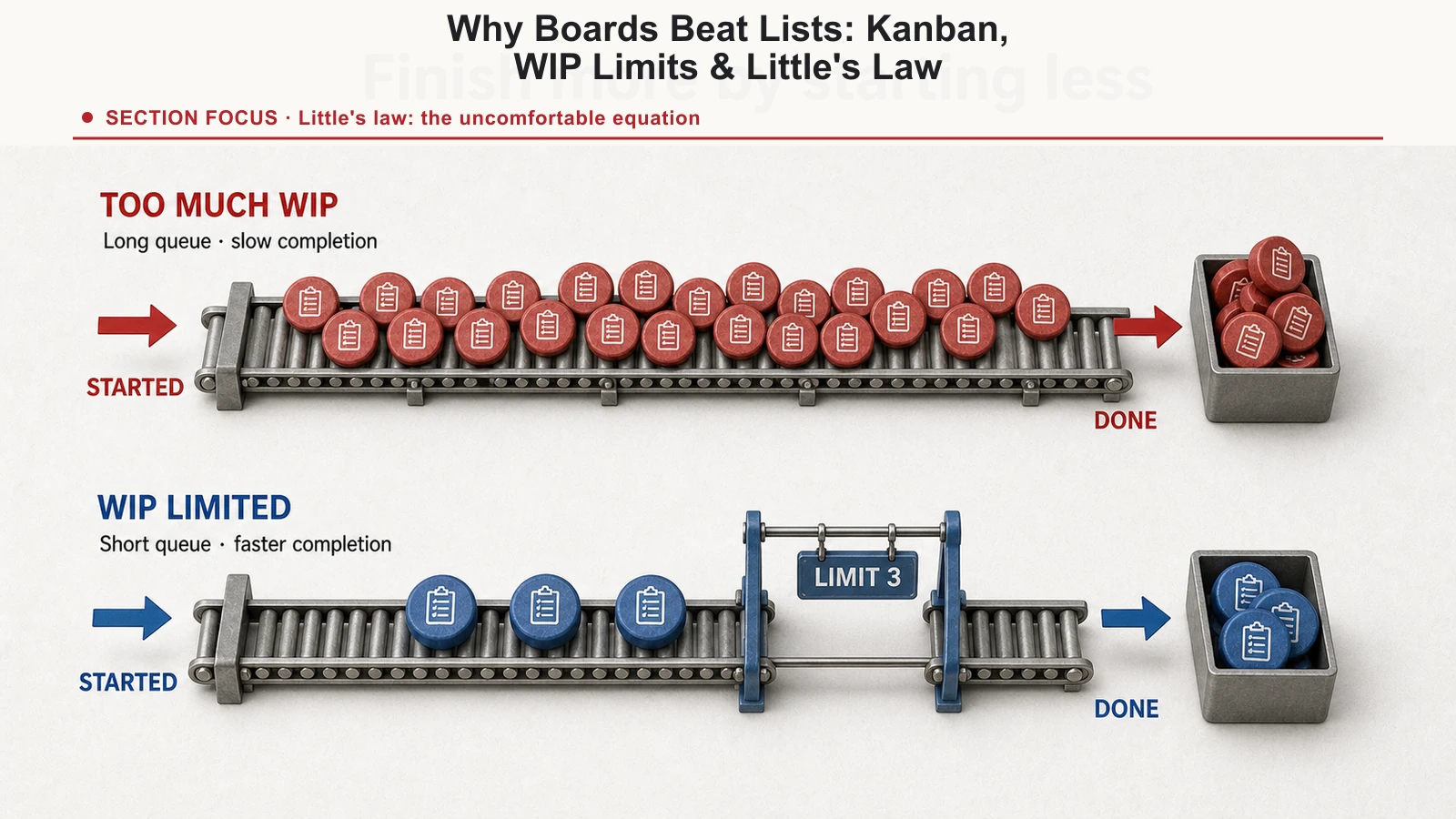
In 1961, MIT's John Little proved a deceptively simple result from queueing theory, one that holds for any stable system: assembly lines, supermarket checkout lines, hospital wards, and your project board included.
Average cycle time = work in progress ÷ throughput
Your throughput (how many things you actually finish per week) is roughly fixed. It's set by your hours, your energy, and your skill, and it doesn't move just because you're excited about a project. That leaves exactly one variable under your direct control: how many things you let yourself work on at once.
Run the numbers. Say you finish about one meaningful thing per week:
- 6 items in progress → each one takes an average of 6 weeks to finish
- 2 items in progress → each one takes an average of 2 weeks
Same person. Same effort. Same throughput. You triple your speed per item just by starting less.
The psychology agrees with the math
The queueing argument alone actually understates the case, because a high WIP doesn't just divide your capacity. It shrinks it.
The switching tax. Researchers who measured the cost of shifting between tasks found that performance drops every time you switch, and the "resumption lag" of reloading context can eat up 20-40% of your productive time on complex work. Juggle six projects and you're paying that toll dozens of times a week. You end up dividing a smaller pie than you thought you had.
The open-loop tax. The Zeigarnik effect, a finding from the 1920s showing that interrupted tasks stay mentally "active" longer than finished ones, means every card sitting In Progress keeps running quietly in the back of your head, including at dinner. Later research found that these open loops measurably drag down performance on unrelated tasks, and that the drag disappears once the task has a concrete plan attached to it. A short In Progress column is, cognitively, a shorter list of things your brain refuses to stop rehearsing.
Kanban's origin: the supermarket insight
Taiichi Ohno built the original kanban system at Toyota in the 1950s after studying American supermarkets: shelves get restocked only when a gap appears, a "pull" system where downstream demand pulls upstream work along. The result became the Toyota Production System, still one of the most studied manufacturing methods ever devised.
Personal kanban, formalized decades later by Jim Benson and Tonianne DeMaria Barry, borrows exactly two rules from all that factory machinery:
- Visualize the work.
- Limit work-in-progress.
That's the whole system. Everything else is decoration.

Running it without fooling yourself
1. Make Backlog vs Todo a real border, not a suggestion. Backlog is deliberately parked and guilt-free. Todo is committed. Something should only move from Backlog to Todo when something else finishes. That's the pull system in action. If everything lands straight in Todo, you've just rebuilt the infinite list with extra columns.
2. Cap In Progress at two or three. When you want to start something new and the column's full, you're left with two honest choices: finish something, or consciously demote something back to Backlog. Both are wins. Quietly letting the column grow is the only real loss.
3. Read the pile-ups, not the cards. The board's real diagnostic power is in the pattern, not any single card. Cards stacking up in one column means a bottleneck. A card that hasn't moved in two weeks usually means it's mislabeled: too big, blocked, or secretly something you were never going to do. Act on the pattern, not the individual card.
4. Let moving a card backward be a power move. Demoting something to Backlog is the WIP limit working exactly as intended, a decision that frees up capacity, not an admission of failure.
What TaskCoach.AI does with this
Every Space in TaskCoach.AI ships with a Kanban view over the same task database as the other seven views, so dragging a card to Done stamps the completion, pays out the XP, and feeds your analytics all at once. The drag is the data entry. Backlog and Todo are kept as separate columns on purpose, because that parked-versus-committed distinction is the load-bearing wall of the whole WIP-limit idea. Custom columns let you match your real pipeline (Scoping, Drafting, Review, Shipped) so bottlenecks show up exactly where they actually live.
The bottom line
Your completion rate is fixed. Your WIP is a choice.
Little's Law turns "focus" from a nice idea into arithmetic: every item you start joins the divisor that slows down everything else. The board isn't a prettier list. It's the instrument that makes that divisor visible.
Stop starting. Start finishing.