The numbers
Professional fund managers spend entire careers trying to beat the market. Most of them don't. S&P Dow Jones Indices tracks the scoreboard every year in a report called SPIVA (S&P Indices Versus Active), and the numbers aren't close.
Look at the ten years through 2023: 86% of U.S. large-cap funds underperformed the S&P 500. 92% of mid-cap funds lagged their benchmark. 88% of small-cap funds lagged theirs.
Stretch the window to 15 years and underperformance climbs to 89%. At 20 years, it's around 90%.
These numbers hold up remarkably well across decades and across countries. Wherever you look, active management loses to the index in nearly every market segment and time horizon.
The math
There's a simple reason active managers can't beat the index on average: the market's average return is the market. Every active manager's trades add up to the total market, so before fees, the average active fund earns exactly the market return. No more, no less.
Then subtract fees. A typical active equity fund charges around 1% a year in management fees, sometimes 2%. Add trading costs (0.2 to 0.5% a year for funds that trade often), plus the tax hit from realized gains.
Net result: the average active fund returns about 1.5% less per year than the index it's trying to beat. Over 30 years, that gap is the difference between ending up with $1,000,000 and ending up with $1,600,000, on the exact same starting money.
This isn't a matter of opinion. It's arithmetic.
Why some funds beat the index
A small number of active funds do beat the index over long stretches. Renaissance Technologies' Medallion Fund is the poster child.
Two problems undercut the "just pick a winner" plan, though.
First, survivorship bias. Performance reports only include funds that are still around, quietly excluding the ones that shut down. Count the funds that died along the way, and the real share of funds beating the index over 20 years looks a lot closer to 5% than 10%.
Second, you can't spot the winners ahead of time. Studies of fund-rating systems consistently find they have little to no power to predict which funds will keep outperforming. Past performance doesn't predict future performance, no matter how many stars a fund has next to its name.
Even Medallion is closed to outside investors. The active funds that beat the index over 20 years and are actually available to regular people are vanishingly rare, and there's no reliable way to spot them in advance.
John Bogle's argument
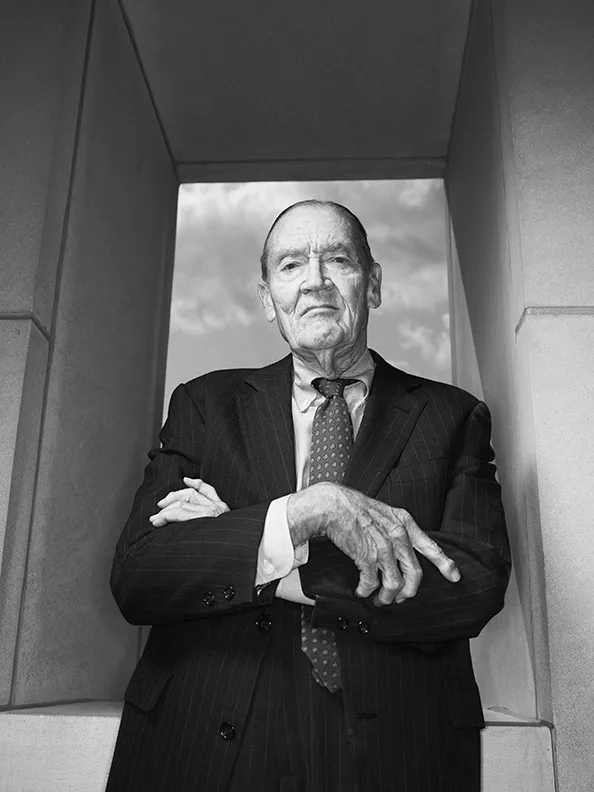
Jack Bogle founded Vanguard in 1975 around an idea that sounded almost too plain to work: regular investors should just own the whole market instead of chasing star managers. His logic ran like this:
- You can't reliably pick tomorrow's winners today.
- The average active fund lags its benchmark by roughly its own fee.
- So the rational move is to buy the index at the lowest possible cost, and hold it.
Vanguard's S&P 500 fund launched in 1976 as the first retail index fund, and Wall Street mocked it for years as "settling for average." Decades later, that "average" has quietly beaten most of the professionals who laughed at it.
Bogle put his own estate's money where his mouth was: low-cost index funds. Warren Buffett has said the same about his wife's inheritance, 90% of it earmarked for an S&P 500 index fund.
What the right portfolio looks like
The classic version, sometimes called the Bogleheads portfolio, uses three funds:
- A U.S. total-market index fund (roughly 60-70% of the portfolio in younger years)
- An international total-market index fund (roughly 20-30%)
- A bond index fund (the share grows with age; a common rule of thumb is bond percentage equals your age, or your age minus 20)
For most people under 40, even that's more complexity than necessary. The simpler version: one target-date fund that automatically shifts toward bonds as retirement gets closer. That's it.
Expense ratios on funds like these run 0.03-0.15%, roughly a tenth of what active alternatives charge.
The common objections
"But the market's overvalued right now." Every active sales pitch says this, always, about every market, forever. Time in the market beats timing the market for almost everyone. The rare professionals who can time markets do exist, but even they fail more often than they succeed.
"My advisor says..." Most advisors get paid through commissions on the active funds they sell you, which means their incentives aren't lined up with your returns. Fee-only fiduciaries are the exception. For most people, the simpler path is no advisor plus a target-date fund.
"I want to beat the market." Statistically, you almost certainly won't. An individual investor with no particular edge has maybe a 5-10% chance of beating a rock-bottom-cost index fund over 30 years. And the odds that you'll believe you beat the market are a lot higher than the odds you actually did.
What TaskCoach.AI does with this
The Wealth pillar tracks the behaviors that actually matter here: is your monthly auto-contribution still running, is your allocation reviewed once a year and not more often than that, has the portfolio gone untouched outside the annual rebalance. Most investors don't fail because they picked the wrong fund. They fail because they couldn't leave a good plan alone. The system is built to handle that part.
The bottom line
Index funds beat active funds for the same reason a 1% fee compounds against you over time: it's arithmetic.
The exceptions can't be picked out in advance, and survivorship bias makes them look far more common than they actually are.
Buy the market. Automate it. Hold it. Leave it alone.
It's not flashy advice. But it's the advice that the wealthiest, most informed investors around, Bogle, Buffett, and Munger among them, have given their own families for decades.