A 2014 slide, not a Japanese tradition
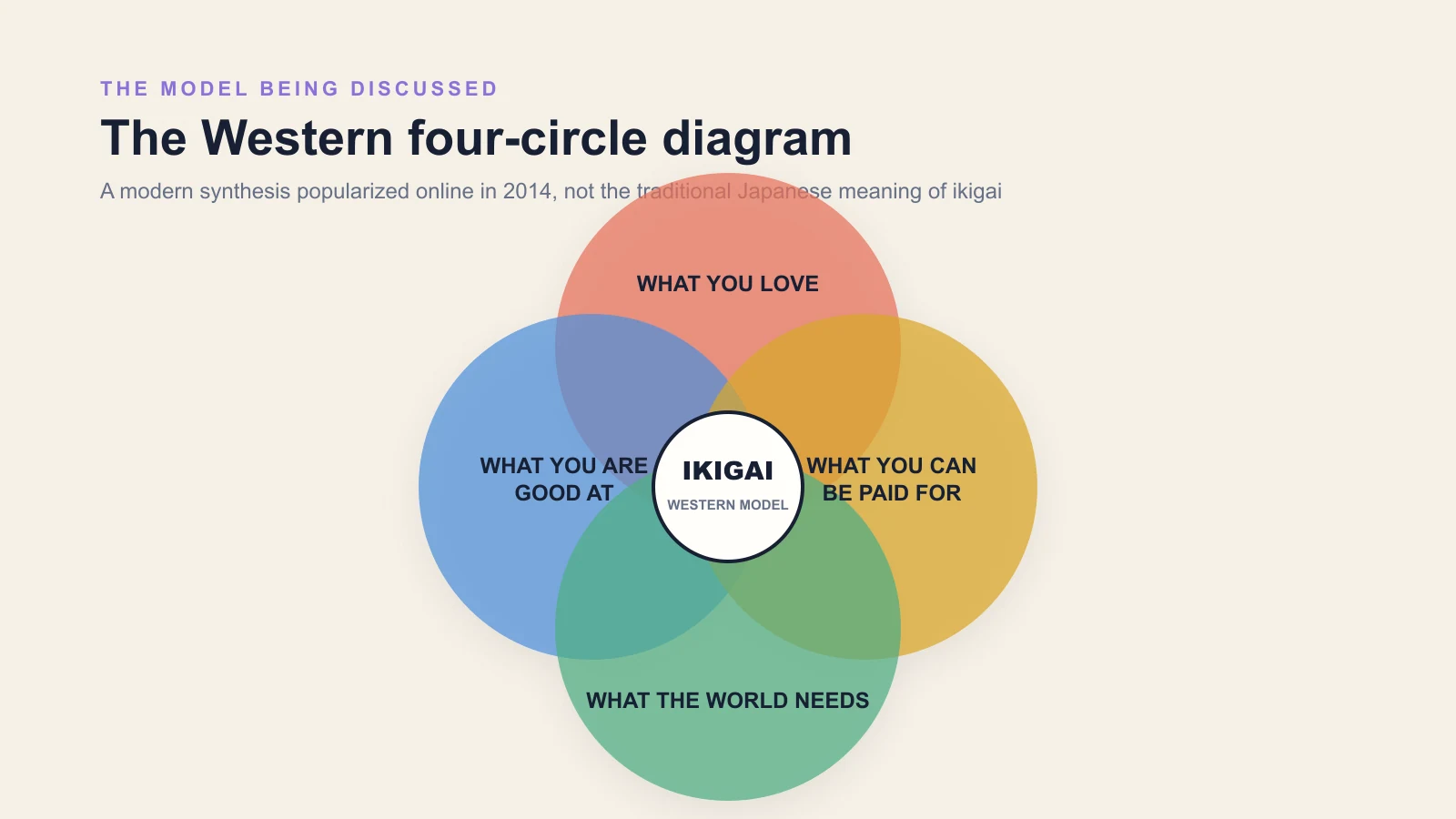
If you've seen the four-circle ikigai diagram (love it, good at it, world needs it, paid for it), what you've actually seen is a 2014 slide made by a guy in the UK named Marc Winn, not some centuries-old Japanese framework.
Those four overlapping circles existed before Winn ever touched them. They came from an unrelated purpose chart made by a Spanish astrologer named Andrés Zuzunaga back in 2011. Winn relabeled the center circle "ikigai," and from there the whole thing went viral as if it had been Japanese all along.
It hadn't.
What the actual Japanese concept means
The first serious treatment of ikigai in Japanese psychology came from a 1966 book by Mieko Kamiya called Ikigai-ni-Tsuite ("On the Meaning of Life"). Kamiya was a psychiatrist who worked at the Nagashima Aiseien sanatorium, treating patients with leprosy. She defined ikigai as whatever gives your life felt value, a sense that it's worth living, more of a spectrum than a four-way market-fit chart.
The concept covers small daily pleasures (a cup of tea, tending a garden, a good conversation) just as much as it covers the big picture of where your life is headed. That "tiny ikigai" idea, the morning coffee that makes getting up feel worth it, sits a lot closer to how Japanese speakers actually use the word than the career-optimization reading most Westerners run with today.
The Tohoku study: why the concept deserves to be taken seriously

The strongest evidence behind ikigai as a real, measurable thing comes from a large study out of Tohoku University, known as the Ohsaki Cohort Study.
Researchers followed 43,391 Japanese adults between the ages of 40 and 79 for seven years, and asked them one simple question: do you have ikigai in your life?
Here's what they found over that follow-up period. People who said yes had a meaningfully lower risk of dying from any cause. Most of that difference came from a drop in cardiovascular deaths specifically. And the effect held up even after accounting for age, education, weight, smoking, drinking, sleep, exercise, blood pressure, and diabetes.
So the concept tracks something real. The famous diagram is misattributed. Both of those things are true at once.
The modern Venn still works, just not as a translation
The four-circle version is genuinely useful for thinking through your own life, even though it isn't Japanese. It's really a mashup of four ideas that were already floating around in Western self-help:
Passion, where what you love overlaps with what you're good at.
Profession, where what you're good at overlaps with what pays.
Vocation, where what pays overlaps with what the world needs.
Mission, where what the world needs overlaps with what you love.
Line all four up on a single activity, and you get the diagram's version of "ikigai." That's a genuinely strong target to aim for.
Here's the part most people miss, though: most people are sitting in a two-circle overlap, not four. Someone stuck in "passion only" loves something nobody will pay them for. Someone stuck in "profession only" is good at something the market wants but doesn't actually care about. Both situations are completely normal, and both are stable places to sit for years. Neither one is the full picture.
What this means for you

Two moves, in order.
First, figure out honestly which two circles you're actually standing in right now. Most people land in profession (skill plus market) or passion (love plus skill). Neither is a failure. Both are just starting points.
Second, pick the neighboring circle and add it on purpose.
Stuck in profession? Add mission. Find a way to point your existing skill at something bigger than the paycheck.
Stuck in passion? Add profession. Find the version of what you love that someone will actually pay for.
Stuck in vocation, meaning it pays and the world needs it, but you don't love it? That's the burnout quadrant. Add passion, or get out.
The four-way overlap was never the starting line. It's what you build toward, usually across several rounds of adjustment, not something you stumble into on day one.
What TaskCoach.AI does with this
The Vision section in our user guide is built around this same four-circle idea: what you want to become capable of, what you're already good at, what would genuinely contribute to something, and what would actually sustain you financially. The pillar system (Mind, Body, Social, Wealth, Career, Home, Leisure) breaks the same life-design problem into smaller, workable pieces instead of dumping it all into one overwhelming "find your purpose" prompt.
Kamiya's "tiny ikigai" idea shows up in our journal and daily check-in too. That morning coffee that felt worth getting up for is a real piece of data. A handful of small satisfactions a day tells you something true about which parts of your life are alive and which ones aren't.
The bottom line
The Venn diagram is a Western mashup from 2014.
The actual concept behind ikigai is older, broader, and backed by real data, the Tohoku study among it. Both things can be useful at once. Mixing them up is exactly what produces the "I can't find my four-way overlap, so I must be failing at life" trap.
You don't need a four-way overlap to have ikigai. You need a genuine sense that the life you're living is worth getting up for.
Start with two circles. Adjust as you go. The four-way version is the destination, not the entry fee. , references: [ { name: 'Sense of Life Worth Living (Ikigai) and Mortality in Japan: Ohsaki Study', author: 'Toshimasa Sone, Naoki Nakaya, Kaori Ohmori, et al.', datePublished: '2008', publisher: 'Psychosomatic Medicine', url: 'https://doi.org/10.1097/PSY.0b013e31817e7e64', }, { name: 'Ikigai-ni-Tsuite (On the Meaning of Life)', author: 'Mieko Kamiya', datePublished: '1966', publisher: 'Misuzu Shobo', }, { name: 'What Is Your Ikigai?', author: 'Marc Winn', datePublished: '2014', publisher: 'The View Inside Me (blog)', url: 'https://theviewinside.me/what-is-your-ikigai/', }, { name: 'Propósito (Venn Diagram of Purpose)', author: 'Andrés Zuzunaga', datePublished: '2011', publisher: 'Original Spanish purpose chart, later adapted by Marc Winn', }, ], }, { slug: 'case-study-madonna-buder-ironman-at-82', pillar: 'Body', category: 'Life Transformation', author: authors.orion, title: "From Catholic Nun At Rest To Ironman Finisher At 82: Sister Madonna Buder's 50-Year Transformation", description: "Sister Madonna Buder didn't start running until she was 48. She finished her first Ironman at 55. At 82 she became the oldest woman ever to complete one. The \"Iron Nun\" is the case study for late-starting transformation that most people never let themselves consider.", seoTitle: "Sister Madonna Buder: First Ironman at 55, Last at 82", seoDescription: "Sister Madonna started running at 48, finished her first Ironman at 55, and became the oldest woman to finish one at 82. The late-start case.", imageUrl: '/blog-images/ai/audit-2026-07/case-study-madonna-buder-ironman-at-82-hero.webp', publishedDate: '2026-04-20T09:00:00Z', updatedDate: '2026-05-15T09:00:00Z', tldr: "Sister Madonna Buder didn't start running until 48, after a priest suggested it as spiritual discipline. She finished her first Ironman at 55 and, at 82, became the oldest woman ever to complete one. Over her career she's finished more than 340 triathlons and 45-plus Ironman-distance races.", keyTakeaways: [ "She started running at 48, ran her first marathon at 52, and completed her first Ironman at 55.", "She finished Ironman Canada at 82, becoming the oldest woman ever to complete an Ironman.", "She's completed more than 340 triathlons and 45-plus Ironman-distance races, well into her late 80s.", "She trains in her habit and has never followed a coach's program, fitting running and biking around her duties as a Sister.", "Race organizers created new age-group categories more than once because she kept aging past the existing ones with no one left to compete against.", ], faq: [ { q: "When did Sister Madonna Buder start running?", a: "At 48, in 1978, after a priest at a retreat suggested it as a way to find 'harmony of body, mind, and soul.' She'd never been an athlete. Her first run was a single mile around a Catholic cemetery in borrowed tennis shoes." }, { q: "What did she accomplish at 82?", a: "She finished Ironman Canada, a 2.4-mile swim, a 112-mile bike ride, and a 26.2-mile run, becoming the oldest woman ever to complete an Ironman. By then she'd already finished more than 340 triathlons and 45-plus Ironman-distance races over the course of her career." }, { q: "Does she follow a structured training plan?", a: "No. She's never worked with a coach, and she fits running and biking around her duties as a Sister, like prison visits and hospital pastoral work, rather than around a training calendar. She trains in her habit, which is part of what makes her such a striking contrast to elite Ironman culture." }, { q: "What does her story actually prove about starting late?", a: "That major endurance achievement is still possible decades past what's considered the 'optimal' training age. Race organizers had to create entirely new age categories because she kept outlasting the competitors in her existing one. What made it work wasn't late-life intensity. It was 45-plus years of steady, low-key training that never stopped." }, ], mentions: ["Sister Madonna Buder","Iron Nun","Ironman triathlon","Sisters for Christian Community","masters athletics","age-group records"], relatedSlugs: ["resistance-training-longevity-mortality","zone-2-cardio-mitochondria","chronotype-morning-night-owl"], references: [ { name: 'The Grace to Race: The Wisdom and Inspiration of the 80-Year-Old World Champion Triathlete Known as the Iron Nun', author: 'Sister Madonna Buder with Karin Evans', datePublished: '2010', publisher: 'Simon & Schuster', url: 'https://www.simonandschuster.com/books/The-Grace-to-Race/Sister-Madonna-Buder/9781439177495', }, { name: 'Role of the nervous system in sarcopenia and muscle atrophy with aging: strength training as a countermeasure', author: 'P. Aagaard, C. Suetta, P. Caserotti, S.P. Magnusson, M. Kjaer', datePublished: '2010', publisher: 'Scandinavian Journal of Medicine & Science in Sports', url: 'https://pubmed.ncbi.nlm.nih.gov/20487503/', }, { name: 'Declining performance of master athletes: silhouettes of the trajectory of healthy human ageing?', author: 'S. Lazarus, S.D.R. Harridge', datePublished: '2017', publisher: 'The Journal of Physiology', url: 'https://pmc.ncbi.nlm.nih.gov/articles/PMC5407960/', }, ], content:
Spokane, 1978: A Nun Takes Up Running At 48
Sister Madonna Buder didn't run a single step until 25 years into her vows. Marie Dorothy Buder entered the Sisters of the Good Shepherd at 23, back in 1953. She took her vows, became Sister Madonna, and spent the following decades in religious life across the Pacific Northwest.
Then in 1978, at a retreat, a priest gave a talk connecting athletics to spiritual discipline. He suggested she try running, not for fitness, but for what he called "harmony of body, mind, and soul."
She'd never been an athlete in her life. Her first run was a single mile around a Catholic cemetery, in a borrowed pair of tennis shoes.
Forty-five years later, she'd completed more than 340 triathlons and 45 Ironman-distance events, and held multiple age-group world records, several of which race organizers had to invent because she kept aging past the existing categories with nobody left to compete against. She did all of it training in her habit.
Seven Slow Years (1978 to 1985)
The early years had no structure to them. She ran whenever her Sister duties allowed it: between prison visits, hospital pastoral work, and community obligations. No coach, no training plan, no goal bigger than finishing a 5K, then a 10K, then eventually a marathon.
She ran her first marathon at 52, Boston, in 1982, and qualified for it on her own merit.
By 55 she wanted a bigger challenge. A friend mentioned Ironman triathlon, a 2.4-mile swim followed by a 112-mile bike ride and a 26.2-mile run. Most people who attempt one train for six to twelve months under a structured plan first.
She entered Ironman Canada in 1985. She finished.

From there, the Ironman became a fixture. Between 1985 and 2014 she completed at least one Ironman-distance race every year, and several most years.
The Part That Shouldn't Be Possible (2005 to 2012)
Her most remarkable stretch came in her late 70s and early 80s, not her 20s or 30s.
At 75, in 2005, she finished Ironman Wisconsin and became, at the time, the oldest woman ever to complete an Ironman. At 78, in 2008, she finished the Hawaii Ironman World Championship in Kona, widely considered the hardest Ironman on the calendar. At 82, in 2012, she finished Ironman Canada again and set the record she still holds: oldest woman ever to complete an Ironman.

Each of those finishes pushed the boundary of what people assumed aging allowed. Organizers had to add women's 75-79, 80-84, and 85-89 age categories specifically because of her, and in some of them she was the only competitor.
She kept racing into her late 80s, stepped back from Ironman-distance events around 2017 or 2018, and kept doing shorter triathlons into her 90s.
What Actually Made This Sustainable
A handful of specific habits show up again and again in her interviews and in her 2010 autobiography, The Grace to Race.
Training fit around her real life, not the other way around. Her religious duties came first. Running and cycling got squeezed into the gaps: early mornings, between meetings, on the way to visit prisoners. Sessions ran 30 to 90 minutes, not four-hour blocks, and that pace held up for decades instead of burning her out in five years.
No coach, no periodization, just showing up. She never followed a modern structured training plan. She ran when she could and biked when she could. Skipping the optimization was, in its own way, what made it sustainable. She never hit the wall that ends most coached athletes' careers.
She paced conservatively. She wasn't chasing fast times. Most age-group Ironman finishers in her categories come in somewhere around 14 to 17 hours; she was often near the back of her group, but she was reliably there, year after year. Racing with a wide margin instead of racing to the edge is what let her keep finishing for decades.
Her faith gave the training meaning. She's consistently described the work as a form of devotion. That framing carried her through setbacks and injuries that would have ended a purely competitive athlete's career.
She actually recovered. Eight-plus hours of sleep, no alcohol, structured meals, a genuinely low-stress daily life. The routine she'd committed to back in 1953 turned out to double as close to ideal groundwork for masters-level endurance sport.
What Her Story Says About "Missing The Window"
The most useful thing to take from Sister Madonna's career: the belief that you've missed your window for an athletic transformation is, more often than not, wrong.
The conventional wisdom says elite athletes start as children, VO2 max starts declining at 25, strength starts declining at 30, and past 50 you're maintaining what you have rather than building anything new.
Her career, and the wider body of research on masters athletes that's grown up alongside stories like hers, shows that conventional wisdom is incomplete. Researchers studying aging and muscle function have found that physical decline is real, but a meaningful chunk of it comes from inactivity rather than age itself, and people who stay active into their 70s and 80s hold onto function levels that sedentary 40-year-olds have already lost. Separate research tracking world-record performances by masters athletes across the lifespan backs this up: the decline is close to linear for most of adulthood, with the steepest drop-off arriving much later, in the eighth decade of life.
None of this means the conventional wisdom is entirely wrong. Elite-of-the-elite performance genuinely does peak in your 20s and 30s in most sports. But elite-of-the-elite was never the goal for most people. The real question is whether you can build to something meaningful starting from wherever you are right now. The answer, repeatedly, is yes.
Turning This Into Something You Can Use
If you're weighing a late-life transformation of your own:
- Start with the smallest real version. A mile around the block. A 20-minute walk. It doesn't need to be hard. It needs to happen.
- Build slowly, on purpose. It took Sister Madonna four years to go from her first mile to her first marathon, and seven to reach her first Ironman. Slow compounding is still compounding.
- Fit training around your actual life, not instead of it. She never quit her Sister duties to train. The training found the cracks in her schedule.
- Find a reason that isn't just the workout. Athletic discipline without something deeper behind it tends to run out of steam. The framing can be faith, family, or self-respect. Whatever it is, it's what makes years of repetition worth doing.
- Pace for the long game. Don't train to be fast. Train to still be doing this in 20 years.
What TaskCoach.AI Does With This
The Body pillar and Habits system can hold this kind of slow-compounding build: weekly training minutes, a monthly long workout, an annual milestone race. The Calendar holds the actual training slots. The system surfaces the multi-year trend your gut feeling can't see on its own, the slow climb that eventually adds up to real transformation if you stay with it.
The Bottom Line
Sister Madonna Buder started running at 48. Did her first Ironman at 55. Did her last one, a record-setter, at 82.
That's 34 years of consistent, unglamorous, unoptimized training squeezed between religious duties. No coach, no supplements, no periodization. Just steady work, year after year, held together by a sense of meaning that made the repetition worth continuing.
"I'm too old to start" is rarely as true as it feels in the moment. Sister Madonna's story is the extreme case that proves it. Most readers won't become the Iron Nun, but they do still have decades of compounding available to them, if they're willing to start now.
The variable was never really her age. It was whether she started.