You close a task. Two rings twitch forward. A focus block adds time. A habit check adds another signal.
Then a bigger number moves: Momentum.
This guide lets you pick your route. Read the next section for the 20-second version. Continue through the levels for the full explanation in plain words.
Start here: the 20-second route
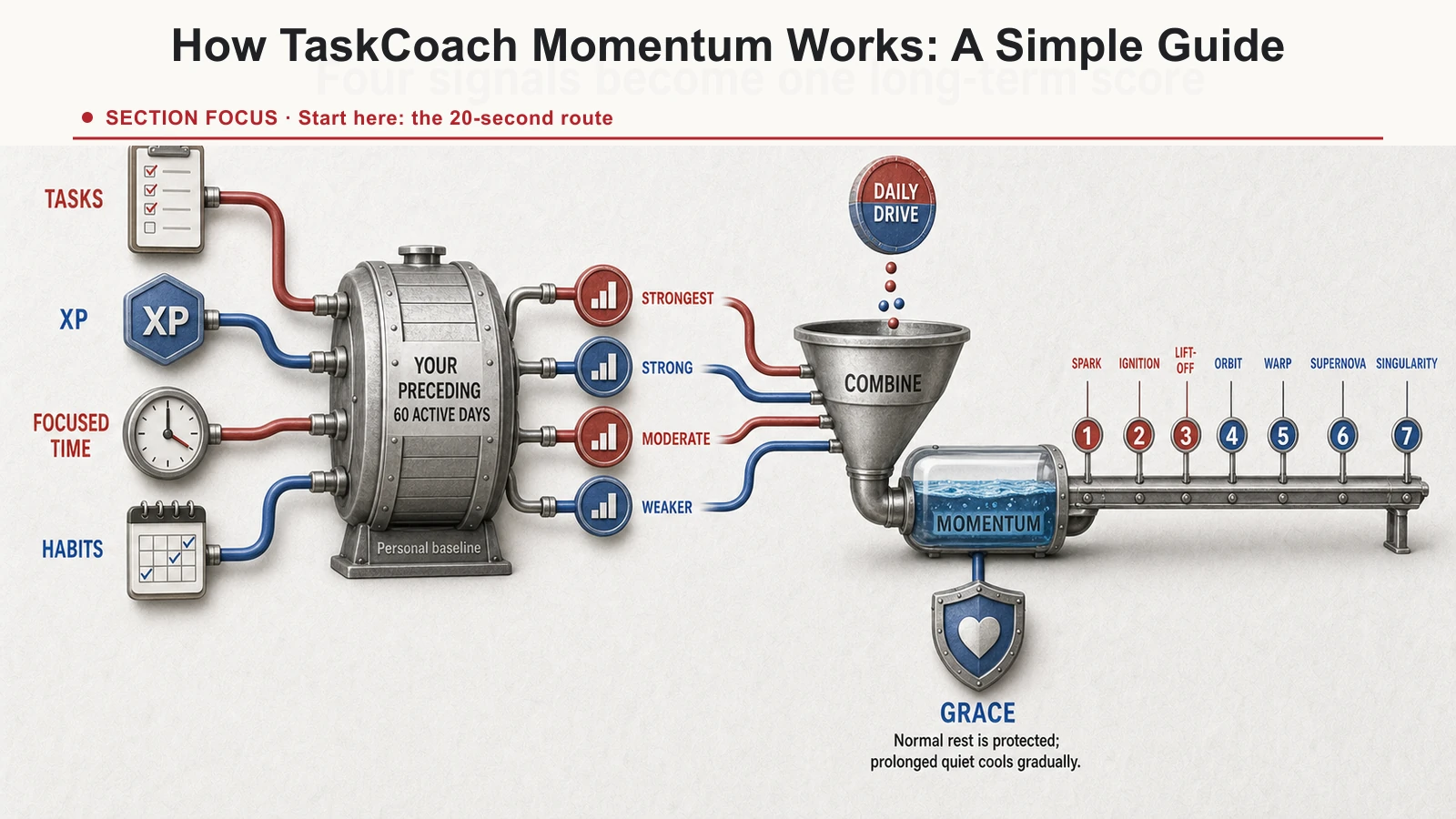
Your Momentum run has five stages:
| Stage | What happens |
|---|---|
| Collect | Tasks, XP, focused minutes, and habits become four daily totals. |
| Compare | Each total is judged against your own preceding 60 active days. |
| Combine | The four results become one Daily Drive deposit. |
| Compound | Daily Drive builds your long-term Momentum balance. |
| Rank up | The same Momentum number maps to Spark, Ignition, Lift-off, Orbit, Warp, Supernova, or Singularity. |
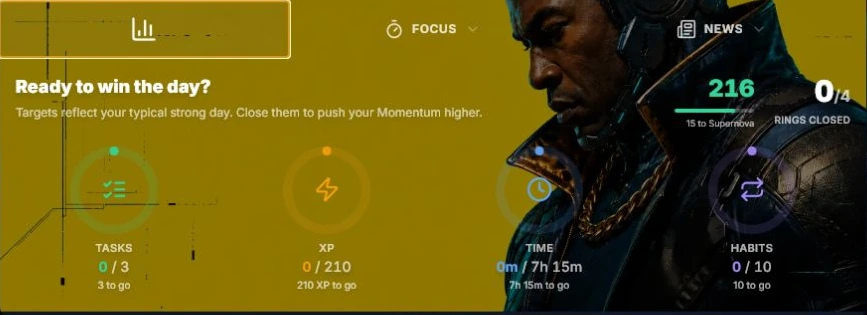
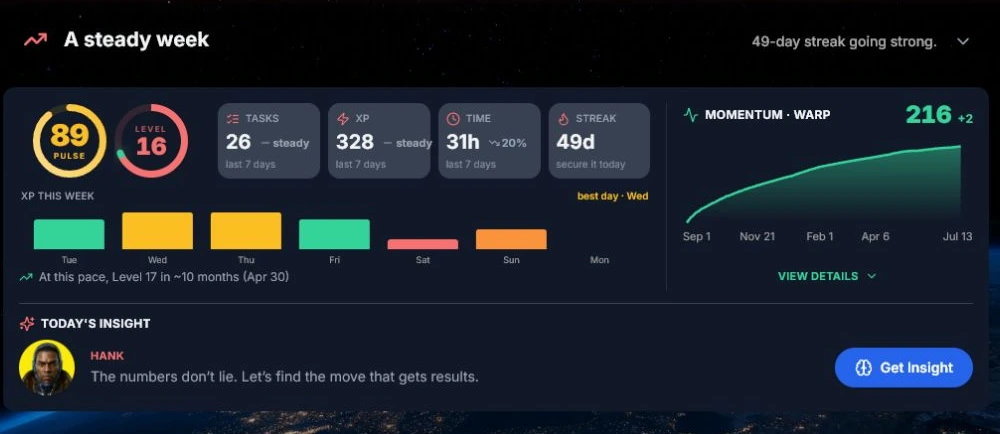
Today's Progress and Week in Review show the same final score. Momentum 216 in the daily header is Momentum 216 on the weekly chart. The weekly +2 means the displayed score is two points higher than it was seven calendar days ago.
Save point: Four signals become Daily Drive. Daily Drive builds Momentum. Momentum decides your rank. You only manage the four signals.
Ready for the full run? Level one starts with what you actually did today.
Level 1: collect your four signals
The engine groups completed activity by calendar day. Every valid completion can feed one or more totals:
| Signal | What counts |
|---|---|
| Tasks | Completed goal, calendar, and space tasks. Habit completions stay in Habits. |
| XP | Positive XP attached to completed activity. |
| Time | Credited minutes attached to completed activity. |
| Habits | Completed habits. |
Open work creates no negative event. An open ring simply means that signal has not reached today's target.
A quiet day adds little or no Daily Drive. It does not trigger an instant point loss.
Checkpoint reached: Progress starts with completed activity. There are no failure points hiding behind unfinished tasks.
Level 2: meet your real opponent
Raw totals make a poor leaderboard. Three tasks might fill your day while someone else clears twelve tiny tasks before lunch.
Your useful opponent is your own recent pace.
An active day has at least one completed task, some XP, credited time, or a habit completion. TaskCoach looks at your preceding 60 active days. Calendar rest days stay out of the baseline, so taking Sunday off does not make Monday look artificially heroic.
For each signal, TaskCoach finds your usual result and the normal amount your days move above or below it.
Imagine that you normally complete three to five tasks on an active day. Four is your center. A six-task day is clearly stronger, while a twelve-task day is unusual enough that the system avoids treating it like twelve ordinary days at once.
New accounts start with gentle guide values for tasks, XP, time, and habits. These keep the first few scores steady. Your real activity gradually replaces them, and TaskCoach shows a calibrating state until you have ten active days.
Save point: Your baseline adapts to you. It uses active days, ignores empty rest days, and gradually replaces starter assumptions with your real history.
Level 3: turn each signal into strength
Now every signal gets a fair comparison.
- No activity in a signal adds nothing from that signal.
- A result near your usual pace adds a solid amount.
- A result clearly above your usual pace adds more.
- A huge outlier gets capped, so one extreme day cannot pay for weeks of inactivity.
This smooth comparison matters. Five completed tasks can be a strong result without six tasks suddenly becoming twice as valuable.
Checkpoint reached: Normal effort counts. Stronger effort counts more. Extreme numbers cannot break the system.
Level 4: build one Daily Drive deposit
A real day has a shape. Deep work might push Time to the top. An admin sprint might make Tasks your strongest signal. A reset day might lean on Habits.
TaskCoach sorts the four signals from strongest to weakest. Your strongest result matters most, the next result still matters a lot, and the remaining two add smaller support.
The signal names never own fixed positions. Time can lead today and Tasks can lead tomorrow.
That flexibility rewards different kinds of useful days. It also asks for some balance, since one inflated signal cannot carry the entire day.
Play one sample day
Suppose four tasks, an hour of focus, and two habits make up your normal active day.
Round one: You land close to those numbers. TaskCoach reads that as a solid normal day and adds a useful Daily Drive deposit.
Round two: You complete more tasks, focus longer, and finish an extra habit. Several signals are now above your usual pace, so the deposit is larger and the day can earn a Win the Day celebration.
A smaller day still moves the run forward. The celebration marks a strong day and never acts as an entry gate.
Save point: Your best signals lead the party. Every useful deposit can help, even on a day that does not earn the celebration.
Bonus room: why ring targets feel different
The rings and Daily Drive share your activity history, then use it for different jobs.
Daily Drive asks, “How strong was this whole day?” A ring asks, “What would count as a strong result for this one signal?”
Each ring target sits a little above your usual result from the preceding 60 active days. It represents a realistic strong day.
Targets also use sensible minimums and readable rounding:
| Ring | Minimum | Rounding |
|---|---|---|
| Tasks | 3 | Nearest whole task |
| XP | 50 | Nearest 5 XP |
| Time | 20 minutes | Nearest 5 minutes |
| Habits | 1 | Nearest whole habit |
Ring closure is a celebration marker. The continuous result has already contributed through Daily Drive, so you can build Momentum before any ring closes.
Level 5: earn the grace shield
Momentum remembers consistency. It also gives normal rest enough room to breathe.
The grace system uses a slow signal called Strength. Think of it as a memory of your recent weeks. Active days push it up gradually. Quiet days let it drift down gradually.
Because Strength moves slowly, one blank day barely changes it. TaskCoach also keeps a quicker view of your recent week called Load. Comparing the quick view with the slow view creates Form, which helps describe whether you are speeding up or easing off. Load and Form do not add points to Momentum. Strength only decides when gentle decay is allowed.
Checkpoint reached: One blank day barely moves Strength. Your recent weeks decide when the decay system can wake up.
Level 6: compound Daily Drive into Momentum
Every Daily Drive becomes a deposit in a long-term balance. New accounts begin with a tiny starter balance so the display has a living starting point.
On an active day, your new deposit is added. During a normal rest day, the balance usually stays protected because Strength still remembers the active days around it.
Decay can start only after Strength falls below 30%. It begins very gently and grows slowly during a longer inactive period. Any new Daily Drive deposit is added on the same day, so even a small amount of activity can cover the drop.
Missing a habit does not subtract a fixed number. A sustained quiet stretch lowers Strength first. The decay valve then opens gradually.
Save point: Rest gets a shield. Momentum can fall only after Strength drops below 30% and your new Daily Drive fails to cover the active decay.
Level 7: reveal the displayed score
The hidden balance can grow for years, so TaskCoach turns it into a cleaner displayed number.
Early Momentum points arrive faster, which makes a new routine feel visible. Later points take more accumulated effort, which keeps higher ranks meaningful. The score can keep growing without racing into silly five-digit numbers.
Your path will vary because your days, baseline, and rest periods are your own. The useful comparison is your direction over time.
Rank room: from Spark to Singularity
Your rank is a readable name for the exact same Momentum score. It has no separate points, multiplier, or currency.
| Momentum | Rank |
|---|---|
| 0 to 39 | Spark |
| 40 to 79 | Ignition |
| 80 to 119 | Lift-off |
| 120 to 169 | Orbit |
| 170 to 229 | Warp |
| 230 to 299 | Supernova |
| 300 and higher | Singularity |
At Momentum 226, you are in Warp with four points to Supernova. Both the daily header and weekly card derive that label from 226.
A long quiet period can eventually cool your rank. One rest day can only cross a rank boundary when your score was already on its edge and Strength had already entered the decay zone.
Checkpoint reached: Rank is your chapter title. Momentum is the only score underneath it.
Replay protection: history stays historical
Your baseline changes as you grow. Old days still deserve the rules available when they happened.
TaskCoach evaluates every historical day against the active days preceding it. June 1 uses information available before June 1. June 2 uses information available before June 2. A stronger future baseline cannot rewrite those earlier deposits.
Correcting or adding an old activity can change the replay because the historical facts changed. Future performance alone cannot.
What can actually lower Momentum?
None of these actions directly subtract points:
- Missing one habit
- Leaving one or all rings open
- Completing fewer tasks than yesterday
- Taking a normal rest day
- Breaking a streak
- Carrying an incomplete task into tomorrow
Those days may add less Daily Drive. A drop begins only after Strength falls below 30% and the day's deposit cannot cover decay.
After a prolonged inactive period, decay reaches its gentle cap. The displayed score still falls more slowly than the hidden balance, so returning after time away feels recoverable.
Read your score in five seconds
The main number shows accumulated consistency against your evolving pace. The seven-day change shows direction.
- Momentum 126, +4: your balance grew, adding four displayed points this week.
- Momentum 226, 0: your displayed score held steady across the week.
- Momentum 226, −2: Strength was already below 30%, and recent Drive did not cover all decay.
Ring fractions show today's next moves. Rank gives the score a memorable stage. The chart shows whether your current direction is climbing, level, or cooling.
One last distinction: Habit Automaticity
An individual habit has its own 0 to 100 automaticity score. It tracks effective days toward a 66-day reference and answers one local question: how established is this behavior?
The Momentum in Today's Progress and Week in Review covers tasks, XP, focused time, and habits together. The User Guide calls the local habit value Habit Automaticity to keep the two jobs clear.
Your next move
You never need to calculate any of this during the day.
Choose one useful action. Finish it. Let the rings show today's route and let Momentum remember the longer run.
Four signals. One deposit. One score. Your next rank is built one real day at a time.