Why making friends gets so much harder after 30
Most adults will tell you the same thing: making close friends got dramatically harder somewhere around age 30. The friendships from school, college, and your first job are still there. New ones just don't seem to show up anymore.
It's a structural problem: the way adult life is set up makes forming close friendships nearly impossible, no matter how outgoing you are.
The three conditions that produce friendship
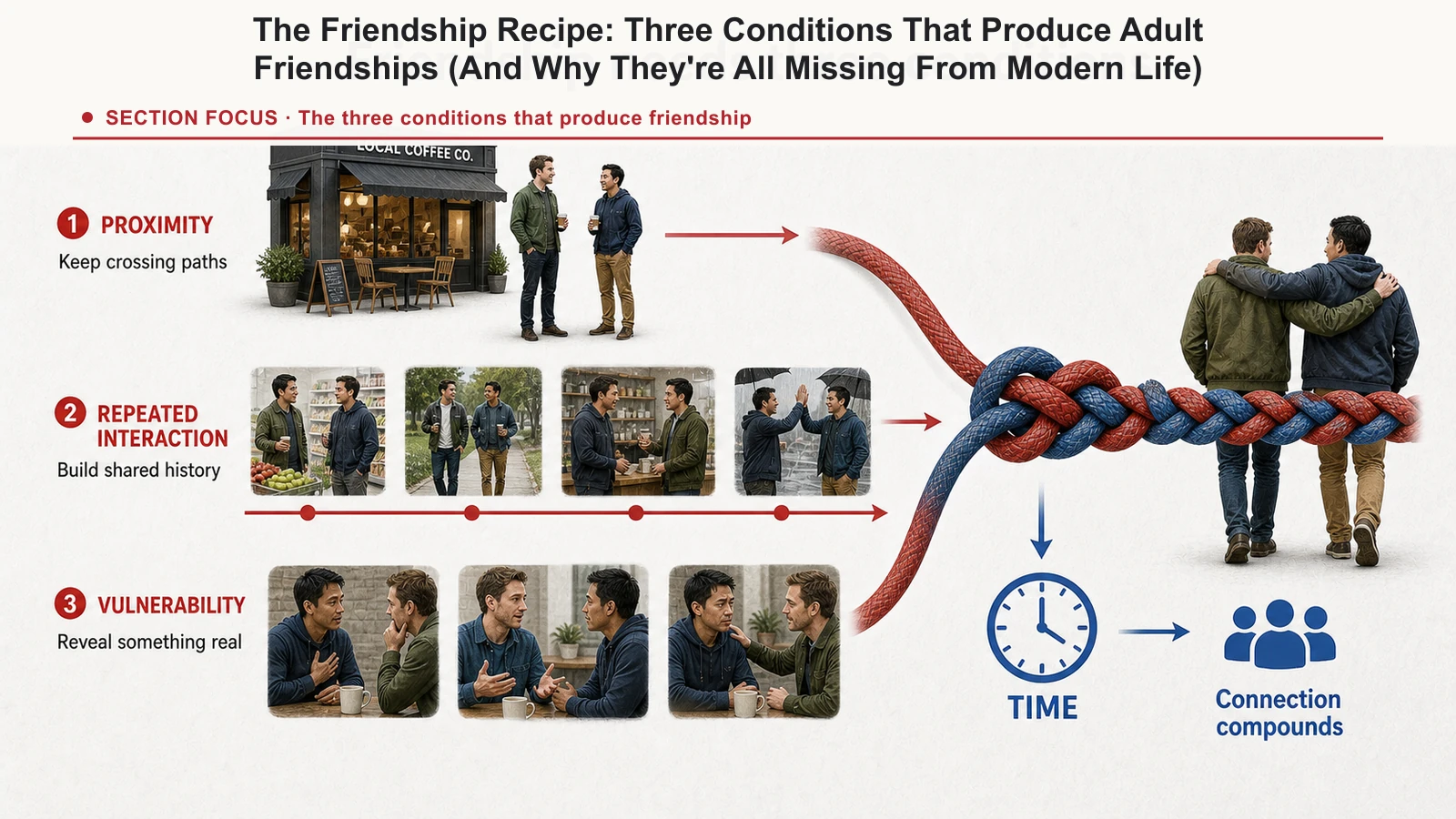
Sociologist Rebecca G. Adams spent years studying how friendships form across a lifetime, and landed on three conditions that, together, reliably produce close friendships.
Physical proximity. You have to actually see the person on a regular basis. Phone calls and video chats can maintain a friendship that already exists, but they rarely create a new one from scratch.
Repeated unplanned interactions. Bumping into each other by accident, sharing a context that produces casual, low-stakes contact. The word doing the work here is "unplanned." Meetings scheduled in advance just don't build the same thing.
Settings that invite vulnerability. Contexts where sharing something personal feels natural rather than awkward. Late-night dorm conversations. Downtime during military service. Drinks after work.
Line up all three and friendships form almost on their own. Lose even one, and it stays hard no matter how much you want it to happen.
Why it was easier before 30
School, college, military service, and your first real job all hit these three conditions at once, without anyone trying:
- School: you're in the same building five-plus hours a day (proximity), sharing classes and hallways (unplanned interaction), bonded by shared struggle and teenage intensity (vulnerability-inviting).
- College dorms: you're in the same building around the clock (proximity), sharing common spaces (unplanned interaction), staying up late fueled by uncertainty about the future (vulnerability-inviting).
- Military boot camp: you're in the same unit (proximity), in constant unplanned contact, under extreme shared stress (vulnerability-inviting).
- Entry-level jobs: you're in the same office daily (proximity), running into people at the water cooler (unplanned interaction), bonding over shared frustration with management (vulnerability-inviting).
That's why the friendships from those years tend to run deepest. The conditions lined up without anyone engineering them.
Why it's harder now
Ordinary adult life, as most people live it, doesn't meet any of the three conditions on its own.
- Proximity disappears when people live spread out, drive everywhere, and treat socializing as a scheduled event rather than a byproduct of daily life.
- Unplanned interaction vanishes the moment you stop sharing a daily space with anyone. Adult contact is almost entirely calendared.
- Vulnerability-inviting settings are rare. Most adult interactions stay polite, transactional, or performed for an audience.
Remote work has only made this worse by stripping out even more of the proximity that used to happen by default. Add it up and you get adults with plenty of "friends" by Facebook's count, but noticeably fewer close ones, a gap that seems to widen steadily through middle age.
The 200-hour number
Communication researcher Jeffrey Hall set out to measure something that sounds unmeasurable: how long it actually takes to move from stranger to close friend as an adult. His numbers:
- Acquaintance to casual friend: about 50 hours of time together.
- Casual friend to friend: another 90 hours.
- Friend to close friend: 200 or more hours on top of that.
That's 200-plus hours after you're already calling each other friends. See someone once a week for two hours, and you're looking at roughly two years before you reach close-friend territory.
That's exactly why adult friendships feel slow to build. The math isn't exaggerating. Two years of regular contact, with some real vulnerability mixed in, is what it actually takes to get close. Less than that, and you end up with pleasant acquaintances instead.
How to recreate the conditions on purpose
Here's the structural fix, broken into four moves.
1. Build proximity through a regular shared activity. A weekly run group. A book club that actually meets every month. A poker night that's protected on the calendar no matter what. The activity itself becomes your proximity engine.
2. Engineer unplanned interaction. Live somewhere walkable, where you run into the same people. Work from a co-working space instead of alone at home. Show up at the same gym at the same time every week. That repeated, low-stakes contact is what builds the foundation.
3. Choose settings that invite vulnerability. Most adult socializing happens in contexts that suppress it: work events, networking mixers, polite dinners with acquaintances. Look instead for long walks, a shared struggle like training for something together, or small dinners with people you've known a while.
4. Keep showing up for 6 to 24 months without expecting anything. Most casual acquaintances will stay casual, and that's fine. The few that turn into real friendships need patience more than anything else. Don't try to speed it up. Just keep showing up.
What doesn't work
Forced one-on-one meetings. "Let's grab coffee" with someone you barely know rarely produces a friendship. It's too formal, too much like a transaction.
Online-only relationships. Twitter friends, podcast friends, and Discord friends are real connections, but they rarely turn into close friendships without some in-person component.
Networking events. These settings actively suppress vulnerability by design, so friendships rarely form there no matter how many people you meet.
Waiting for it to happen. Adult friendships basically never form by accident anymore. The conditions have to be built on purpose.
What TaskCoach.AI does with this
The Social pillar can hold this as a tracked commitment: weekly group attendance, hosting something monthly, a quarterly check-in on how your friendships are actually doing. The calendar holds the time slots so they don't quietly slip away. Getting to close-friend territory as an adult takes a real structural commitment for most people, and the system is built to make that commitment visible instead of easy to forget.
The bottom line
Adult friendship needs three things: proximity, unplanned interaction, and settings that invite vulnerability.
Modern adult life hands you none of them by default.
The fix is structural: recreate the conditions through a regular shared activity, in a setting that allows a little self-disclosure, and keep it up for 6 to 24 months.
Close friendships take around 200 hours of shared time to form as an adult. Plan around that number. Keep showing up. The friendships compound once they exist, but they have to form first.