Flow is engineering
Mihaly Csikszentmihalyi, pronounced roughly "chick-sent-me-high," spent thirty years at the University of Chicago studying the state that athletes, surgeons, programmers, and musicians all describe the same way: being "in the zone." He called it flow, and unlike a lot of psychology from that era, he treated it less like a vague mood and more like an engineering spec you could actually build toward.
A 2022 review that pooled 22 separate neuroimaging studies confirmed the neural signature behind it. Flow engages your executive-attention network while quieting down your default-mode network, the same network that lights up during mind-wandering, rumination, and generally stewing over yourself. That combination, focus climbing while self-referencing drops, is exactly why flow feels effortless even when the work itself is genuinely hard.
The three engineering conditions
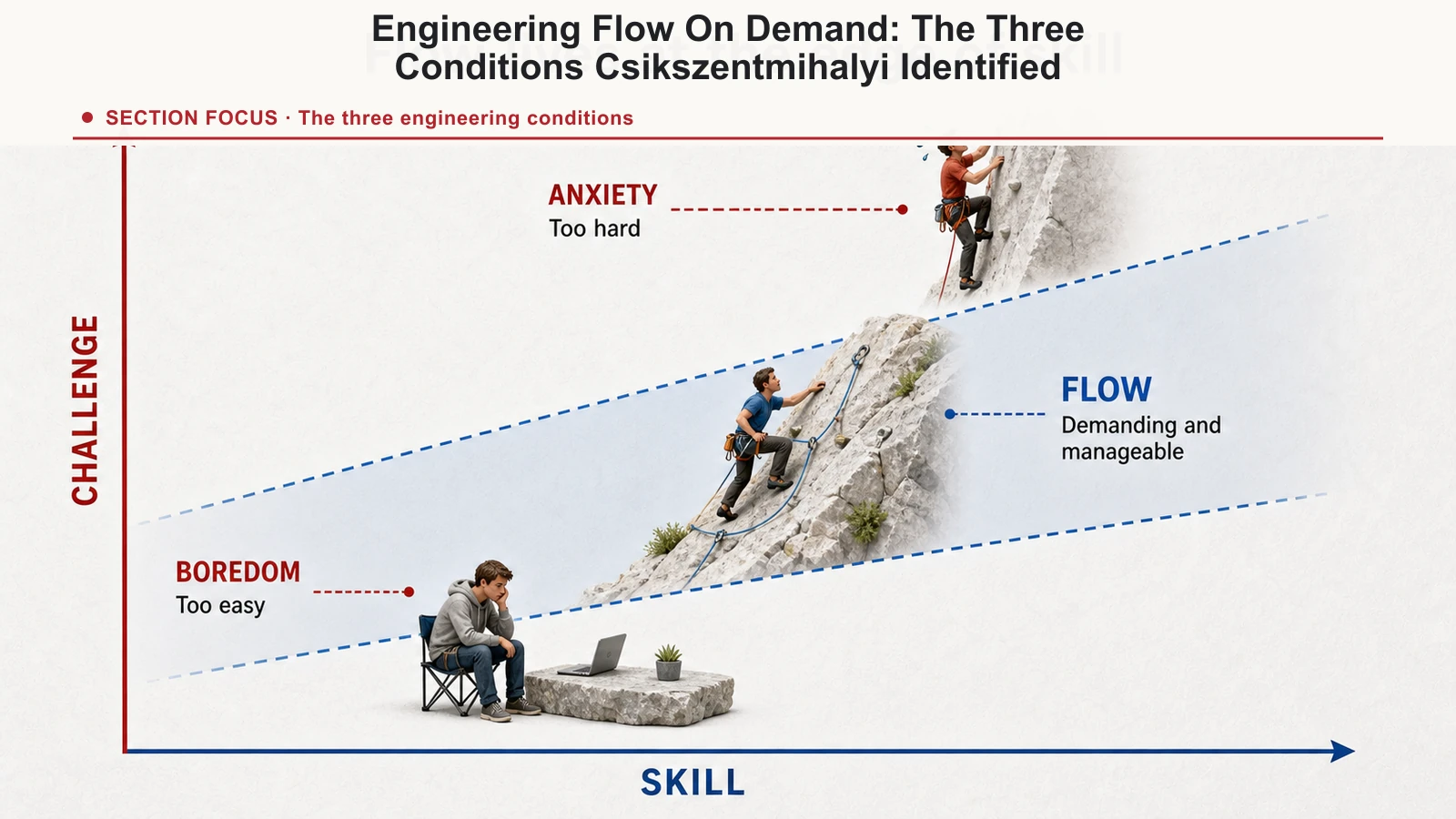
Flow shows up reliably when three specific conditions are met at the same time. Miss any one of them and you get boredom, anxiety, or scattered attention instead.
A clear, immediate goal. Not "improve the product." Not even "redesign the onboarding." Something more like "rewrite the first three onboarding screens by 11 AM," specific enough that you can tell, in the middle of working, whether your next move actually serves it.
This is the condition most people violate constantly in knowledge work. Most hours of most workdays run against goals so abstract they can't even trigger the executive-attention circuit in the first place. With no clear target, your brain defaults to whatever grabs its attention instead, usually email, Slack, or whatever task feels most urgent-but-anxious.
Immediate feedback. You need to see the result of your next action within seconds, not minutes. Coders get this from a running test suite. Surgeons get it from how tissue responds in real time. Writers can build it artificially through word counts, reading back what they just wrote sentence by sentence, or working in short "next paragraph" beats.
The thing that kills flow is feedback that takes longer than about ten seconds to show up. Writing a ten-page document with no internal checkpoints isn't a flow activity. Writing that same document broken into fifteen paragraph-sized beats, each with a clear "this paragraph nails X" target, is.
Challenge calibrated roughly 4-15% above your current skill. This is the same territory Vygotsky was pointing at, and Csikszentmihalyi landed in a similar spot independently. Too easy, and your mind wanders off to something more interesting. Too hard, and you tip into anxiety, which suppresses the executive-attention network and hands control back to the default-mode network. The sweet spot feels "just barely doable": uncomfortable, but not panic-inducing.
What this means for the daily work block
Here's how to actually put the three conditions to work in a normal day.
Before the block starts (5 minutes). Write down one clear goal: "Complete the database migration script for the user_settings table," not "work on migrations." Name your feedback loop: "I'll know it worked when the tests pass." Then estimate how long it should realistically take if you're genuinely focused; if that estimate runs past 90 minutes, the goal is too big and needs to be split.
During the block (25-90 minutes). One goal. One screen. One feedback signal visible the whole time. No tab-switching, no email, no Slack. Every one of those breaks the executive-attention network, and rebuilding it afterward costs real time; research out of UC Irvine put the average switching cost at around 22 minutes per interruption.
After the block (5 minutes). Did you hit the goal? What did the feedback actually tell you? Was the difficulty about right, or too easy, or too hard? Use the answer to tune the next block before you start it.
That's a closed loop, unglamorous but the most reliable way to manufacture flow on purpose, on your bad days as much as your good ones.
The anti-flow state: scattered anxiety

Flow's opposite is scattered anxiety, sometimes called defensive distraction.
Here's the pattern: a hard, vague task is sitting on your plate. The goal isn't clear. There's no feedback in sight. Unable to productively engage the executive-attention network, your brain reaches for the nearest source of immediate feedback instead, usually email, Twitter, or Slack. Each of those hands you a quick, clear response. Your brain prefers them not because they're actually valuable, but because they're flow-compatible in a way the real task currently isn't.
The fix here is making the hard task itself flow-compatible: clarify the goal, build in a feedback loop, and calibrate the challenge to something you can actually engage with.
What TaskCoach.AI does with this
Focus mode is built directly around Csikszentmihalyi's three conditions.
Clear goal: one task on screen, no other tabs, named explicitly before the session starts.
Immediate feedback: the elapsed-time bar, plus the simple done-or-not-done choice at the end.
Calibrated challenge: the system tracks how long each type of task actually takes you, so the AI coach can suggest task sizes that honestly fit a 25 or 50 minute block instead of guessing.
The Mood Vitals and Player Stats integration adds a fourth piece that Csikszentmihalyi never formally named, but that current neuroscience points toward: state matching. Flow comes more easily from a high-mood, high-energy state than from a low-mood, low-energy one. The mood-and-energy check-in lets the system suggest flow-compatible work that actually fits the state you're in right now, instead of the state you wish you were in.
The bottom line
Flow is a cognitive state built from three specific conditions you can engineer on purpose, on command, on your worst days as much as your best ones.
If you can't get into flow on a given task, the diagnosis is almost always one of those three conditions failing. Figure out which one, fix it, and try again.
The state is reproducible the moment you stop treating it as magic and start treating it as something you can actually build.