Identity is five layered things
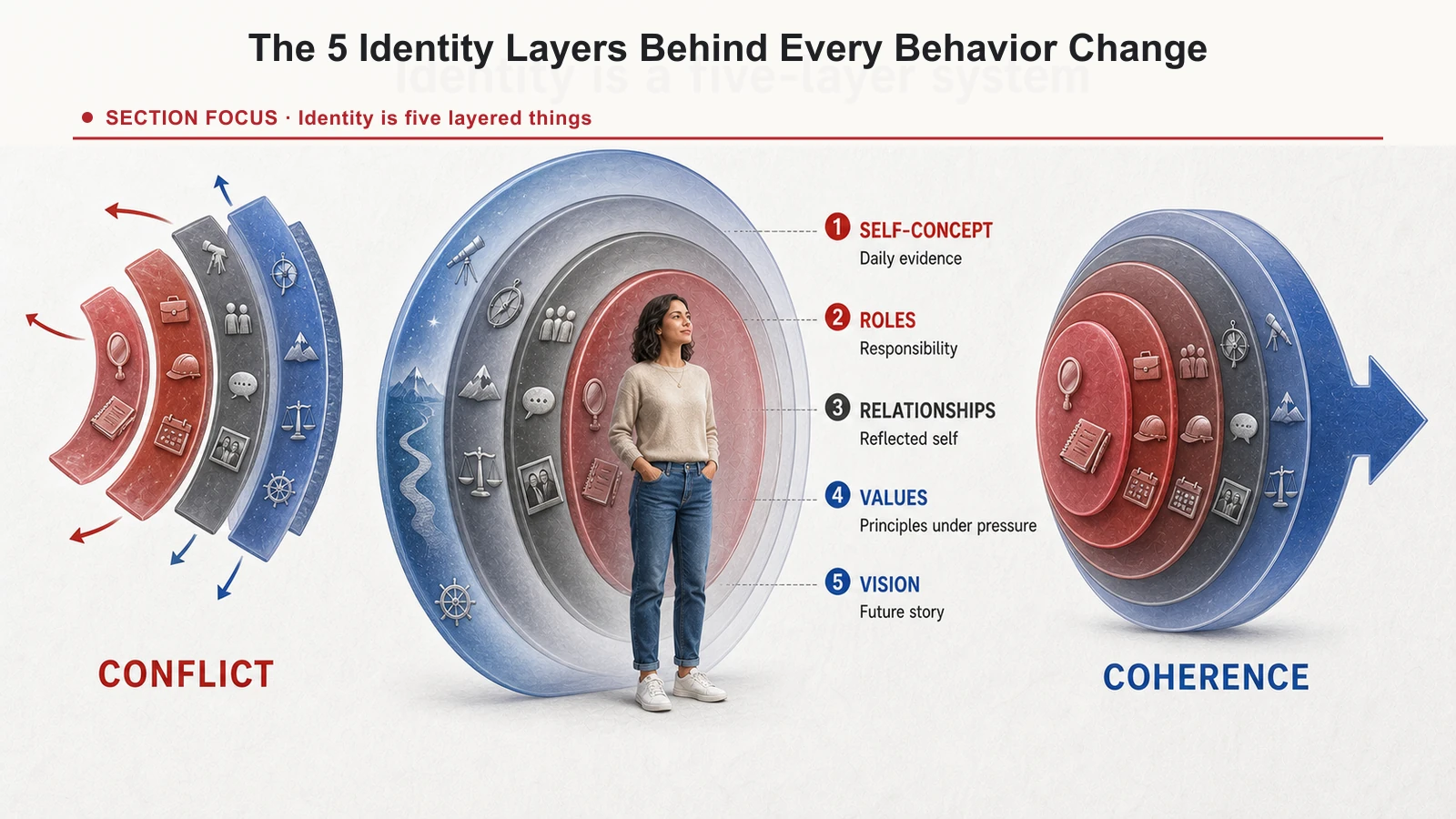
In our piece on identity-based habits, we covered why changing how you see yourself produces more lasting behavior change than chasing an outcome ever does. James Clear's framework was a good starting point, but it's fairly thin on what "identity" is actually made of.
Identity is a layered structure, and different layers respond to completely different kinds of work. The framework below draws on self-concept research from Hazel Markus at Stanford and Marilynn Brewer at Ohio State, plus the narrative identity work of Dan McAdams at Northwestern.
Once you see the layers separately, identity-level change stops being a vague idea and turns into something you can actually work on.
Layer 1: self-concept
This is the surface layer: the running description you carry of who you are. "I'm a writer." "I'm someone who runs." "I'm organized."
It's also the layer James Clear's Atomic Habits mostly operates on. Every habit that lines up with your self-concept reinforces it. Every habit that contradicts it quietly wears it down.
What strengthens it: daily behavior that backs up the claim. Research on habit formation (the "roughly 60 days" finding from Lally and colleagues) applies directly here. The identity solidifies the more consistently you act it out.
What weakens it: repeated behavior that contradicts the claim. "I'm someone who reads" gets a little less true every evening you reach for your phone instead of a book.
Layer 2: social roles
The positions you occupy in relation to other people: parent, manager, sibling, coach, friend. Each role comes with its own expectations, its own internalized standards, and its own weight in how you see yourself.
Most adults are juggling somewhere between five and seven active roles at any given time. Those roles compete with each other for your hours (the manager role and the parent role both want the same evening), and together they shape your decisions in ways your conscious self-concept usually doesn't notice.
What strengthens it: actually doing the role well. The parent who shows up for school events. The manager who follows through on commitments to their team. Performing the role well is what makes the role identity feel real.
What weakens it: role conflict that never gets resolved. Someone stuck between a demanding job and a demanding home life, unable to show up fully for either, slowly loses coherence in both roles at once.
Layer 3: close relations
Part of your identity only exists in relation to other people. Your five closest relationships, a topic we cover in our piece on the three tribes, each hold a version of you that doesn't exist anywhere else. The version of you that shows up with your spouse is genuinely a little different from the version that shows up with your closest friend.
That's just how identity works socially. Lose a close relationship, through distance, conflict, or loss, and you lose the specific version of yourself that only existed inside that relationship.
What strengthens it: actual investment in your closest relationships: time, presence, willingness to be vulnerable. This is where the well-known findings from the long-running Harvard adult development research apply most directly.
What weakens it: drift, lost contact, betrayal. Major life transitions like divorce or bereavement hit identity hard precisely because they remove whole layers of relational identity at once.
Layer 4: values
The principles you treat as non-negotiable. Honesty. Loyalty. Excellence. Service. Freedom. Family. Held seriously, any one of these can shape your behavior for decades.
Values run deeper than roles or self-concept. The same value shows up across many roles at once (an "excellence" value shapes how you parent, how you manage, how you create). Values also don't shift easily, and when they do, it's usually only after something significant happens in your life.
What strengthens it: holding the line under real pressure. A value that survives being tested is a value that's actually real. A value that collapses under pressure was probably self-deception in the first place.
What weakens it: small compromises that seem harmless individually but pile up. Each one quietly reduces how much authority that value has over your future choices.
Layer 5: vision
The story you tell about where your life is heading. The aspirational version of you, five, ten, twenty years out.
Dan McAdams' narrative identity research at Northwestern found that adults who can tell a coherent story connecting their past, present, and future report more meaning and higher wellbeing than adults who can't. The vision layer is simply the future-facing half of that story.
What strengthens it: periodic refinement. Vision boards, annual reviews, multi-year planning. Your vision isn't fixed in stone; it should keep getting sharper as you learn more about who you're actually becoming.
What weakens it: having no vision at all. Drift. The popular "let the universe surprise you" mindset sounds relaxed, but it tends to leave identity weaker over time. Your brain wants a future to aim at.
How the layers interact
These five layers don't operate in isolation. They either reinforce each other or quietly undermine each other.
A clear vision sharpens your values, because once the destination is obvious, the principles required to get there become obvious too.
Values you actually hold shape how you show up in each role: how you parent, how you manage, how you create.
Doing your roles well feeds your self-concept. "I'm a good parent" needs actual evidence of being a good parent behind it.
And your self-concept needs to roughly match what your close relations experience, or the mismatch itself becomes a source of instability.
Line all five up, and identity feels coherent and holds steady under pressure. Let them conflict, and identity fragments, and behavior starts looking erratic even to you.
Diagnose a conflict between layers
Identity problems often arrive as a scheduling problem. You keep missing a personal goal, overreact to feedback, or feel guilty in two places at once. The conflict becomes clearer when you name which layers are competing.
Take one recurring tension and write one sentence from each relevant layer:
- Self-concept: "I am dependable."
- Role: "A good manager stays available to the team."
- Relationship: "My partner needs me to be present after work."
- Value: "I value care and competence."
- Vision: "I want a life with deep work and an intact home life."
Now circle the sentences that demand the same hour. The problem is visible: dependability has been defined as constant access, while presence at home also requires protected attention.
Resolve the collision with a behavioral definition. "Dependable manager" might mean clear office hours, fast response to true emergencies, and a handoff note before logging off. That definition preserves the identity while changing the behavior that expresses it.
Use three tests for the new definition:
- Specificity: could another person tell whether you did it?
- Reciprocity: would you expect the same behavior from somebody in your position?
- Sustainability: could you repeat it for a year without quietly resenting everyone involved?
If a definition fails, revise it. Identities should guide choices, not issue unlimited invoices against your time.
Keep the final behavioral definition near the decision point. A sentence in your weekly plan is more useful than a value hidden in a journal. Review it after two weeks using actual outcomes: what improved, what broke, and which layer still has no voice.
The strengthening protocol
A 30-day way to work through each layer in turn:
Days 1-6: self-concept audit
List the five self-concept claims that matter most to you. For each one, list the daily behaviors that would actually back it up. Find the one or two behaviors most contradicted by your current habits, and start running those daily.
Days 7-13: role audit
List your five to seven active social roles. For each, name one role-aligned action you've been neglecting. Schedule it.
Days 14-20: relations investment
Run the connection audit (covered in our piece on the connection audit) against your five closest relationships. Find the one that's most underinvested, and schedule real re-engagement with that person.
Days 21-26: values articulation
Write your top five values, one word each. For each, note a recent moment where you either upheld it or compromised on it. Decide what you'll do differently going forward.
Days 27-30: vision refinement
Spend two to three hours writing out the ten-year version of who you intend to be. Get specific. Then write the one-year version. Then the 90-day version that actually starts moving you there.
Running all five exercises in sequence is what integrates the layers instead of leaving them separate.
Track identity change across life areas
TaskCoach.AI is built around seven pillars (Mind, Body, Career, Wealth, Social, Home, Leisure), and they map loosely onto these identity layers: Career onto roles, Social onto relations, Mind onto values. The pillar identity ranks, from Initiate through Apex, explicitly encode self-concept progression as you level up. The vision board feature covers the vision layer directly.
The system treats identity work as part of goal achievement instead of something separate from it.
Strengthen the layer carrying too much
Identity is five layers. Each layer responds to a different kind of work. Line them up and they reinforce each other; let them conflict and they fragment.
Self-concept. Roles. Relations. Values. Vision.
Strengthen each one deliberately, and watch your behavior follow along. Identity does the work that motivation alone never quite manages.