Naming is the whole skill
What predicts your mental health isn't how you feel. It's whether you can tell your feelings apart. That's the finding Lisa Feldman Barrett keeps landing on, after twenty years running the Interdisciplinary Affective Science Lab at Northeastern University.
Not whether you "have" emotions. Not whether you're good at expressing them. Whether you can look at a rough moment and say, specifically, what's happening in it.
She calls this skill emotional granularity, and the evidence is hard to argue with. People who can tell "frustrated" apart from "tired," "restless," and "disappointed" make better decisions, bounce back from bad days faster, drink less, need fewer psychiatric medications, and report higher life satisfaction than people who lump everything into one big "bad."
The fix is mostly vocabulary, plus a daily habit.
The measurement
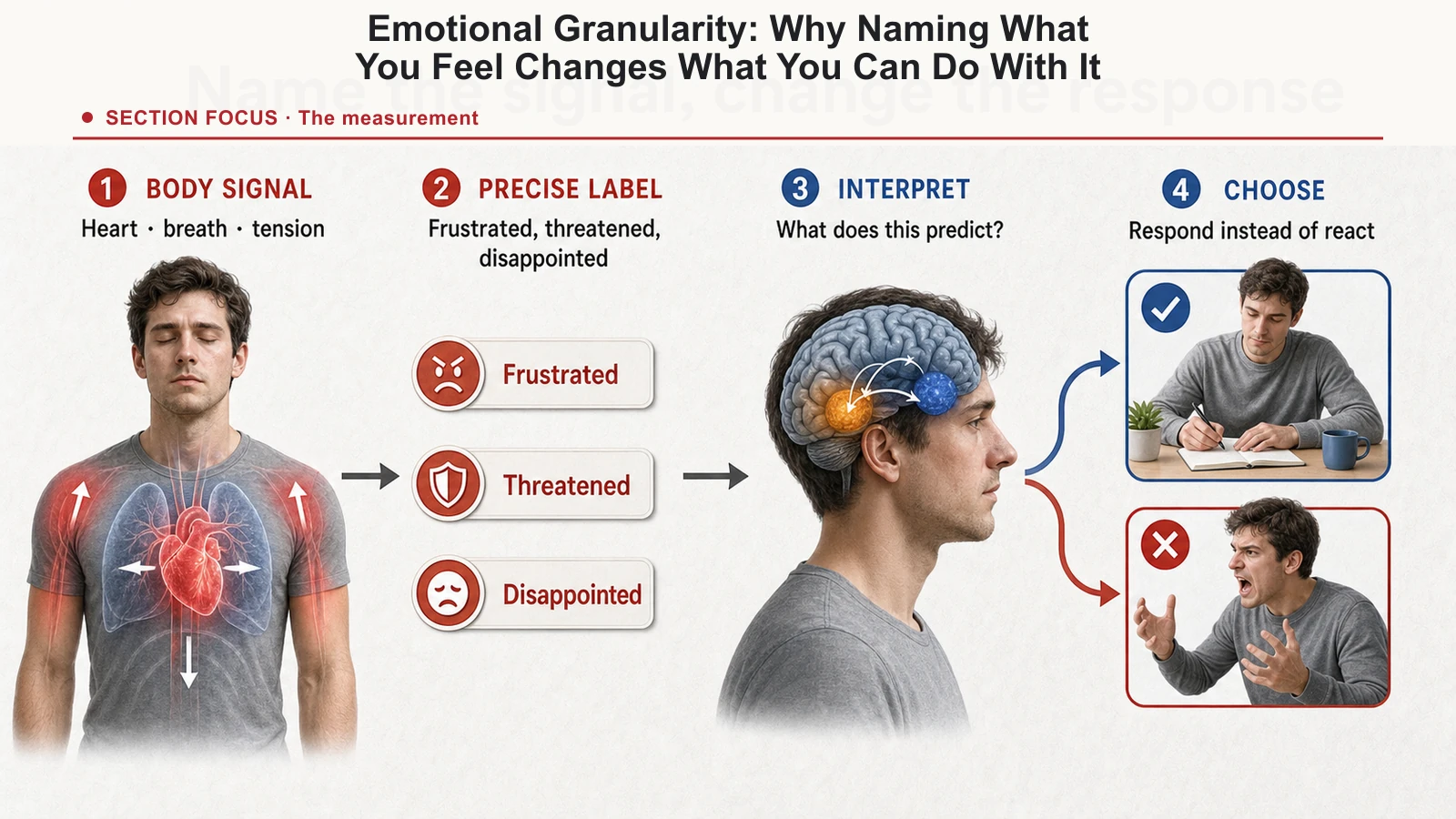
Researchers measure granularity in a fairly simple way. A standard task has people log their emotions every day for 28 days, rating the intensity of several feelings (sad, angry, frustrated, and so on) on a 0 to 4 scale.
People with low granularity rate everything about the same within a bad day. If it's rough, they'll mark sad, angry, frustrated, and disappointed all at a 3 or higher. The whole experience reads as one undifferentiated blob.
People with high granularity split it apart. On the same bad day, they might rate frustrated a 4, disappointed a 2, sad a 1, and angry a 0. Same rough day, four distinct signals instead of one blur.
That single measurement predicts a long list of things that happen next.
The downstream effects
A 2015 review pulled together what the research says happens once you can name feelings this specifically:
- Mental health. Higher granularity tracks with lower depression, anxiety, and borderline personality symptoms, in both clinical samples and the general population.
- Regulation. People with high granularity reach for a wider, more effective set of coping strategies. People with low granularity lean harder on alcohol, food, and avoidance.
- Medication burden. In one long-running study, people with low granularity were more likely to still be on psychiatric medication five years later than closely matched peers with high granularity.
- Recovery speed. After something bad happens, high-granularity people return to their normal mood faster. The bad day stays a bad day instead of turning into a bad week.
Simply putting a label on a feeling doesn't fully explain why this works. The real mechanism is more interesting than that.
The real mechanism: prediction, not labeling
Barrett's wider theory, the theory of constructed emotion, says emotions aren't fixed reactions your brain switches on. They're predictions your brain builds in real time about what's happening in your body and what to do about it. She lays out the full case in her book How Emotions Are Made.
Under that model, granularity matters for three reasons:
- Sharper emotion concepts make sharper predictions. "I'm frustrated" points toward one set of actions. "I'm tired" points toward a different set. "I feel bad" points toward nothing in particular.
- Sharper predictions make regulation more targeted. Frustration calls for stepping away and starting with something easier. Tiredness calls for food, water, or a nap. Anxiety calls for cutting uncertainty by gathering more information.
- Granularity is capped by vocabulary. You can't tell apart what you don't have words for.
That third point is why expanding your vocabulary is the highest-leverage move here. Your brain's prediction system can only work with the concepts it has on hand. Give it more concepts and its predictions get sharper.
The vocabulary gap
Most adults keep 3 to 5 negative-emotion words in active rotation: angry, sad, anxious, frustrated, tired. That's the whole kit.
People who've trained this skill, therapists, contemplatives, certain close-knit communities, work with 15 to 30 active labels instead:
- Anger family: irritated, frustrated, resentful, indignant, contemptuous, enraged
- Sadness family: disappointed, melancholy, grief, despondent, wistful, regretful
- Fear family: anxious, apprehensive, dread, panic, unease, worried
- Tiredness family: depleted, drained, dull, foggy, sluggish, weary
- Restlessness family: agitated, antsy, fidgety, impatient, on edge
Each of those words points to a different fix. "Resentful" needs a conversation. "Drained" needs rest. "On edge" needs movement and less stimulation. Flatten all of it into "bad mood" and you lose the signal that would have told you what to do next.
The practice
The training itself is simple, and people tend to see measurable change within 6 to 8 weeks of practicing daily.
Name it daily. Once a day, name your current state with one specific word. Not "fine," not "OK," an actual word. If the first one that comes to mind is too vague, make yourself pick a more specific one from a longer list.
Grow your list. Keep a running list of emotion words. When a character in a book feels something you can't quite name, add the word to your list. Most people land somewhere around 30 to 50 words that actually get used.
Split close states apart. Twice a week, pick two similar-sounding states from your list and write down the real difference between them. What separates "frustrated" from "resentful," for you specifically? That's what builds the fine-grained distinctions your brain needs.
Notice where it shows up in your body. Every state has a physical signature. Frustrated often shows up as jaw tension. Anxious as a tight chest. Tired as pressure behind the eyes. Linking the word to the sensation speeds up how fast you recognize it next time.
What TaskCoach.AI does with this
The mood check-in is built around this exact mechanism. It doesn't ask "are you OK?" It asks for a specific label and an intensity, and over time it tracks which words you reach for and which ones you never use.
The journal flow works the same way: it asks "what specifically frustrated you about this?" instead of "how do you feel?" The Mood Vitals section in Analytics then charts how your emotional vocabulary grows over time. People who stick with this tend to add 10 to 15 words to their working vocabulary over six months, and the mood-stability gains that come with it show up on the same chart.
The bottom line
You can't regulate what you can't name.
Vocabulary is the lever. Naming it daily is the practice. The effect sizes are real, and the whole thing costs nothing.
That's rare in psychology: an intervention with genuinely zero cost and a genuinely large payoff. Most people skip it anyway, because "just name the feeling more precisely" sounds too simple to actually matter.
The research says otherwise.