The universal first step
Dave Ramsey's baby steps. Suze Orman's pyramid. The FIRE community. Mr. Money Mustache. These personal finance camps disagree about almost everything else, but they all start at the exact same place.
Build an emergency fund before you do anything else.
That feels like a waste of money. Cash sitting in a savings account earning 4-5% while the stock market averages 10% looks like money left on the table. It isn't a waste. It's the move that keeps every other move from blowing up in your face.
Why the math works
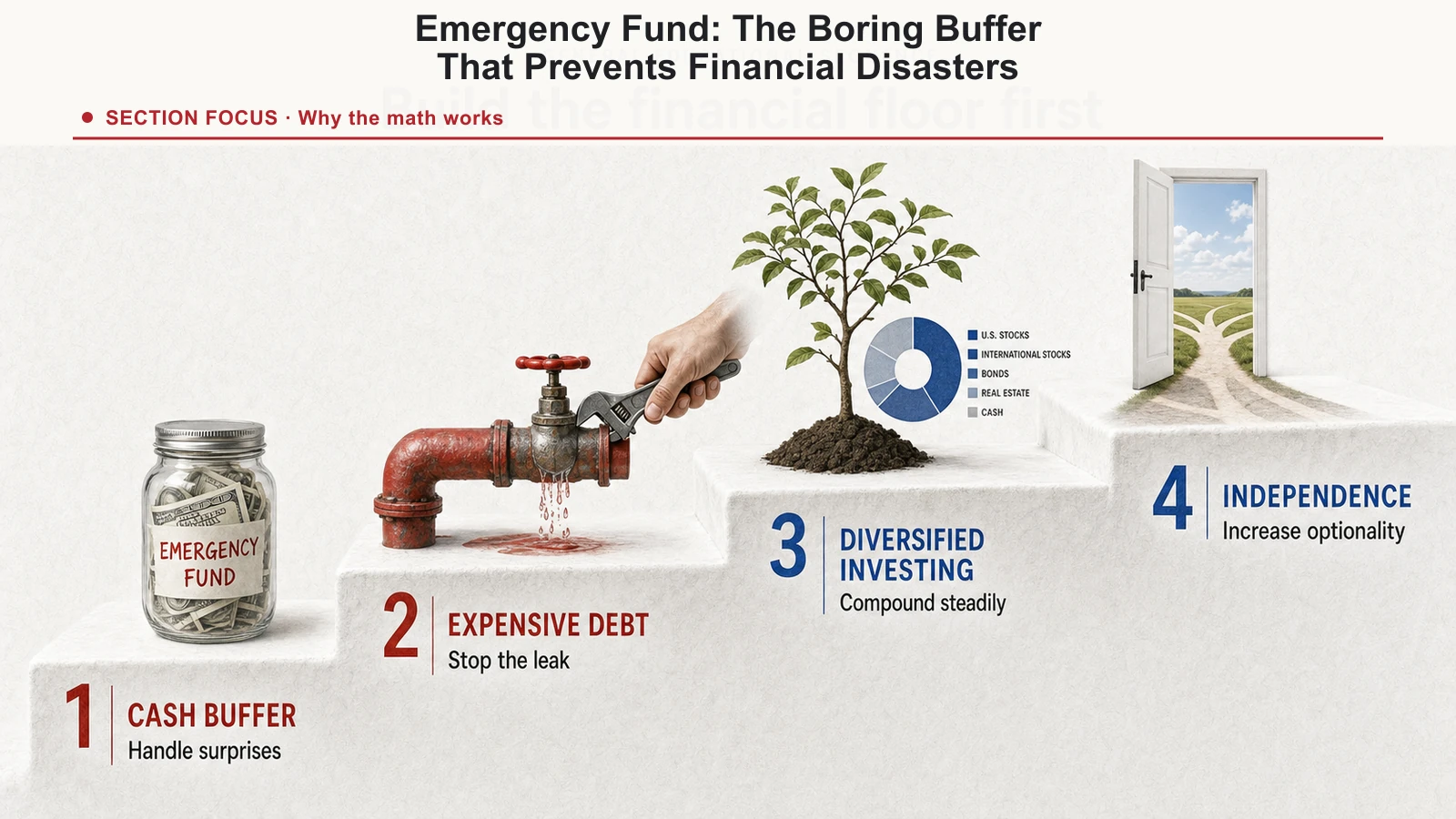
Picture the same $2,000 car repair happening two different ways.
Without a fund: no cash on hand, so the repair goes on a credit card at 22% APR. You make minimum payments for 18 months. Final cost: $2,400.
With a fund: you pay from savings, then spend the next 4 to 6 months topping the fund back up. Final cost: $2,000.
That's $400 saved on a single repair. Stretch it over a decade, with the 3 or 4 similar events (a car, a medical bill, a layoff) that statistically show up in most people's lives, and you're looking at $1,500 to $2,500 in savings. That's before you count the stress of not carrying debt payments on top of your regular budget.
The part that actually matters: credit card debt at 22% compounds against you faster than almost any investment compounds for you. Carrying credit card debt while you invest is investing at a guaranteed loss, and an emergency fund is what keeps you out of that trap.
How big
The standard target is 3 to 6 months of essential expenses, not your total spending:
- Rent or mortgage
- Utilities
- Food (groceries, not takeout)
- Insurance premiums
- Minimum debt payments
- Transportation (gas, basic car costs)
- Phone and internet
Say your household spends $4,000 a month on essentials. Your target range is $12,000 to $24,000.
Leave the lifestyle spending out of this math entirely. The goal isn't "keep living exactly as I do now if I get laid off." It's "keep a roof over my head and food on the table while I find the next paycheck."
3 months: dual income, stable industry, work that's easy to replace. 6 months: single income, volatile industry, dependents in the mix, a tougher job market. 12 months: self-employed, highly specialized, slow to replace.
Where to keep it
Three criteria matter:
- Liquid: you can withdraw it within a few business days.
- Stable: it doesn't move with the market.
- Some yield: at least enough to beat inflation.
Right answer: a high-yield savings account. Rates in 2024-2025 run 4-5% APY, and Wealthfront, Ally, Marcus, Discover, and Capital One all offer competitive options.
Wrong answers:
- A stock index fund (volatile: it could be down 30% on the exact day you need the cash)
- CDs longer than 6 months (your money is locked up, which defeats the whole point of liquidity)
- A checking account (interest rate is basically zero)
- Crypto (too volatile for money you might need next month)
A high-yield savings account is for safety and liquidity, not returns. The return is everything you save by never touching a credit card in an emergency.
The sequence
Most personal finance frameworks put the steps in roughly this order:
- Build a starter emergency fund ($1,000 to $2,000) to cover immediate emergencies
- Pay off high-interest debt (credit cards, payday loans)
- Build the full emergency fund (3 to 6 months of expenses)
- Capture your full 401(k) match (it's a 100% return, so never skip this)
- Pay off remaining debt (student loans, car loans)
- Invest beyond the match (Roth IRA, then more 401(k), then a taxable account)
- Save for shorter-term goals (a house down payment, and so on)
The emergency fund and the high-interest debt both come before stock investing, and the math isn't close: 22% interest on a credit card beats a 7% expected stock return in every market, every time.
When to use it
The honest test: would you take out a loan or rack up credit card debt to cover this?
- Job loss: yes
- A medical bill insurance doesn't cover: yes
- A car breakdown that stops you from getting to work: yes
- The furnace dying in January: yes
- A "great deal" on something: no
- A vacation: no
- Concert tickets: no
- "I want to upgrade my phone": no
The fund exists for genuine emergencies. The discipline isn't in building it, it's in refusing to raid it for lifestyle spending dressed up as an opportunity.
Calculate runway in layers
Six months is a slogan until you define the monthly number. Start with survival expenses, not average spending.
Include housing, basic utilities, insurance, minimum debt payments, food, transport, medication, and obligations you cannot pause. Exclude travel, optional subscriptions, accelerated debt payments, and saving for future purchases. The result is your essential monthly burn.
Build three targets:
| Layer | Target | Job |
|---|---|---|
| Shock buffer | one expensive surprise | handles a repair, deductible, or urgent trip |
| Short runway | one to three months of essential burn | absorbs a brief income gap |
| Full runway | a risk-adjusted number of months | supports a longer disruption |
Choose the final runway from actual risk. A dual-income household with stable employment and low deductibles may need less than a freelancer with variable clients, dependents, a chronic condition, or an older home. The number should explain the risks it covers.
Set refill rules before using the fund. Decide which savings contributions pause, how much cash flow redirects to rebuilding, and which discretionary costs remain reduced until the first layer is restored.
Review the monthly burn twice a year and after major life changes. Rent increases, a new dependent, paid-off debt, or different insurance can move the target even if your risk tolerance stays the same.
Keep the calculation visible beside the balance. "€12,000" can feel arbitrary. "Four months of essential costs" tells you what the money protects and makes raiding it for an ordinary purchase less tempting.
Make rebuilding automatic
In TaskCoach.AI, Wealth habits can track this directly: "emergency fund topped up this month" as a yes/no habit, and "fund within target range" as another. After a real emergency drains the account, the app keeps surfacing the rebuilding work so the fund doesn't quietly stay underfunded for months.
The fund buys decision time
3 to 6 months of essential expenses. A high-yield savings account. Before stocks, before luxuries, before anything else discretionary.
This is the boring foundation everything else stands on. Skip it, and one unlucky month can wipe out two years of progress.
The math is dull. The protection is substantial.