Habits & Routines · Career

The Eisenhower Matrix: Why Q2 Is Where Real Work Lives

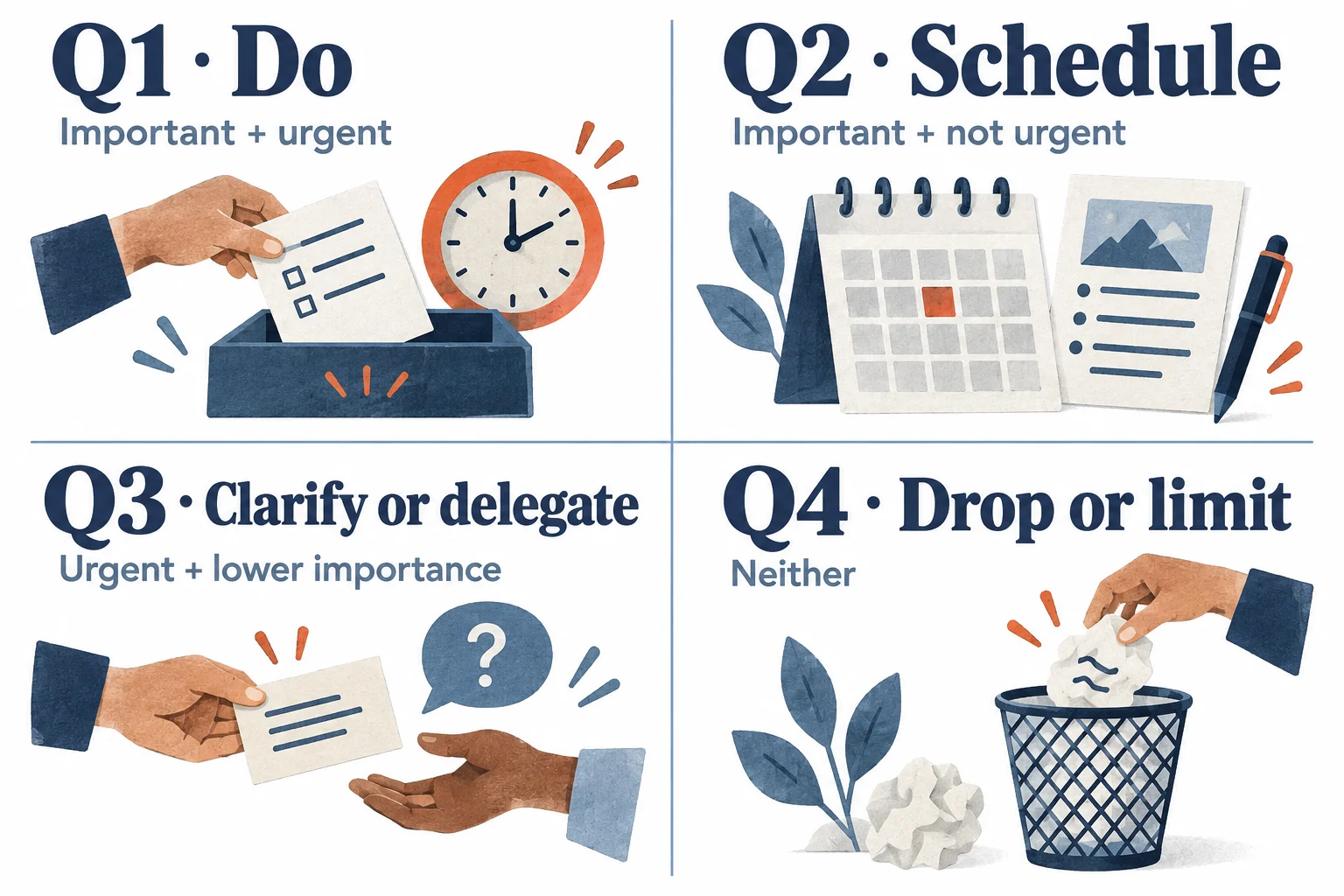
Dwight Eisenhower's urgent/important matrix splits every task into four quadrants. Most people live in Q1 and Q3 (urgent) and never get to Q2 (important but not urgent), which is where almost all the leverage actually compounds.

https://taskcoach.ai/blog/eisenhower-matrix-quadrant-two-life/

Urgent and important are not the same thing

Your inbox has forty things marked important. None of them are actually important, not in the way that matters for your career or your health. They're just loud. Meanwhile the thing that would genuinely move the needle, the strategy work, the skill you keep meaning to build, the conversation you're avoiding, sits untouched because nothing about it is on fire.

This is the exact confusion Dwight Eisenhower pointed at in a speech he gave in Evanston, Illinois, in August 1954. He said he had two kinds of problems: the urgent and the important, and the two rarely overlapped. He didn't even claim the insight as his own. He credited it to an unnamed former college president. Thirty-five years later, Stephen Covey turned that observation into a full framework in The 7 Habits of Highly Effective People, and it's been known as the Eisenhower Matrix ever since.

The matrix runs on two questions, asked about everything on your plate:

  • Urgent: does it have a deadline? Is it demanding attention right now?
  • Important: does it move you toward an outcome that actually matters?

| | Urgent | Not urgent | |------------------|---------------------|----------------------| | Important | Q1: Crises | Q2: Strategy | | Not important| Q3: Distractions | Q4: Escapism |

The value of the matrix is the discipline of asking those two questions separately, because your gut tends to merge them. Most of what feels urgent isn't important. Most of what's actually important doesn't feel urgent, not until you've ignored it long enough for it to turn into an emergency.

What actually lives in each quadrant

Q1, urgent and important, is firefighting. The outage. The deadline that's actually today. The decision that can't wait another hour. Some of this is simply what it means to have a job, but for most knowledge workers, a good chunk of it started as Q2 work that got put off until it became an emergency.

Q2, important but not urgent, is where the leverage lives. Strategy. Planning. Building a skill. Deep, focused work. Relationships. Your own health. Everything in this quadrant pays off big, just later, and nothing about it screams for your attention today. That's exactly the problem.

Q3, urgent but not important, is reactive busywork. Most email. Most meetings. Other people's priorities showing up in your calendar. This is the quadrant people mistake for importance most often, because urgency feels like importance even when it isn't.

Q4, neither urgent nor important, is escapism. Doomscrolling. Reorganizing your desk for the fourth time this month. Some of it is legitimate recovery, your brain does need downtime, but most of it is avoidance wearing a recovery costume.

Most workers live in Q1 and Q3. Leverage is in Q2.

Why Q2 carries the leverage

Line these up side by side and the case makes itself:

  • Preventing ten emergencies beats handling ten emergencies. That's what strategy work does: it's Q2 quietly erasing Q1 before Q1 happens.
  • Building a skill that makes future work twice as fast beats grinding at your current pace forever.
  • Investing in a relationship while things are calm beats scrambling to repair it mid-crisis.
  • Taking care of your health while you're healthy beats the medical bills and downtime that show up later.

The pattern repeats across all four: an hour in Q2 tends to save you several hours of Q1 or Q3 down the line, by some estimates five to one or better. Nobody's measured this precisely at scale, so treat it as a working rule of thumb rather than a lab result. Directionally, it's hard to argue with: prevention is cheaper than the fire it prevents.

Why Q2 keeps losing

If Q2 is where the leverage is, why does almost nobody live there? Four reasons, and they compound.

Q2 sits silently and waits to be scheduled. Q1 and Q3 are screaming, and the loud usually wins.

  1. Silence costs Q2 attention. Q1 and Q3 make noise, and a silent, important task loses to a loud, unimportant one nearly every time, because the loud one is standing in front of you demanding a response.
  2. Q2 pays off later. Your brain's reward system is built for immediate payoffs, not ones that show up in six months. Answering an email feels like progress right now. Writing a strategy doc doesn't, even though it's worth ten times more.
  3. Q2 looks like nothing is happening. Two hours spent thinking through a plan looks, from the outside and often from the inside too, indistinguishable from procrastination.
  4. Most workplaces reward the wrong quadrant. Fast replies and constant visibility get noticed and praised. Those are Q3 behaviors. Nobody puts "spent the morning thinking" on a performance review, even in the weeks it mattered most.

How Q3 hijacks your attention

Here's the spiral, and you already know it by heart. An email lands. Something about it (the subject line, the sender, the exclamation point) reads as urgent. Your brain treats that urgency as importance, even though the two aren't the same thing, and you switch tasks to deal with it.

That switch isn't free. Part of your attention stays stuck on the thing you just dropped, and it takes roughly 23 minutes to fully refocus on what you were doing before the interruption. Do that eight times in a day, a conservative estimate for most inboxes, and you've spent the bulk of your working hours in transition instead of in work.

That's the real mechanism behind "I was busy all day and got nothing done": a full day of Q3 pulling you out of Q2 before you ever built any momentum. Busy and productive are not the same word.

What this looks like in practice

Theory is easy. Here's what it actually takes to live this out on an ordinary Tuesday.

  1. Protect a morning Q2 block. Before you open email or join a single meeting, spend sixty to ninety minutes on your highest-leverage task. This is probably the single most valuable habit in knowledge work, and it only works if it happens before the day gets a chance to hijack you.
  2. Batch Q3 into specific windows. Two defined thirty-minute slots for email and chat, not a standing tab you glance at all day.
  3. Trace your fires back to their source. Every time a Q1 emergency lands, ask which Q2 task would have prevented it, then schedule that task instead of just fighting the same fire again later.
  4. Notice when you've drifted into Q4. Then decide, honestly, whether it's recovery (fine, keep it) or avoidance (a sign something in Q2 is scaring you off).

How TaskCoach.AI handles this

You can tag any task with urgency and importance separately, so the app knows the difference even when your calendar doesn't. The Daily Clock view shows you the quadrant breakdown of tomorrow's schedule before tomorrow actually happens, while you can still change it.

The AI coach is built to defend Q2 specifically. When you plan your day, it surfaces your highest-leverage Q2 tasks first, then layers the genuinely urgent stuff around them. That ordering does the work your willpower would otherwise have to do at 8am, which is exactly when willpower is least reliable.

The bottom line

Four quadrants, and only one of them compounds. Q2 is where strategy, skill, health, and relationships get built, and it's also the easiest quadrant to skip, because nothing in it is yelling at you.

Most people spend their week bouncing between Q1 and Q3 and call it a productive day. The fix is structural: a protected block for Q2 before the day gets a chance to interrupt you, specific windows for Q3 instead of a standing invitation, and enough self-awareness to catch Q4 drift before it eats an afternoon.

The matrix Eisenhower described is more than seventy years old at this point. People don't fail to apply it because they've never heard of it. They fail because Q3 gets there first, every single morning, before they've had a chance to choose.

Frequently asked questions

What is the Eisenhower Matrix?

It's a simple two-axis framework, urgent on one side and important on the other, that sorts everything on your plate into four quadrants. Q1 is urgent and important: crises and real deadlines. Q2 is important but not urgent: strategy, prevention, deep work, relationships. Q3 is urgent but not important: most email, most of what lands on your calendar because it mattered to someone else. Q4 is neither: pure escapism. Stephen Covey popularized the framework in The 7 Habits of Highly Effective People (1989), building on a line Eisenhower used decades earlier.

Why is Q2 the leverage quadrant?

Because it prevents problems instead of reacting to them. An hour of strategy work can save you several hours of putting out fires later, often five to one or better as a rough rule of thumb. Building a skill makes every future hour of work faster. Investing in a relationship while things are calm means you're not scrambling to repair it during a crisis. The payoff is real. It's just delayed, which is exactly why it's easy to skip.

Why do most people never reach Q2?

Q2 doesn't make noise, and Q1 and Q3 both do, so the loud stuff wins by default. Q2's payoff is delayed, and your brain's reward system is built for immediate wins, not distant ones. It can also look like procrastination from the outside, since deep thinking doesn't look like activity. And most workplaces reward fast responses and visibility, both of which are Q3 behaviors dressed up as productivity.

How do I actually live in Q2?

Start with a protected morning block, sixty to ninety minutes on your single highest-leverage task, before you touch email or join a meeting. Batch Q3 into two defined thirty-minute windows instead of letting it run all day. Track which Q1 fires trace back to Q2 work you deferred, then actually schedule that work next time. And when you notice yourself drifting into Q4, ask honestly whether it's recovery or avoidance.