What the studies can tell you
John Gottman and collaborators built a long-running program that observed couples discussing real disagreements, coded their behavior, recorded measures such as heart rate, and followed later relationship outcomes. Julie Schwartz Gottman later worked with him to translate the research into the Gottman Method and related interventions.
Some published models reported high classification accuracy within the samples and procedures studied. Those figures should not be treated as a home divorce calculator. Accuracy depends on the sample, the measures included, the follow-up period, and whether a model is tested on people beyond the data used to develop it.
The behaviors that gave it away weren't what most people would guess.
The four horsemen
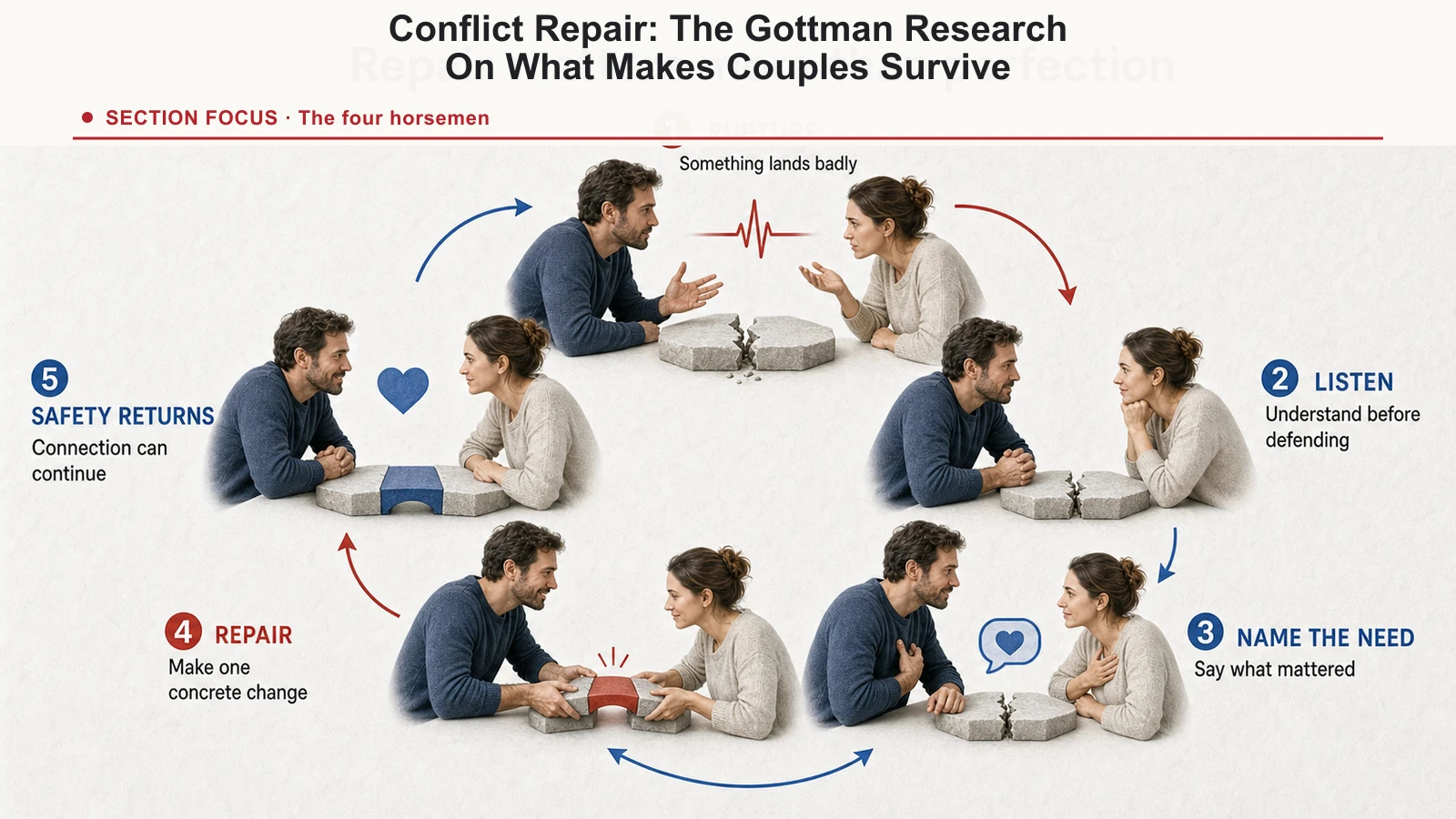
Four behaviors kept showing up in the couples heading for divorce.
1. Criticism. Attacking your partner's character instead of naming a specific behavior. "You never help with the kids" is criticism. "I need help with the kids tonight" is a complaint.
The difference matters more than it sounds like it should. Criticism is global and goes after identity. A complaint is specific and asks for something. Couples can absorb a lot of complaints. Criticism corrodes something slower and harder to repair.
2. Contempt. Eye-rolling, sarcasm, mockery, name-calling: anything that communicates "I'm better than you." Gottman's framework treats contempt as a particularly serious predictor in the observed interaction patterns.
Contempt isn't the same as anger. Anger says "I'm upset about what you did." Contempt says "I'm above you as a person." It's corrosive in a way that's hard to walk back once it's out.
3. Defensiveness. Refusing to take any responsibility, counter-attacking, playing the victim. "It's not my fault, you're the one who..."
Defensiveness blocks repair before it can start. Even when the defense is technically fair, doing it constantly stops the relationship from learning anything.
4. Stonewalling. Shutting down, going quiet, withdrawing from the conversation entirely. Often this isn't coldness, it's flooding: the body is too physiologically activated to keep engaging, so it shuts the whole thing off.
To the person doing it, stonewalling can feel like staying calm. To the partner on the other side, it feels like being abandoned mid-conversation.
The antidotes
Each horseman has a specific, practiced counter-move.
Antidote to criticism: the gentle startup. Open with a soft, specific complaint instead of a global attack. "I'm feeling overwhelmed and could use some help" lands completely differently than "you never help me." The format that works: "I feel X about Y, and I need Z."
Antidote to contempt: build a culture of fondness and admiration. Deliberately notice what you appreciate about your partner and say it out loud regularly. Suppressing an eye-roll leaves the underlying hostility untouched. Specific, credible appreciation builds a different interaction pattern.
Antidote to defensiveness: own some piece of the problem. Even 5% counts. "You're right, that came out harsher than I meant it." Taking your share opens room for your partner to take theirs.
Antidote to stonewalling: physiological self-soothing. When your heart rate spikes and your body floods, take a real break, 20-30 minutes, and let your body calm down before coming back to the conversation. The part people usually skip: announce the break out loud ("I need 30 minutes, I'll be back") instead of just disappearing.
Read the 5:1 ratio as a pattern
In the Gottmans' coded conflict discussions, stable and satisfied couples showed about five positive interactions for each negative one. The ratio describes a group pattern under specific observation. It does not assign a pass or fail score to one argument.
In practice that means:
- Five moments of appreciation for every criticism
- Five moments of kindness for every harsh tone
- Five moments of real attention for every dismissal
Positive behavior includes interest, empathy, affection, humor, and signs that you are still on the same side. Anger or disagreement can still occur. Longitudinal work also found more than one stable conflict style, including validating, volatile, and conflict-avoiding couples.
The practical implication is to protect warmth and curiosity while disagreeing. Counting every exchange can become its own source of strain, so use the ratio as a direction rather than a quota.
Repair attempts
A repair attempt is a move intended to reduce escalation or restore connection.
A repair could be an apology, an acknowledgment of a fair point, a request to slow down, or a proposal for a timed break. Humor and touch can also help when they are welcome.
Repair is a two-person process. An apology that avoids responsibility, a joke that humiliates, or touch that is unwelcome does not de-escalate. A useful repair names the shift, respects the other person's boundary, and leaves a path back to the issue.
Use a four-step repair debrief
Run this after both people are calm enough to stay present. Keep it to one conflict and stop if either person becomes flooded again.
- Name the turning point. Each person completes: "The conversation started getting worse when..." Describe an observable moment rather than diagnosing intent.
- Own one contribution. Name the tone, assumption, interruption, withdrawal, or escalation you controlled. Do not attach a "but" to it.
- Identify the repair signal. Ask what would have helped in that moment: a slower restart, reassurance, an apology, five minutes of listening, or a timed break.
- Make one next request. Use: "When this comes up again, could we...?" Keep the request behavioral and small enough to test.
For a timed break, state when you will return. Twenty to thirty minutes may help physiological arousal settle, but the exact time matters less than making the pause predictable and following through. If either person needs longer, send a brief update and propose a new time.
Keep a simple traffic-light agreement for future conflict:
- Green: both people can listen, summarize, and make a specific request.
- Amber: voices rise, contempt appears, or either person starts repeating the same point. Use the agreed repair phrase.
- Red: either person feels overwhelmed, afraid, or unable to stay respectful. Stop and follow the agreed pause or safety plan.
Know when repair advice does not apply
Mutual communication exercises assume both people can disagree without retaliation. If conflict includes coercive control, threats, stalking, forced sex, physical violence, monitoring, or fear about what will happen after you speak honestly, the priority is safety rather than a better joint conversation.
The National Domestic Violence Hotline advises against couples counseling with an abusive partner because the unequal power structure and disclosures in therapy can create additional risk. If this describes your situation, contact a local domestic-abuse service or the Hotline's confidential safety-planning resources. If you are in immediate danger, contact local emergency services when it is safe to do so.
The practices worth adopting
Three specific habits the research supports most strongly.
The state of the union meeting. Weekly, 30-45 minutes, actually scheduled. Cover what went well this week, what's been stressful for each of you, and one specific thing you each need from the other going into next week. This keeps small issues from stacking up and puts repair on a schedule, instead of only reaching for it when things blow up.
A deliberate reunion ritual. Choose a greeting that both people welcome: a kiss, hug, cup of tea, or two uninterrupted minutes together. The Gottman Institute often teaches a six-second kiss, but six seconds is a clinical prompt rather than a biological threshold. Consent and reliable attention matter more than the stopwatch.
Noticing bids. Bids are small attempts at connection: "look at that bird," "I had a weird thought today," "want to go for a walk?" Practice responding clearly even when you cannot engage: "I want to hear this after I finish the call" is more useful than silence.
Schedule the repair and protect the details
The Social pillar can hold relationship maintenance as a set of deliberate practices: a weekly check-in on the calendar, a mutually chosen reunion ritual, and a reminder to notice bids for connection. Keep private conflict details out of shared tasks if recording them could create risk or embarrassment.
What to practice this week
The four horsemen identify recurring interaction risks: criticism, contempt, defensiveness, and stonewalling. Each has a practical counter-move you can rehearse.
Use the 5:1 finding as a reminder to keep respect, interest, and warmth available during disagreement. Practice one recognizable repair phrase and agree on how a timed break ends.
None of this is glamorous. It's a weekly meeting. Small daily moments of fondness. Deliberately repairing after things go wrong. Most couples never do this work on purpose, and drift into exactly the patterns this research predicts.
The patterns are observable and the counter-moves are specific. That gives you something to practice without pretending a research model can issue a verdict about one relationship.