The math
Say two people each invest $300 a month at a 7% average real return (that's after inflation, roughly what the broad stock market has delivered over the long run).
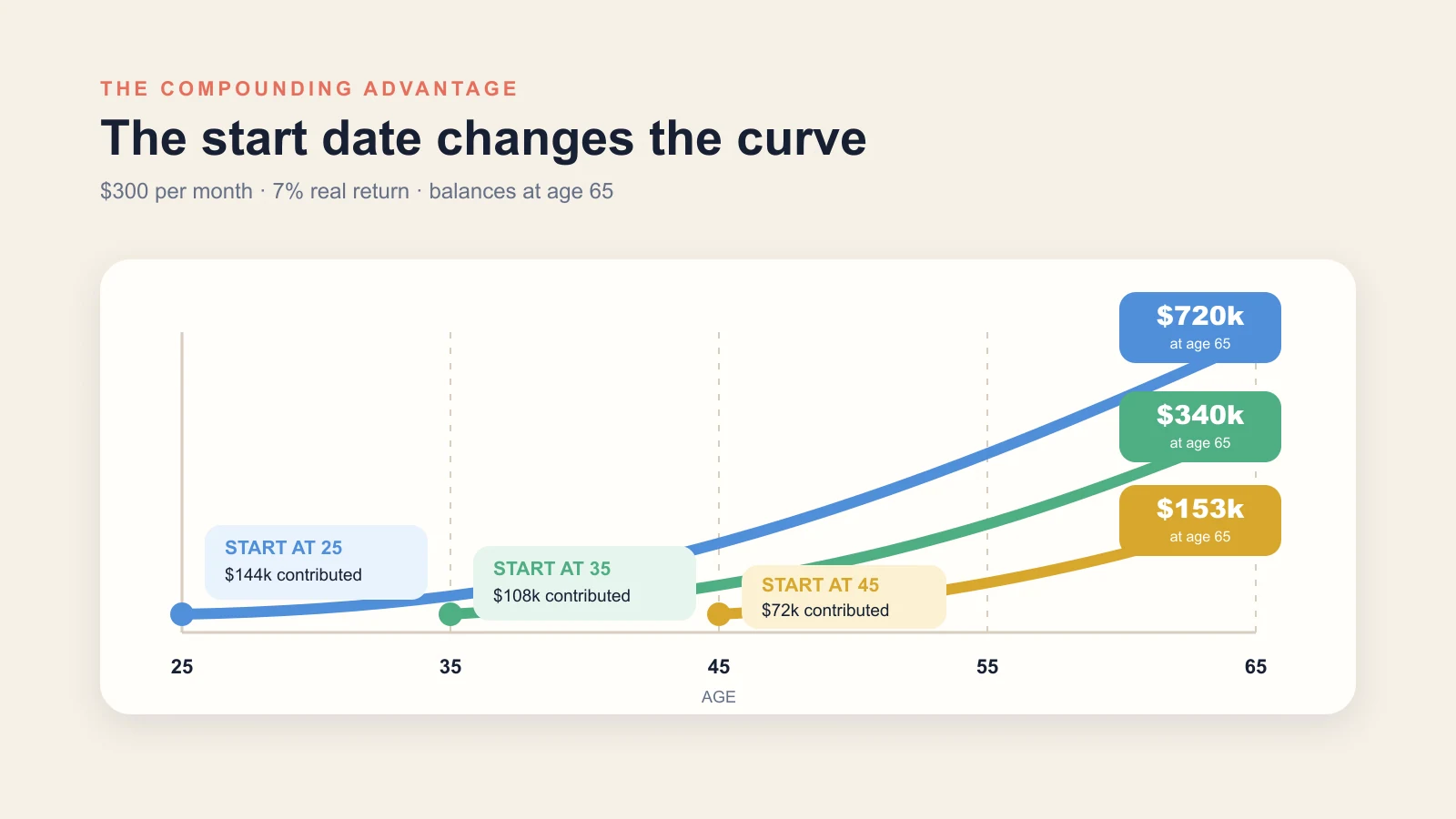
One starts at 25 and stops contributing at 65. She puts in $144,000 of her own money across those 40 years. Her account ends up around $720,000.
Another starts at 35. He contributes $108,000, 25% less than she did. His account at 65: about $340,000.
A third waits until 45. He puts in $72,000, half of what the 25-year-old contributed. His balance at 65: roughly $153,000.
Read those numbers again. The 25-year-old put in twice as much cash as the 45-year-old. Her ending balance was 4.7 times larger.
That gap has nothing to do with being smarter about money or picking better investments. It's time. Nothing else in this story is doing the work.
Why most people don't act
Three excuses do most of the damage, and each one sounds reasonable in the moment.
"I don't have enough to invest yet." Someone who waits until they "have enough" at 35 just gave up half their retirement, without a single moment that felt like giving anything up.
"I'll start when I get a raise." Lifestyle creep eats the raise before it ever reaches a brokerage account. The person waiting for the raise to start investing usually never starts.
"I need to research investments first." A two-year research phase before you invest a dollar works out functionally the same as not investing at all. The compounding clock doesn't pause while you read reviews.
The actual discipline is starting before you feel ready, with whatever amount you can genuinely sustain.
The rule of 72
Here's a shortcut worth memorizing: divide 72 by your annual return, and you get roughly how many years it takes your money to double.
- 6% return: doubles in 12 years
- 9% return: doubles in 8 years
- 12% return: doubles in 6 years
Doubling time matters more than the raw percentage, because doublings stack on each other. $10,000 growing at 7% becomes about $80,000 in 30 years: $10K to $20K to $40K to $80K, three doublings. The same $10,000 at 14% becomes roughly $640,000 over the same 30 years: six doublings instead of three.
Sustained 14% returns almost never happen in the real world, though. A realistic long-run assumption is 6-8% real return, and that's already enough to build serious wealth if you give it decades.
Why picking the perfect investment doesn't matter
Most people assume the path to wealth runs through picking the right stocks. The data says otherwise.
SPIVA, the S&P's own scorecard tracking actively managed funds against their benchmarks, has followed this for years, and the pattern barely moves: the large majority of actively managed funds underperform the S&P 500 over a 10-year stretch, and the underperformance rate gets worse, not better, over 20 years. The handful of funds that do beat the index can't be identified ahead of time. If they could be, this wouldn't still be a debate.
Translation: for most people, the best move is to buy the entire market through a low-cost, broad-market index fund, hold it for decades, and not sell when it drops.
The discipline isn't in picking winners. It's in not picking at all: accepting the market average, automated every month, left alone for decades.
The behavioral failure
The market drops around 30% roughly once a decade. When that happens, the average retail investor tends to sell near the bottom and buy back in near the top, which is exactly backwards, and it quietly wrecks the compounding.
A well-known (and admittedly debated, on methodology grounds) analysis from DALBAR Inc. found that the average mutual fund investor earned close to 3% a year over a multi-decade stretch, while the funds they were invested in returned closer to 7%. The gap wasn't the funds' fault. It came from investors moving their money at the wrong times.
The fix sounds almost too simple: automate the contribution, ignore the account, repeat for 30 years. Set up the automatic transfer, then stop looking. Let the math run in the background.
It feels wrong, honestly, like you should be doing something. The evidence says doing nothing, on purpose, is the something.
What this looks like in practice
- Open a brokerage account. Fidelity, Vanguard, and Schwab are all fine choices; fees and fund options are close enough to identical at this scale that the pick barely matters.
- Choose a target-date fund, or build a simple three-fund portfolio (US total market, international total market, bonds).
- Set up an automatic monthly contribution timed to land right after your paycheck.
- Increase the contribution by 1% every year, or put half of every raise toward it.
- Don't check the account during a crash. Once a year is plenty.
That's the whole protocol. Retail investing gets dressed up as complicated so it feels like you need someone managing it for you. Mostly, you don't. You need automation and the patience to leave it alone.
What TaskCoach.AI does with this
The Habits and Wealth pillars can track the behaviors that actually determine the outcome, rather than the investment picks themselves: whether the automatic contribution ran this month, whether you checked the market today (a surprisingly useful thing to log). The system doesn't replace your brokerage account. It supports the two things that actually decide how this turns out: automation and patience.
The bottom line
Compound interest is real, it's exponential, and over the long run it's mostly a function of time.
Start at 25 instead of 35, and you end up with roughly double the money for the same monthly contribution.
The right investment for almost everyone is a broad-market index fund, automated, left alone for decades.
The hard part was never picking the right investment. It's staying out of the way of the compounding once it's started.