You close a useful ChatGPT conversation, feel clearer for ten minutes, and then do exactly what you did yesterday.
Start with the main prompt below. It guides the conversation from your situation to one manageable next step. The other nine prompts are optional shortcuts for specific problems.
1. Start here: your main coaching prompt
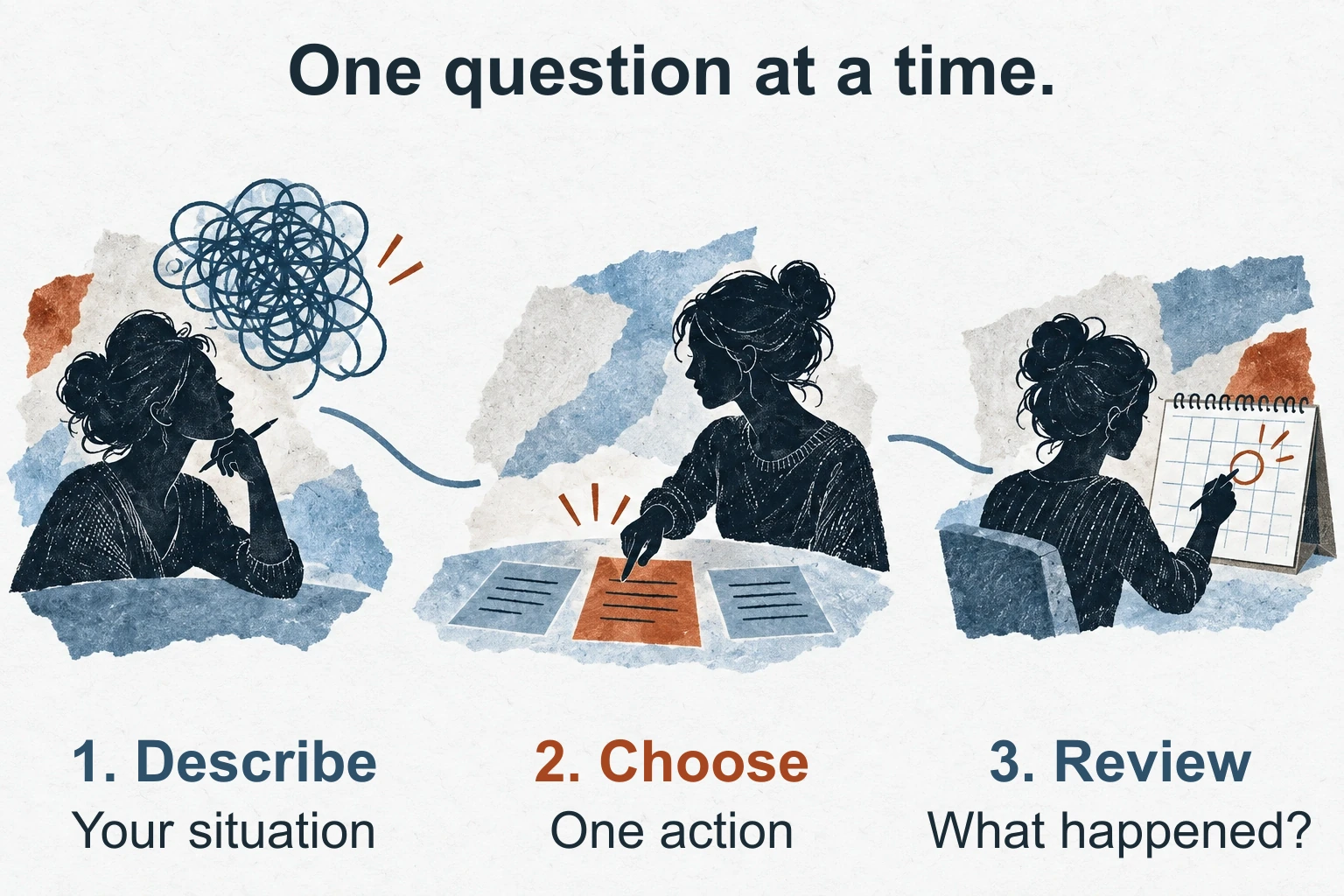
Copy this into a fresh chat exactly as it is. There's nothing to fill in first. Describe your situation when ChatGPT asks, then answer one question at a time. You can start without reading the rest of this article.
Be my practical life coach. Ask what I'd like help with, then wait. Ask only the questions needed to understand my goal, situation, and constraints, one at a time. Use my answers without guessing. Then help me choose one next step that fits my available time, including setup. Let me confirm what counts as done, when I'll act, and a future review date. Keep each reply under 120 words.
Pick what you need today
Already know what you need? Choose a focused prompt below. Each works on its own.
- Where to start: Use the main prompt, prompt 1 · Choose a priority, prompt 2
- A difficult week: Review it, prompt 3 · Unstick a task, prompt 4
- Habits: Start small, prompt 5 · Restart after a lapse, prompt 6
- Decisions and self-talk: Test a choice, prompt 7 · Try a CBT thought record, prompt 8
- Follow-through: Make a commitment, prompt 9 · Review the result, prompt 10
For prompts 2 through 10: Copy one into a fresh chat and replace its two or three brackets. Use specific facts: “I have five minutes after breakfast” gives the chat more to work with than “I'm busy.” Write “unknown” when you don't know a cause. No setup prompt is needed.
The examples below use fictional situations. Check the answer before you use it.
Goal clarity
2. Choose what gets your time
Use this when several good goals are competing for the same hours.
I'm choosing between [goals]. I have [available hours and fixed deadlines]. What matters most to me is [priority]. Recommend one focus for this week, explain what will wait, and divide only my available hours between the necessary steps. Total the minutes and stay within my limit. Keep deadlines visible. Ask me to confirm the tradeoff. Keep each reply under 120 words.
Example: Three goals are competing for four hours
Situation: A job application, a course, and home organization all want your attention. You have four hours this week. The application closes Friday, and changing jobs matters most.
A useful result: Protect the application deadline and let the other two goals wait. In our test, the plan used 30 minutes checking requirements, 75 tailoring a resume, 60 on application answers, 45 proofreading and submitting, and a 30-minute buffer. Total: 240 minutes. Confirm the steps fit your application before accepting them.

Weekly reviews
3. Learn from the week you actually had
Use this when your plan looked reasonable but the week told a different story.
I planned [plan], actually completed [results], and ran into [obstacles and available time next week]. Help me review the gap. Suggest one change that fits the time I have, including preparation. If the cause is unclear and would change your advice, ask one question and wait. Otherwise, finish with what I should record to see whether the change helped. Keep each reply under 120 words.
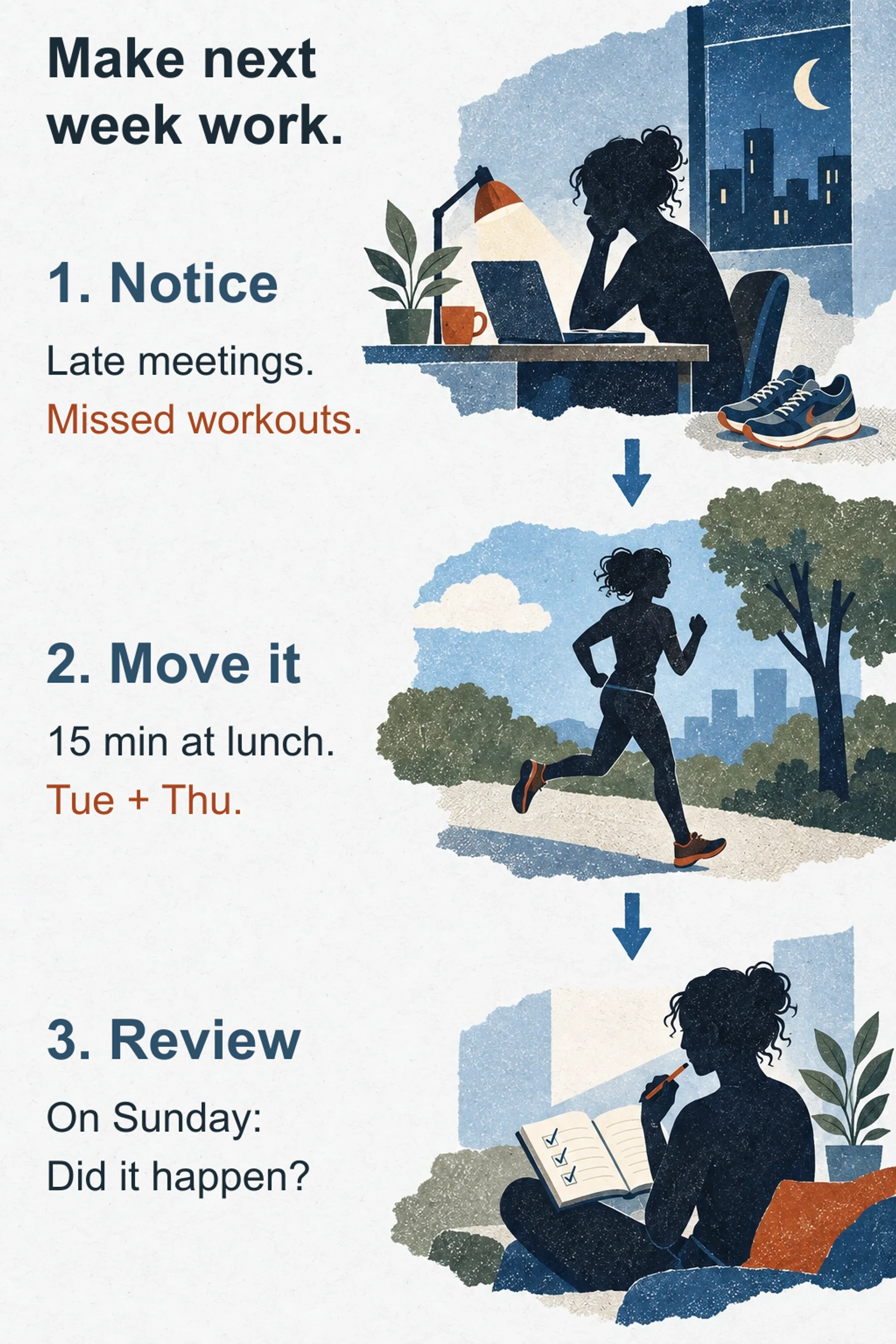
Example: Evening workouts keep losing to late meetings
Situation: You planned three evening workouts, completed one, and missed two when meetings ran late. Tuesday and Thursday lunch each have 20 minutes free.
A useful result: Try a 15-minute lunch workout, leaving five minutes for setup and getting back to work. The model suggested one lunch slot as a backup for an evening session. For the illustration, we chose both lunch slots and added a Sunday check-in to compare the plan with what happened.
4. Unstick the task you keep postponing
Use this when the same unfinished task keeps appearing on a new list.
I keep putting off [task]. When I try, [what actually happens]. My deadline and available time are [details]. If the obstacle is unclear, ask one question and wait. Otherwise, suggest one useful first step that fits my time. Preserve every requirement for completion, and make clear if this step is only preparation. Keep each reply under 120 words.
Habits
5. Make starting easier
Use this when getting started takes more effort than you can face today.
I want to [habit], but I get stuck at [obstacle]. An existing moment I can use is [daily routine]. Give me a version that takes under two minutes and still practices the habit. Write one if-then plan using that cue and one clear definition of done. Anything beyond that minimum is optional. Keep each reply under 120 words.
6. Restart without catching up
Use this when a missed week is starting to feel like the end of the habit.
I stopped [habit] because [what happened, or unknown]. My next opportunity is [when I can start; minutes available; energy]. Suggest the smallest restart that still practices the habit. Keep my cue and fit inside the available minutes. Use the same minimum in the plan and definition of done. No catch-up work. Suggest a check-in. Keep each reply under 120 words.
Example: Travel interrupted your reading habit
Situation: You missed a week of reading while traveling. You're home, tired, and have five minutes after breakfast.
A useful result: The model suggested one page after breakfast tomorrow. We made the illustrated version smaller: one paragraph counts as done, and extra reading is optional. Record whether you did it, then check again after three breakfasts. There's no backlog of missed pages to repay.

Decisions
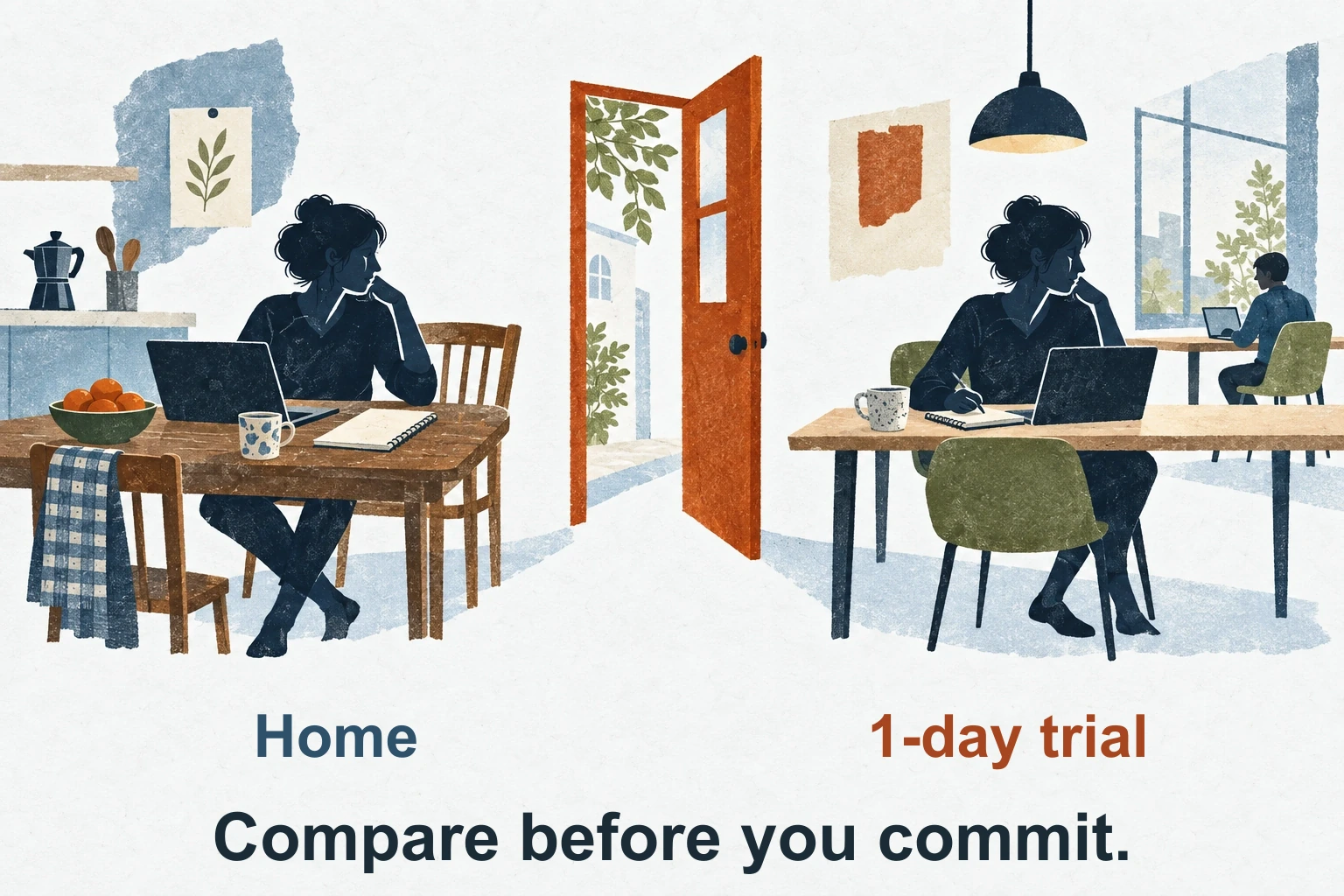
7. Test a choice before committing
Use this when more thinking has stopped producing new information.
I'm deciding [choice]. My options, stakes, and constraints are [details]. Identify the unknown most likely to change the decision. Propose one low-cost, reversible test or one question that would help answer it. Ask me to confirm any spending limit and success measure first. Explain what the result still wouldn't tell us before I make a larger commitment. Keep each reply under 120 words.
CBT and self-talk
8. Work through a thought with CBT
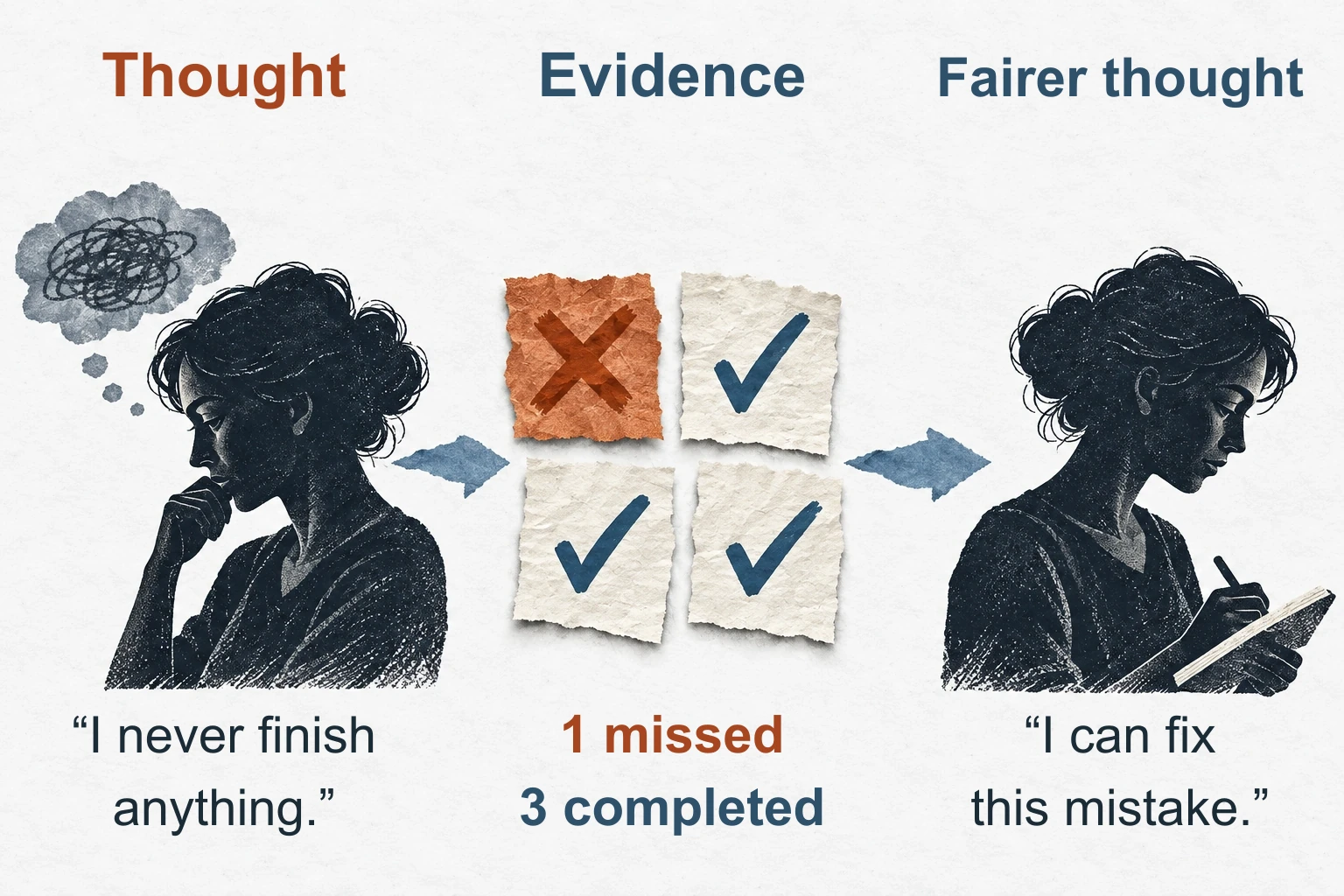
Use this when one bad moment has become a verdict on your whole ability. This adapts a cognitive behavioral therapy (CBT) thought record: notice the thought, examine the evidence, and find a more balanced interpretation.
I'm thinking “[thought]” after [what happened]. Guide me through a simple CBT thought record. Ask how I feel, then wait. One question at a time, help me examine evidence for and against the thought, using only facts I provide. Help me write a balanced alternative that acknowledges the problem, then ask how I feel now. Don't force positivity or diagnose me. Keep each reply under 120 words.
Follow-through
9. Make a commitment you can check
Use this when you've decided what to do and need to make it concrete.
I want to finish [action] by [deadline]. My available time and obstacle are [details]. Propose a slot including preparation and define done. Preserve required steps; don't invent shortcuts for missing items. If completion won't fit, ask for another slot. Preparation leaves the task unfinished. Suggest a commitment and a future date to review the result. Ask me to confirm both. Keep each reply under 120 words.
10. Come back with what happened
Use this at your check-in, whether you completed the action or missed it.
I agreed to [action, timing, and definition of done]. What happened was [result and evidence]. My current constraints are [details]. Use only my facts. If I haven't explained a missed action, ask what got in the way and wait. Then suggest whether to repeat, shrink, or change the action. Ask me to confirm one commitment and a future date to review the result. Keep each reply under 120 words.
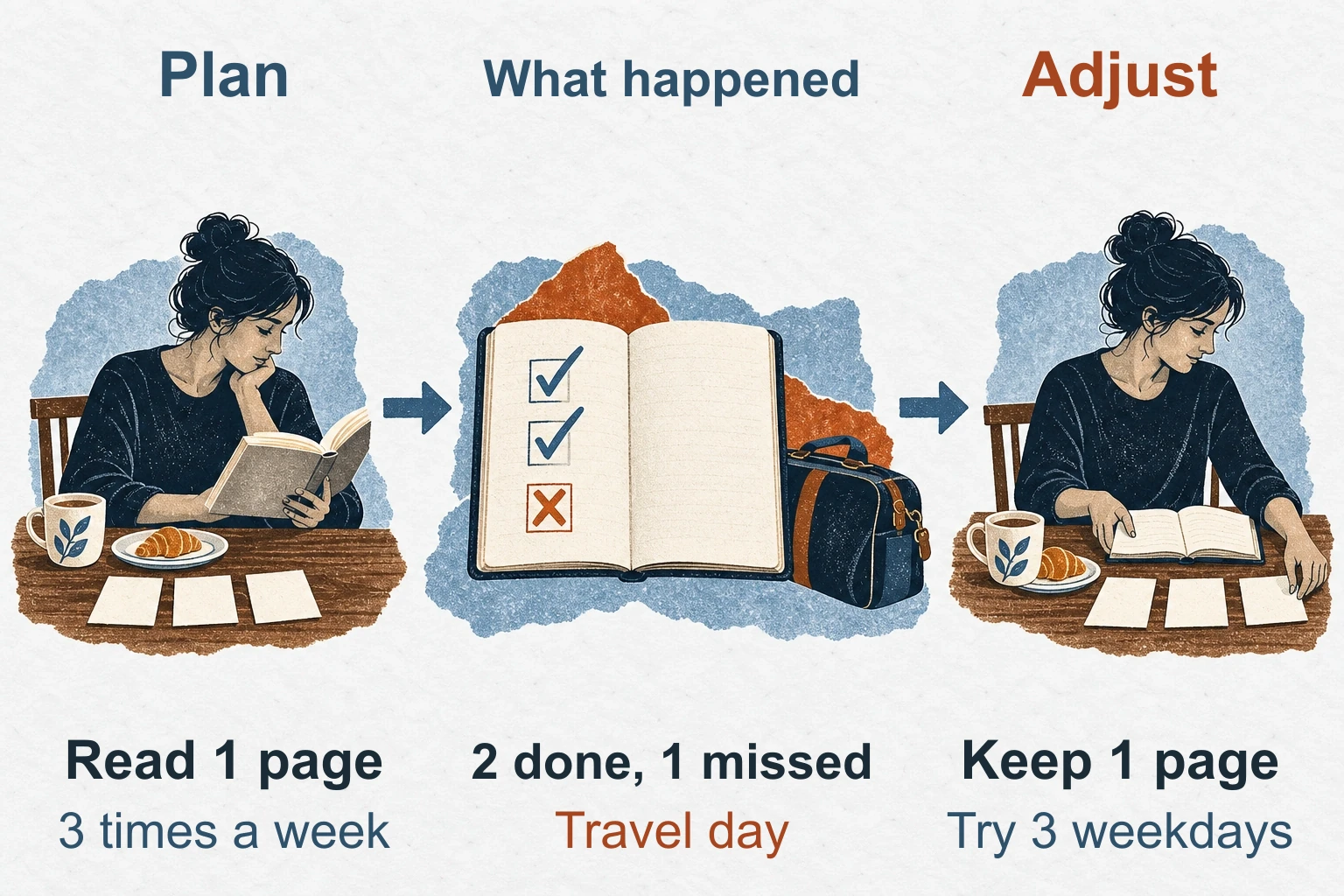
Example: Two reading sessions happened; Saturday was missed during travel. Keep the one-page minimum and try three reliable weekday breakfasts next week.
Check the answer before you use it
An answer can sound reasonable and still invent the reason you missed a goal. In an earlier fictional test, the reader completed two readings and missed Saturday. The model blamed weekend timing. We hadn't told it why Saturday failed.
Before accepting a plan, check three things:
- Evidence: Did you supply the facts behind its explanation?
- Fit: Does the action fit your time, energy, and responsibilities, including setup? Add up any timed steps.
- Finish: Can you tell exactly when it's done?
If a check fails, point out the assumption, restate the relevant fact or constraint, and ask the chat to revise that part. You can reject a proposal without starting the conversation again.
Make the next check-in easy
Save your agreed action, time, definition of done, and check-in date somewhere you'll see them. At the check-in, add what happened and what got in the way. Use those details in prompt 10. A missed action and an unknown cause are both useful information.
Specific if-then plans help here: a recognizable situation triggers a concrete response. Research on implementation intentions supports that planning principle. It doesn't establish that these exact AI prompts will change everyone's behavior.
ChatGPT can still make mistakes. Memory, reminders, and follow-up depend on the features and setup you use. Put the commitment somewhere it will surface again.
These exercises don't replace therapy, medical advice, crisis support, or other qualified professional care. Verify high-stakes advice with qualified sources.
For coaching alongside your goals and schedule, compare the best AI life coach apps. TaskCoach's standalone chat is a Premium feature.
One prompt, one action, one check-in. Start there.