1998. Florida. Selling Fax Machines.
Sara Blakely was 27. She had a communications degree from Florida State, two failed attempts at the LSAT behind her, and a brief stint auditioning for Disney World character roles that went nowhere (she didn't fit the height requirements for Goofy).
By 1998 she was selling Danka fax machines door-to-door across Florida: cold-calling small businesses, demoing the machines, trying to talk owners into switching providers. She was good at it, a top rep, but the work wore her down. She had $5,000 in savings and nothing else to fall back on.
Her recurring annoyance was pantyhose. She wanted to wear white pants, but every pair of hose she owned either showed through the fabric, bunched at the ankle, or left a visible seam across her toes in open-toed shoes. One night she cut the feet off a pair of control-top pantyhose and pulled them on under white pants instead.
That was the whole invention. "I knew immediately I had a product," she said later.
Two Years Of Nights And Weekends
Blakely didn't quit the fax-machine job for two years. She built Spanx after hours and on weekends, with no cushion beyond that original $5,000.
The process, pieced together from her interviews since, was relentlessly iterative.
In the first year, she called every hosiery mill she could find in North Carolina, the center of US hosiery manufacturing, and got turned down by most of them. She kept calling until one mill owner's two daughters convinced him to give her a shot, and she finally had a manufacturer.
She designed the packaging herself, the red-and-yellow box with three women that's still recognizable today. She tested more than fifty possible names before settling on "Spanx," partly because research suggested hard consonant sounds like "K" stick in people's memory, and partly because it was just a little bit provocative.
In the second year, she wrote her own patent application after lawyers quoted her $3,000 to $5,000, more than she could spare. The patent eventually went through.
She then drove to Neiman Marcus in Dallas with the prototype in a manila envelope and talked her way into ten minutes with the hosiery buyer. The buyer wasn't impressed, so Blakely asked her to step into the bathroom, put the product on right there, and showed her the difference in person. The buyer placed an order on the spot. Around the same time, Blakely mailed a basket of Spanx samples to Oprah Winfrey's production team and followed up.
The Oprah Moment
In November 2000, Spanx showed up on Oprah Winfrey's "Favorite Things" list, the annual roundup of products Oprah personally vouched for.
It sold out within days. Blakely had been running the operation more or less solo out of her apartment, and it buckled under the sudden demand while she scrambled to scale it in real time.
Within a year of that moment, Spanx revenue topped $4 million. Within five years, it passed $250 million. The product spread from Neiman Marcus into Bloomingdale's, Macy's, Nordstrom, and eventually QVC, where Blakely's own on-camera pitching, honed over years of door-to-door sales calls, drove huge direct-response numbers.
Why The 100% Ownership Matters As Much As The Product
The detail that shows up in almost every business-school write-up of Spanx: Blakely owned the entire company until 2021.
No outside investors. No venture capital. No equity handed out to early employees beyond performance bonuses. She grew the business entirely on its own revenue, reinvesting profit back into it year after year.
That structure is why, when Blackstone bought a majority stake in 2021 at a $1.2 billion valuation, nearly all of that money went straight to her. Compare that to founders who raise several rounds of venture funding and often own somewhere between 5 and 15 percent of their company by the time they exit; the same headline valuation can translate into dramatically less personal wealth.
This is a lesson about ownership structure as much as it's a lesson about entrepreneurship. How you own the thing you build determines what you actually walk away with.

What Actually Worked
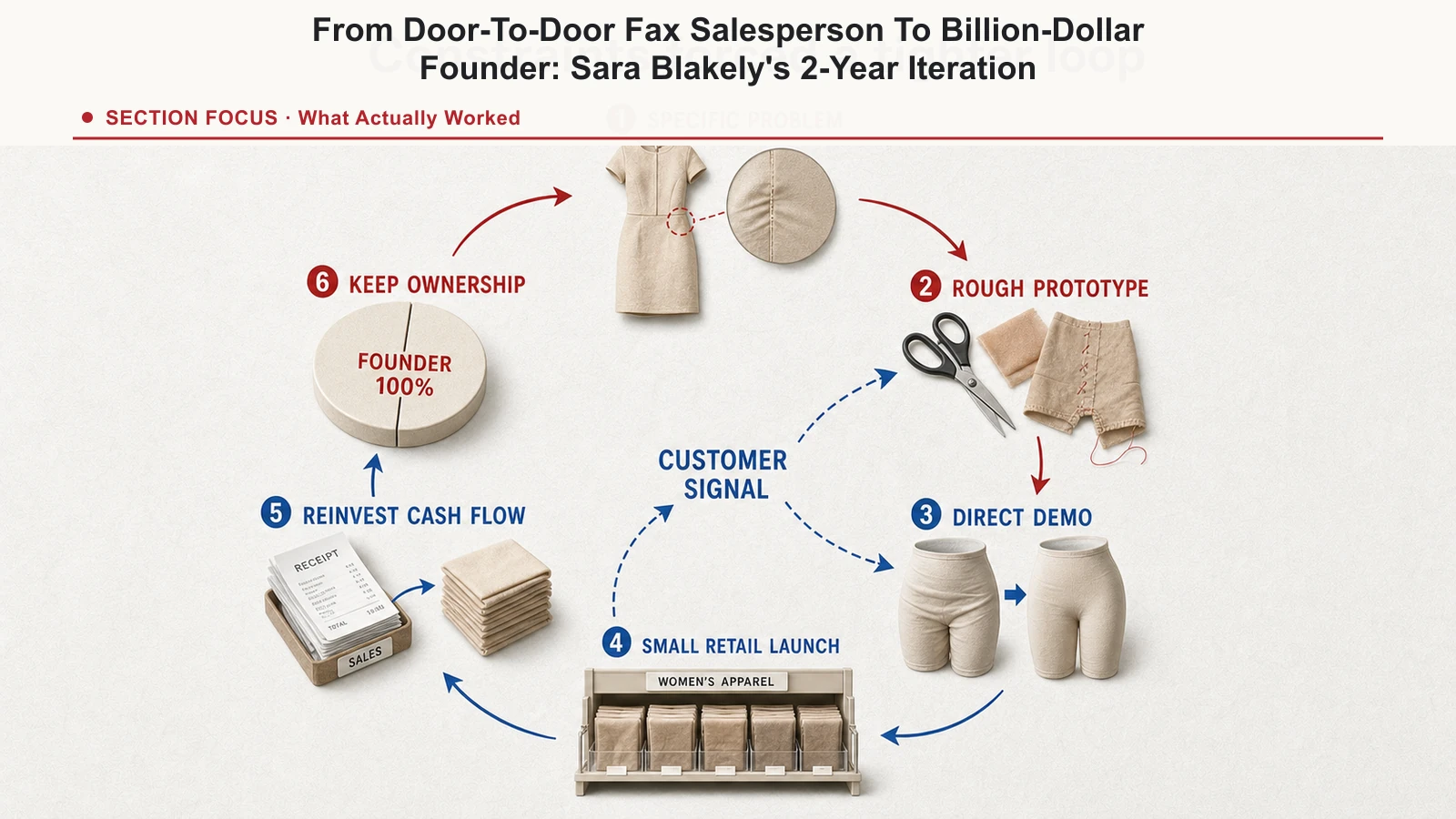
A handful of specific choices recur across Blakely's own retelling of the story:
She didn't quit too soon. Two years of building Spanx while still selling fax machines. The fax income covered her bills while the Spanx work compounded quietly in the background. Most startups that fail quit the day job too early and run out of runway before the product ever finds its market.
She wrote her own patent. Most non-lawyers assume that's out of reach. She read the USPTO's instructions, drafted the application herself, and got it approved. The barrier turned out to be more assumed than real.
She demoed the product herself, in person. The Neiman Marcus buyer wasn't interested until Blakely physically showed her the difference. A lot of sales isn't persuasion so much as interrupting someone's assumptions, and the bathroom demo did exactly that.
She sent samples straight to Oprah. Most founders wouldn't bother; "she'll never actually see it" kills the attempt before it starts. Blakely sent it anyway. The odds of it working were low, but the potential payoff was high enough to make the attempt worth it regardless.
She optimized for ownership over speed. No outside investors, no diluted equity. That discipline is what let two decades of growth translate into an exit that went almost entirely to her.
What Most Founders Get Wrong By Comparison
They quit the job before the product is real. Leaving your day job is the part startup culture likes to celebrate. Keeping it a year or two longer is often what actually lets the product mature.
They skip the cold pitching. Most founders try to hire salespeople or buy ads before they've personally pitched a hundred potential customers themselves. Blakely pitched buyers, retailers, and editors herself for years, and that early, unglamorous sales experience isn't something you can outsource or shortcut.
They play it safe with the name. "Spanx" was a little transgressive, and plenty of marketing committees would have vetoed it. Memorable tends to beat safe once you're actually trying to get noticed.
They underrate the patent as a bargaining chip. Competitors eventually found ways around Spanx's patent, but during the critical first few years of growth it gave Blakely real leverage with retailers, more useful as a negotiating tool than as an ironclad legal shield.
They don't protect their ownership. Every round of dilution a founder avoids compounds all the way to the exit. Chasing fundraising headlines can quietly work against a founder's actual long-term payout.
Turning This Into Something You Can Use
If you're weighing an entrepreneurial move of your own:
- Don't quit the job yet. Build the product on nights and weekends, and let your paycheck fund the build.
- Make 100 cold pitches before you hire a salesperson. You need to learn what that conversation actually sounds like firsthand.
- Demo the product live, in person, to the actual buyer. Skip the deck. Show them the difference directly.
- Grow on revenue as long as you can. Every funding round you skip is equity you keep.
- Send the long-shot pitch anyway. It probably won't land. The expected value is still positive, even at a low hit rate.
What TaskCoach.AI Does With This
The Goals, Habits, and Wealth pillars can hold the shape of a multi-year side hustle: which experiment is live this quarter, what it's actually generating, what the next pivot looks like. The system is built for the kind of slow-compounding work a side business requires, the kind most people give up on after 90 days because nothing about it feels dramatic yet.
The Bottom Line
Door-to-door fax sales at 27. A billion-dollar founder by 41.
The transformation took two years of nights-and-weekends product development, one bathroom demo at Neiman Marcus, one sample basket mailed to Oprah's team, and twenty years of bootstrapped revenue growth on top of that.
The approach was relentlessly iterative, smart about structure (keeping 100% ownership), and hands-on at every step (Blakely personally drove her own early sales and press for years).
The "overnight success" was really a two-year side hustle, followed by a five-year growth curve, followed by two more decades of sustained operation. The luck was Oprah. The reason Oprah's call turned into a real business was years of compounded work that had already happened by the time the call came in.