1994. Edinburgh. Living On Welfare.
Joanne Rowling was 28. She'd recently split from her husband, a Portuguese journalist, after a short and reportedly rough marriage. She was raising her four-month-old daughter alone and living on UK Income Support, about £70 a week.
She described this stretch of her life years later, in a 2008 Harvard commencement address, as the lowest point she'd ever hit:
"By every usual standard, I was the biggest failure I knew. An exceptionally short-lived marriage had imploded, and I was jobless, a lone parent, and as poor as it is possible to be in modern Britain, without being homeless. The fears that my parents had had for me, and that I had had for myself, had both come to pass, and by every usual standard, I was the biggest failure I knew."
She was severely depressed, and has spoken openly since about having suicidal thoughts during this period. She started cognitive behavioral therapy and was eventually prescribed antidepressants.
And in the middle of all that, she wrote the first 200 pages of Harry Potter and the Philosopher's Stone (retitled Sorcerer's Stone in the US) longhand, in Edinburgh cafes, while her daughter Jessica slept in a stroller beside her.
The Unglamorous Writing Routine
Her process between 1994 and 1995 wasn't anything you'd find in a productivity guide.
She wrote whenever Jessica napped, usually two to four hours a day, split into whatever chunks the baby's schedule allowed. Her spots were the Elephant House and Nicolson's Cafe (now called Spoon), both an easy walk from her flat. She'd push the stroller around until Jessica fell asleep, then duck into a cafe and nurse a single coffee through the entire session. She wrote by hand, on notebook paper. She didn't own a computer.
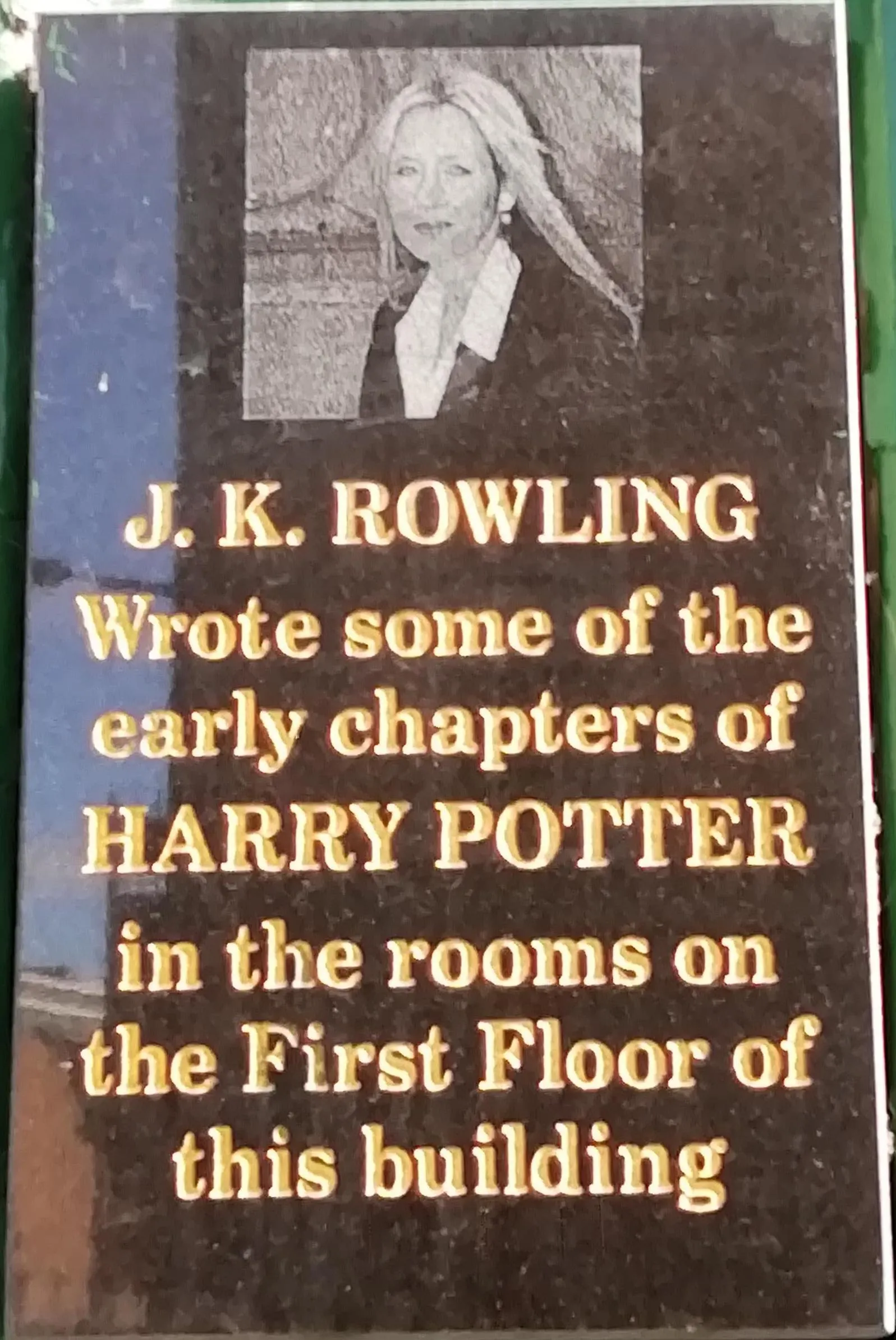
It took five years to finish. The Elephant House later mounted a plaque marking the table where she used to sit, and both cafes became pilgrimage stops once the books took off.
Twelve No's
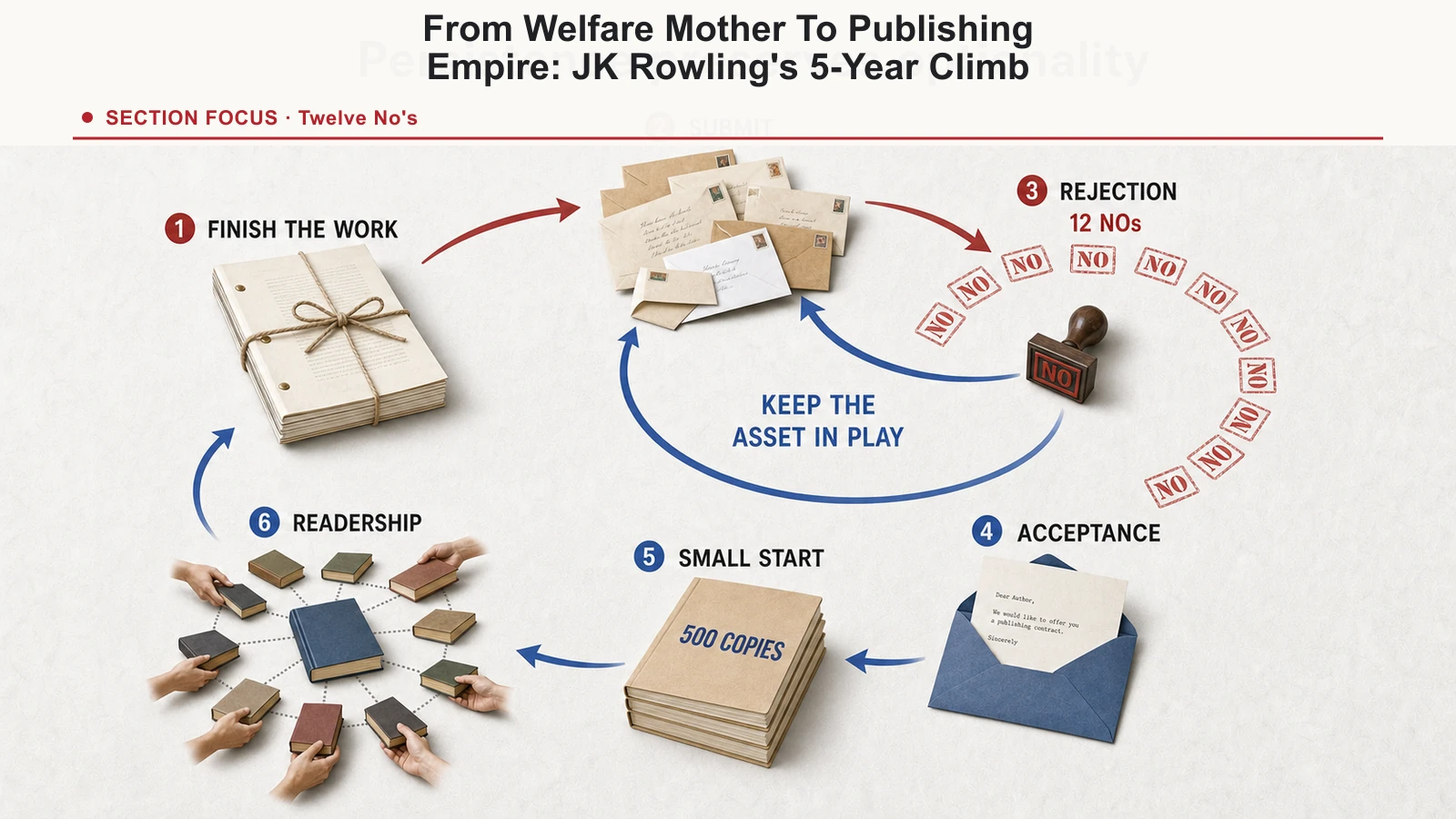
Once the manuscript was finished in 1995, Rowling's agent, Christopher Little, sent it out to UK publishers. Twelve of them turned it down.
Some of the rejection letters, which Rowling later shared publicly, read almost comically wrong in hindsight: too long for a children's book, too complex for children, no market for this kind of fantasy, maybe try writing for adults instead.
The thirteenth publisher was Bloomsbury, at the time a fairly small house with a children's imprint. Chairman Nigel Newton brought the manuscript home and handed the first chapter to his eight-year-old daughter, Alice. An hour later she came back and demanded to know what happened next.
Bloomsbury bought the book in August 1996. The advance was £1,500, worth roughly £2,800 today, which is modest by any measure.
A 500-Copy Start
The first UK edition of Philosopher's Stone came out in June 1997. The initial print run was 500 copies, most of which went straight to libraries; the full trade run was 5,150 hardcovers.
It sold slowly at first, spread by word of mouth among kids, then picked up momentum after it won the Nestlé Smarties Book Prize that fall. Bookseller buzz followed, and a second printing came soon after.
Scholastic bought the US rights in 1997 for $105,000, a record at the time for a debut children's book, and released the American edition (renamed Sorcerer's Stone at the publisher's insistence) in September 1998.
By 1999 the franchise was generating serious money. By 2004, Forbes had named Rowling the first author ever to reach billionaire status from book sales alone.
The Five-Year Climb, Compressed
- 1990: The idea for Harry Potter comes to her on a delayed train from Manchester to London.
- 1990 to 1994: Sporadic writing while she teaches English in Portugal, gets married, and gets divorced.
- 1994: She moves back to Edinburgh as a single mother on welfare and starts writing in earnest.
- 1995: The manuscript is finished.
- 1995 to 1996: Twelve rejections.
- 1996: Bloomsbury says yes. £1,500 advance.
- 1997: Publication. A 500-copy first run.
- 2004: Billionaire status, according to Forbes.
Call it 14 years from idea to billionaire, or five years from serious writing to publication. Either way, the "overnight success" story skips over a stretch of documented poverty, depression, and a dozen professional rejections.
What The Story Actually Teaches
A few lessons hold up:
Rejection isn't the final word, even from people who know the market. Twelve publishers passed on a book that would go on to outsell almost everything else in its category. The right reader, in this case an eight-year-old, can override the gatekeeper's judgment entirely, even when the gatekeepers had legitimate reasons for their pass.
A cramped schedule can still produce finished work. Two hours a day, longhand, in a cafe, while a baby slept nearby. Not an efficient setup by any stretch. But she kept at it for years, and the manuscript got done.
Treatment, not suffering, made the work possible. Rowling credits therapy and medication with getting her to a place where she could keep writing, and she's been a long-time advocate for mental-health funding since. The version she actually tells is that treatment made it possible to keep working despite the depression, a long way from the romantic idea that depression made her a genius.
Small distribution isn't failure. A 500-copy first run is a seed, not a launch. Word of mouth in a small, genuinely engaged audience (children and librarians, in this case) compounded for years before the wider explosion happened, and it only happened because that niche audience had already proven the book worked.
The "I'm a failure" story in your head can be flatly wrong about your actual trajectory. At 28, Rowling checked every box a culture uses to define failure: divorced, broke, on welfare, depressed, no career to speak of. At the very same time, she was writing one of the best-selling book series in history. Both of those things were true at once.
Turning This Into Something You Can Use
If you're in a comparable stretch right now:
- Figure out what the actual work is: the thing you'd do even with nobody watching or approving.
- Find the time, however small. Rowling's two hours during a nap is more focused effort than most people give the project they claim matters most to them.
- Finish the draft before you show anyone. Don't edit as you go. Get something complete, however rough, first.
- Expect rejection and keep sending it out anyway. Most working artists rack up dozens of no's. What separates them is whether they kept submitting after it, not the rejection itself.
- Treat your mental health as part of the plan, not an obstacle to it. Sustained creative work needs a functioning mind behind it. Getting help is part of the protocol, not a detour from it.
What TaskCoach.AI Does With This
The Goals and Habits system can hold a daily-writing habit as a simple binary: did you do the work today or not. The Pillar system holds the rest of your life alongside it, Wealth, Career, Body, Mind, so the creative project doesn't quietly starve everything else that keeps you functional enough to sustain it.
The Bottom Line
A divorced single mother on welfare in 1994. The world's first billionaire author by 2004.
The ten years in between involved depression, therapy, medication, years of daily writing in cafes, twelve rejections from publishers, and a first print run of 500 copies.
The "overnight success" framing leaves out the part that actually explains what happened. The climb is the lesson, not the ending.
Talent is debatable (some of the prose is genuinely brilliant, some of it just serviceable), but talent was never really the variable that decided this story. What decided it was years of sustained creative work through public failure, backed by treatment for the conditions that made the work feel impossible some days. Most people who could have written something this good stop after the first rejection. The few who keep going are the ones whose names you actually know.