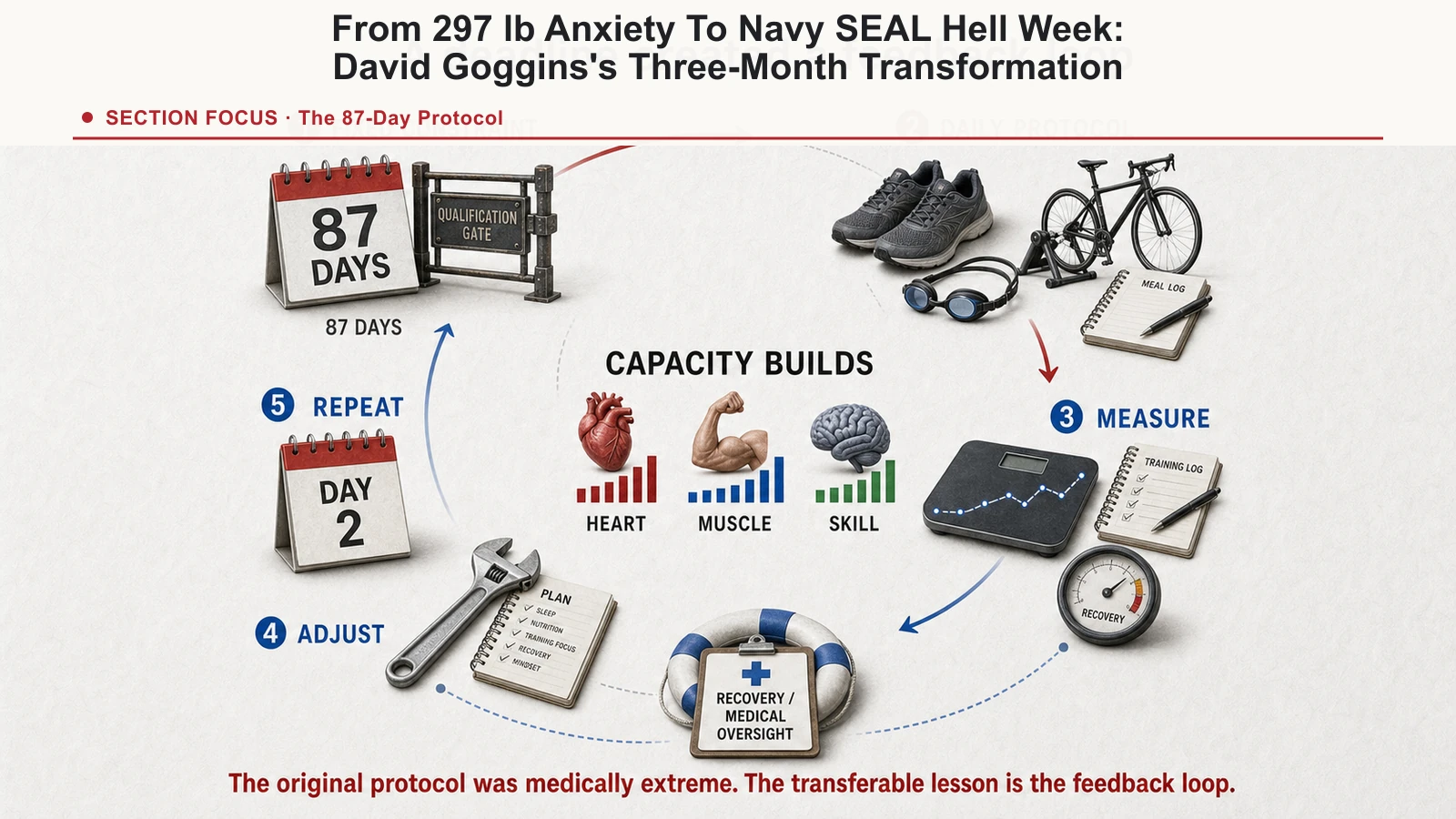
David Goggins reported going from 297 to 191 pounds before entering Navy SEAL training. The 106-pound loss took less than three months; completing training took repeated attempts. A 2018 military interview records his graduation on August 10, 2001.
The story began with a television program showing SEAL candidates doing something he had spent years avoiding: staying in the water when every part of them wanted to leave.
He was working in pest control and weighed 297 pounds. The program showed Navy SEAL candidates enduring Hell Week. According to Goggins, watching it brought back his own unfinished ambition from Air Force Pararescue training. He began calling recruiters.
Most turned him down. One offered a route forward, with a severe condition: he had to meet the weight requirement in less than three months.
That is the part of the story everyone remembers. The part you can use begins when inspiration has worn off and the work is still waiting.
Read the transformation · Use the mental tools · Plan your first week
The transformation, and what it cost
The military interview gives this sequence. The weights describe his preparation for training, not his current measurements.
| Stage | What the account records |
|---|---|
| Before applying | Working in pest control and weighing 297 lb, about 135 kg |
| Preparing to qualify | Losing 106 lb, about 48 kg, to reach 191 lb, about 87 kg, in less than three months |
| Training attempts | Pneumonia and fractures interrupted his progress |
| August 10, 2001 | Graduating with BUD/S Class 235 on his third attempt |
The kilogram figures are rounded conversions. The interview does not establish his heaviest lifetime weight or what he weighs today.
He also described the price. He entered training already physically worn down. Pneumonia and fractures interrupted his progress, and he had to restart. The interview records that his third attempt succeeded: he graduated with BUD/S Class 235 on August 10, 2001. Read the military interview.
The familiar three-month transformation was the beginning of a much longer process. Getting eligible for training and becoming a Navy SEAL were separate achievements.
Do not copy his rapid weight loss or train through injury. That regimen was dangerous. For a weight or fitness change of your own, work with a qualified health professional on an appropriate plan. The CDC recommends a gradual approach to weight loss and emphasizes food, activity, sleep, and stress management together. CDC guidance.
For the basic principles behind a weight goal, see our guide to energy balance.
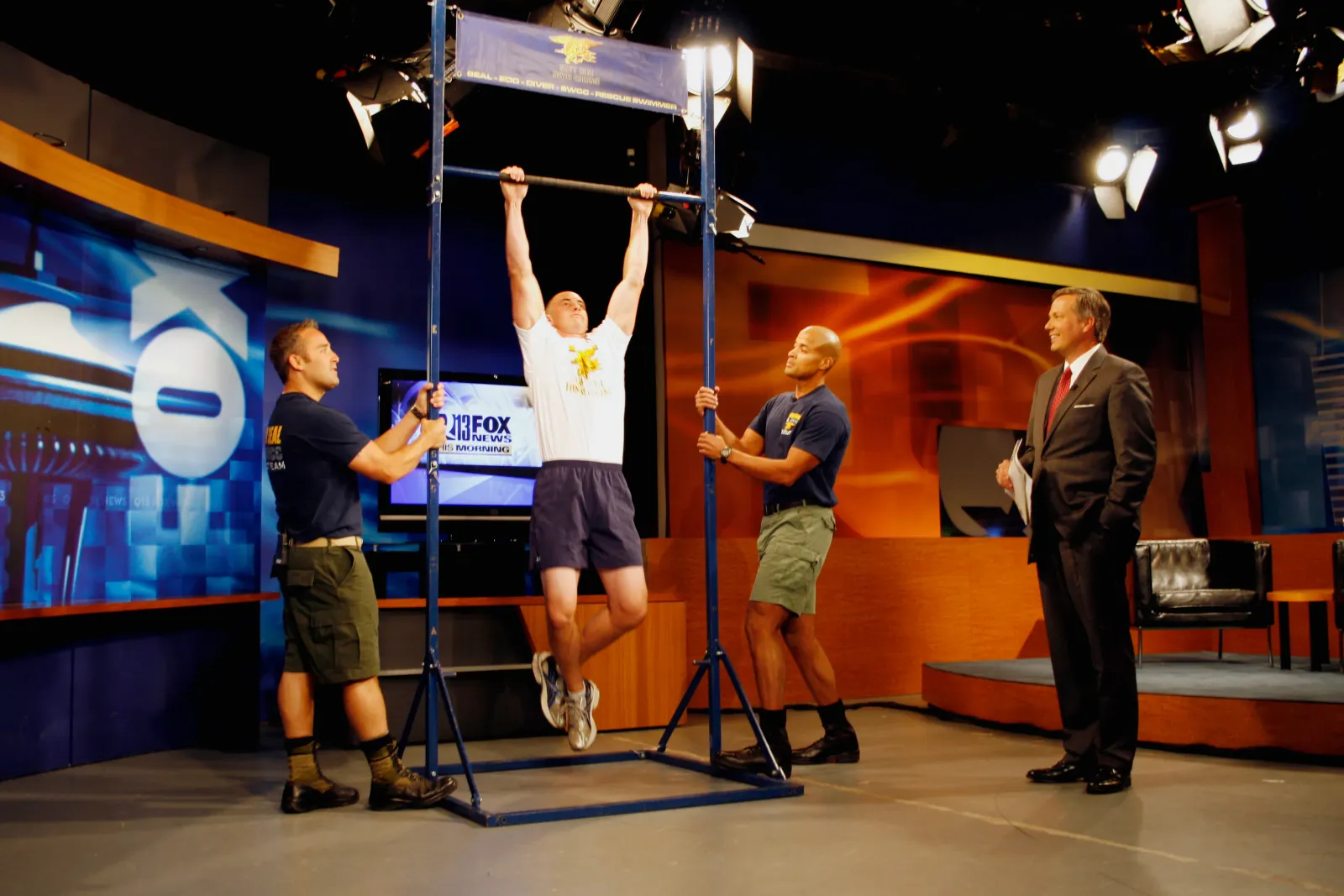
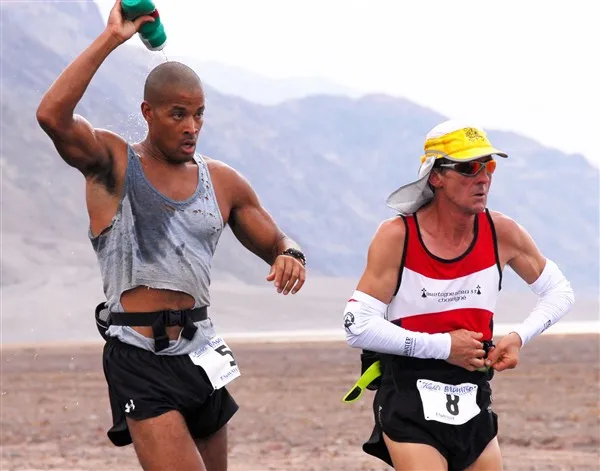
Goggins later completed Army Ranger School and built an endurance career. His achievements include Badwater finishes and a former world record of 4,030 pull-ups, completed in 17 hours in 2013. His published achievements.
The impressive part is the range of difficult things he returned to. You don't need the same ambitions to recognize the question his story puts in front of you: what have you decided you're incapable of before giving yourself a workable chance to practice?
Four Goggins tools you can adapt
Goggins describes his approach in Can't Hurt Me and Never Finished. The versions below adapt those ideas to everyday goals: learning a skill, changing careers, finishing a project, or rebuilding a routine.
1. The accountability mirror: get specific
Goggins uses the mirror as a place to confront the gap between what he says he wants and what he actually does.
A useful version starts with a fact you can act on. “I'm hopeless” offers nowhere to go. “I want a different job, but I haven't sent an application in three weeks” points to a next step.
Write three lines:
I want: a role with more creative work. Right now: my portfolio is out of date. Today: I'll improve one project description for twenty minutes after lunch.
Be direct without insulting yourself. Accuracy helps you choose an action. Abuse consumes energy you could spend doing it.
2. The 40% rule: question an early urge to quit
Goggins's “40% rule” challenges the feeling that the first strong urge to stop must be your absolute limit. Treat the number as a motivational metaphor, not a measurement of your body or brain.
For ordinary task resistance, the useful move is a small, bounded test. Before closing a difficult document, try one more paragraph. Before abandoning a practice session, spend five minutes on the part you don't understand, then reassess.
Keep the boundary clear: boredom, uncertainty, and embarrassment are different from injury, illness, or severe exhaustion. Rest, medical care, or asking for help can be the responsible next action. You don't owe a slogan another repetition.
3. The cookie jar: remember your own evidence
The “cookie jar” is Goggins's name for drawing strength from hard things he has already overcome.
Build a note with three examples from your life. They don't have to impress anyone else. You prepared for an interview while nervous. You asked for help. You restarted a course after falling behind.
Make the memory usable by recording what helped: “I was anxious, but practicing the opening answer with a friend made the interview manageable.” That gives you a method to reuse, as well as a reason to believe you can act while uncomfortable.
Keep promises you can point to. Add evidence as you earn it. A finished piece of work is more convincing than a promise about the person you'll become.
4. Callusing the mind: practice the discomfort that matters
Choose a challenge connected to your goal. If you want to change careers, sending an application may be more relevant than taking a cold shower. If you avoid conflict, preparing an honest conversation may be the hard thing worth practicing.
Pick a manageable stretch, give it a stopping point, and allow recovery. The aim is to become more capable of doing meaningful work even when you don't feel ready.
This is where productive stress needs judgment. More discomfort doesn't automatically create more progress.

Turn the inspiration into one week of action
A motivational video can leave you ready to change everything. Use that energy to make one commitment you can keep after the feeling fades. For a repeatable daily action, our guide to habit formation explains how to choose a cue and return after a missed day.
Here is an example for someone preparing for a job interview. The schedule is an illustration you can adapt, not Goggins's own routine.
- Choose one result for the week. For example: prepare three clear stories about your work for an upcoming interview.
- Book the first session. Put twenty minutes on your calendar to draft one story. Include the document or materials you'll need.
- Define “done” before starting. One rough answer with a situation, your action, and a result is enough for this session.
- Use the next sessions to improve it. Practice aloud, get feedback from someone you trust, and revise. Give those sessions a place in the week that fits your commitments.
- Review what happened. Keep the useful work. If you missed a session, identify the obstacle and schedule a manageable next attempt.
You can use the same structure for writing a proposal, studying a topic, or having a difficult conversation.
A daily review can help. The demanding work itself doesn't have to happen every day. A plan that respects your responsibilities is one you have a chance to repeat. Our guide to willpower and planning explains how to reduce the number of decisions you have to remake.
Keep the ambition; build the support
Goggins's story can make individual effort look like the whole explanation. Your own progress may also depend on skills, money, health, time, and other people. Name those constraints so you can work with them.
For the interview example, asking a friend to practice with you brings feedback you might miss on your own.
The strongest adaptation of Goggins's approach is a demanding promise you can act on, supported by honest feedback and room to recover. Make the next action clear enough that tomorrow's version of you knows where to start.
Put your accountability system in TaskCoach
TaskCoach is our recommendation for turning that ambition into a connected plan. Goals hold the direction, tasks give the next step a time, and habits record the repetitions. Notes and the journal can hold your own cookie jar: the work you completed and what helped you get through it. We build TaskCoach.
Start with one target and one scheduled action. The free core includes manual planning, habits, notes, journal, and focus tools; Project and Challenge goal types and broader Brain Chat coaching require Premium.
Put your first action in TaskCoach. Choose something meaningful enough to matter and specific enough to finish. Give yourself one piece of evidence today.