July 1999. Indiana. 297 Pounds.
David Goggins was 24 years old. Working the night shift as an Ecolab pest exterminator. Spraying cockroaches in Steak 'n Shake bathrooms. Weighing 297 pounds. Lying on the couch every evening eating a box of Mini Wheats.
He had washed out of Air Force Pararescue training because he didn't pass the underwater pool tests. The Air Force discharged him. He had failed every meaningful thing he had tried.
That night in July 1999 he flipped channels and landed on a Discovery Channel documentary about Navy SEAL Hell Week. Skeletal men in cold water carrying logs. Most quitting. The narrator listing the casualty rate.
Goggins called the SEAL recruiter the next morning. The recruiter asked his weight. He lied: "215." The recruiter said the cutoff for Goggins's age and height was 191 pounds. He needed to lose 106 lb in 3 months to make the SEAL physical screening test before he aged out of eligibility.
This is one of the most-documented physical transformations in modern history.
The Protocol (87 Days)
Goggins designed it himself. Without a coach. Without a nutritionist. Without modern PED-stack thinking.
Training daily:
- Morning: 2-hour swim at the local pool
- Afternoon: 2-hour stationary bike at the gym
- Evening: 1-hour run
That's 5 hours per day, 6-7 days per week.
Eating:
- Roughly 2,000 calories per day
- High protein, lots of vegetables
- Cut out everything sweet, processed, or convenient
That's an aggressive ~2,000 cal/day deficit for a person whose maintenance was probably 3,500+ cal at his starting weight. Roughly 4 lb/week of loss, sustained for 12 weeks.
Pain:
- His feet bled through his shoes
- He developed urinary tract issues from the volume
- He lost muscle alongside fat (he was untrained going in)
- He was constantly hungry, constantly sore, constantly cold
He hit 191 in 87 days. Passed the physical screening. Got a BUD/S class date.

BUD/S Class 235 (And 231, And 230)
Most people who try BUD/S quit. The historical pass rate hovers around 20-25%. Goggins's first attempt — BUD/S Class 230 — was derailed by double pneumonia and a stress-fracture diagnosis. He was rolled back to Class 231. He broke down again with the same injury cascade. He was rolled back again to Class 235.
In Class 235 — his third attempt — he finished. Despite double pneumonia. Despite a stress-fracture protocol that required casting his shins. Despite being identified mid-training with sickle cell trait, a hemoglobin condition that disqualifies most candidates from intense exertion.
He completed Hell Week three separate times (one full completion + two partial completions before the medical pulls). Almost nobody on Earth has completed Hell Week three times. Goggins finished, became a Navy SEAL, then later qualified as an Army Ranger and Air Force Tactical Air Controller — the only person in US military history to complete all three.
The Mental Framework

Goggins's two books — Can't Hurt Me (2018) and Never Finished (2022) — articulate the framework he used to push through. The most operational pieces:
The Accountability Mirror. Every morning he wrote his goals and his failures on Post-it notes stuck to his bathroom mirror. He stood in front of the mirror and stated them out loud. The point: face yourself before you face the world. No story-telling.
The 40% Rule. When your body and mind say you're done, you've used about 40% of your actual capacity. Knowing this gives you permission to push past the felt limit. The 60% remaining is the gap between most people's effort and what's actually possible.
The Cookie Jar. A mental catalog of past hardships overcome. When training gets hard, he reaches into the cookie jar and pulls out a memory of when he survived worse. The accumulated evidence reframes the current discomfort.
Callusing the Mind. Deliberate exposure to discomfort builds a kind of mental callus. Cold showers. Hard runs after long workdays. Sustained discomfort, voluntarily entered, makes future involuntary discomfort easier to handle.
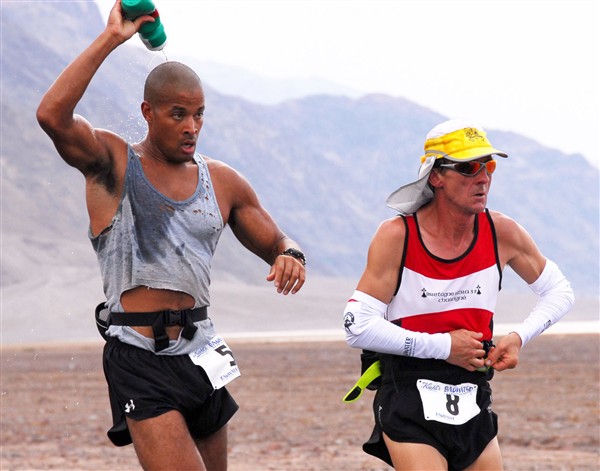
These aren't motivational platitudes. They're operational protocols he used to do specific things — the documented 87-day transformation, the 4,030-pull-up world record, the Badwater 135 finishes.

Why The Story Matters
Three reproducible lessons:
1. The transformation timeline is shorter than most people believe. 87 days from 297 to 191. Not five years of slow progress. Not "eventually." 87 days. The bottleneck is rarely time — it's willingness to do the protocol every single day.
2. The protocol can be brutally simple. No designer drugs. No premium gym. No coach. Just the same protocol every day for three months. Most fat-loss failures are not protocol failures — they're adherence failures. Goggins's edge wasn't a better protocol; it was zero deviation.
3. The mental framework is trainable. The accountability mirror and the 40% rule are not Goggins's personality. They're techniques he developed and applied. They are available to anyone willing to use them.
The honest caveat: the protocol is dangerous. Five hours of training daily at 297 lb produced injuries he then had to push through. Most people should not attempt this directly. The reproducible insight is the mental architecture, not the literal 5-hour days.
What This Suggests Operationally
For anyone considering a hard transformation:
- Write the specific number on a Post-it. Weight, deadline, financial goal. State it out loud. Look at it every morning.
- Design a protocol you can execute every day. Daily reps beat episodic intensity.
- Expect the felt-limit at 40%. When the body says "done," check whether that's real or whether it's the predictable mid-protocol resistance.
- Build the cookie jar. Each completed hard thing is permanent evidence available for future hard things.
What TaskCoach.AI Does With This
The Goals + Habits system can hold the accountability-mirror layer: specific target written, daily statement of intent, daily completion track. The Analytics view surfaces the daily streak. The system handles the structure that Goggins did with Post-its.
The Bottom Line
297 lb → 191 lb in 87 days. Then Navy SEAL. Then Ranger. Then ultra-endurance icon.
One person. Specific protocol. Sustained adherence. Mental framework that's trainable, not innate.
Most transformations are not impossible. They're just unattempted. The protocol Goggins used isn't optimized — but it produced one of the most documented physical transformations of the modern era because he ran it without deviation for 87 consecutive days.
The lesson is not "be like Goggins." The lesson is: the difference between people who transform and people who don't is rarely the protocol. It's the daily adherence to whatever protocol they chose.