Thal, Austria. 1947. Population 800.
Arnold Schwarzenegger was born in Thal, a village of about 800 people in the Austrian state of Styria, two years after World War II ended. His father was the local policeman, carrying real psychological damage from years of Wehrmacht service, the kind that would get called PTSD today. Their house had no indoor plumbing until Arnold turned 15; every morning, someone walked to the well for water.
He spoke no English. He had no money and no connections outside the village. At 14, he saw a magazine photo of Reg Park, a former Mr. Universe, and got interested in bodybuilding, which his parents thought was strange.
By 56, this is who he'd become:
- Seven-time Mr. Olympia, and the youngest man ever to win the title, at 23
- A real-estate millionaire, years before he earned a dollar acting
- The highest-paid action star of the late 1980s and 1990s
- Married into the Kennedy family
- Twice elected Governor of California
This is one of the most deliberately built careers of the last century, laid out in detail across his two memoirs.
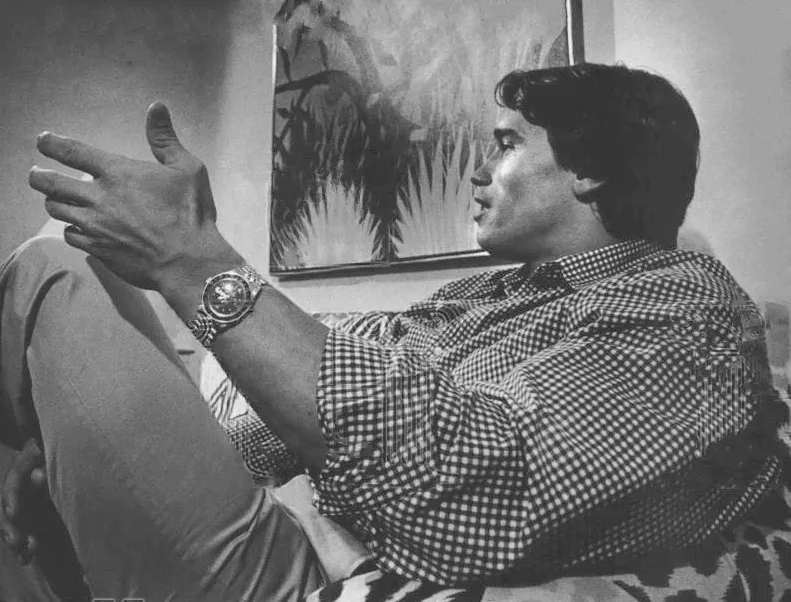
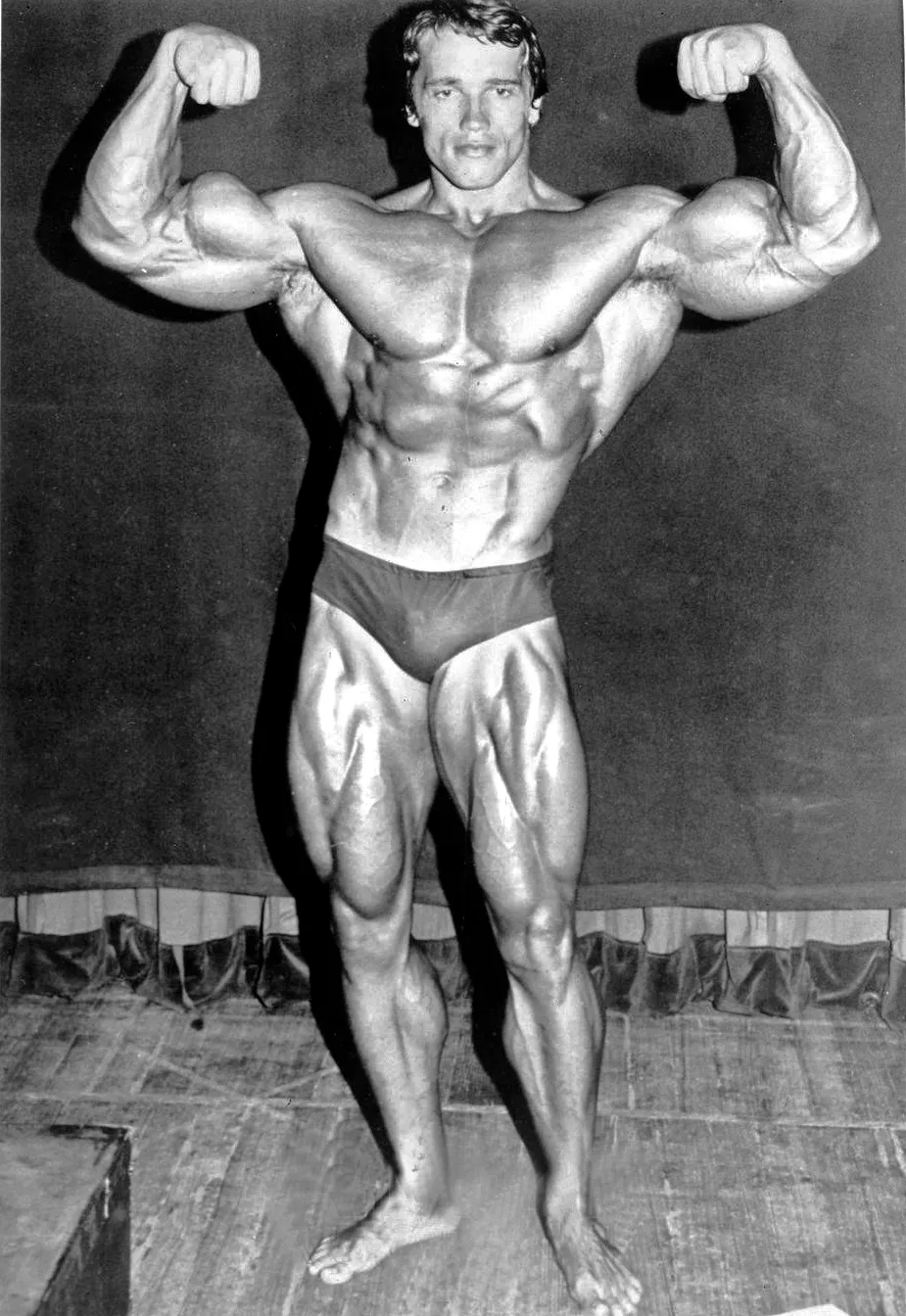
Phase 1: the bodybuilding years, 1962 to 1975
Schwarzenegger started lifting at 15. By 18, he'd won Junior Mr. Europe. At 20, in 1968, he landed in America with $20 in his pocket and just enough English to get by.
Two years later he won Mr. Olympia at 23, the youngest champion ever, and went on to take the title seven times between 1970 and 1980.
What most retellings skip: bodybuilding was the vehicle, not the destination, and he says so himself in his own books. Winning trophies got an unknown kid from rural Austria noticed, which was the actual point.
None of it happened by accident:
- Training: five hours a day, split into morning and afternoon sessions, for years.
- Food: over 200 grams of protein daily, before protein powder was easy to buy.
- Mind: visualization, holding the Mr. Olympia trophy in his head for years before he ever touched the real one.
- Relationships: he cultivated Joe Weider, publisher of America's biggest bodybuilding magazines, who funded his move to the US and gave him a platform.
Training and diet built the body. The body plus Weider's magazines built the fame. Fame was the asset he'd been quietly stockpiling the whole time.
Phase 2: buying real estate before he was famous, 1968 to 1975
This is the part of the story that gets left out most often.
While he was winning bodybuilding titles in the late 1960s and early 1970s, Schwarzenegger was quietly buying property in Santa Monica. He bought his first apartment building at 25, paid for with prize money, posing fees, and profits from a bricklaying business he ran with fellow Austrian Franco Columbu.
Santa Monica real estate took off through the 1970s. By 27, Schwarzenegger's holdings had made him a millionaire, years before acting paid him anything at all.
He's said outright that by the time he started acting, he didn't need the money. Real estate had already given him financial independence, so he picked roles based on career strategy, not paycheck size, and could say no to the parts that would have typecast him for good.
Phase 3: turning disadvantages into a signature, 1975 to 1990
By the normal rules of Hollywood casting, Schwarzenegger had nothing going for him: a thick Austrian accent, a name nobody could spell, a build considered too big for a leading man, no acting training, no theater background.
His first film, Hercules in New York (1969), dubbed over his voice entirely because his accent was judged too hard to follow. His second credit: a 1976 documentary about his own bodybuilding career, Pumping Iron.
The real break was Conan the Barbarian (1982). Director John Milius cast Arnold because of the accent and the physique, not despite them. The role needed a foreign warrior who barely spoke the language, and his old liabilities became exactly what it required.
The Terminator (1984) locked the career in for good. James Cameron had originally cast Arnold as the human hero, Kyle Reese. Arnold pushed to play the villain instead, betting a role built on a handful of clipped lines, "I'll be back" among them, would show his strengths instead of his weaknesses.
Over the next 15 years he became the highest-paid action star working. Terminator 2: Judgment Day (1991) paid him $15 million. By the late 1990s his asking price had climbed to $30 million a film, plus a cut of the profits.
Phase 4: from movie star to governor, 2003 to 2011
In 2003, California moved to recall Governor Gray Davis. Schwarzenegger announced his candidacy live, on The Tonight Show.
Almost no political observer gave him a real shot. He'd never held office. His policy positions were all over the map. Six weeks before the election, he still didn't have a campaign organization in place.
He won anyway.
He served two full terms, from 2003 to 2011, steering California through the 2008 financial crisis and years of brutal budget fights.
Trace the chain backward: politics ran on acting fame, acting ran on the bodybuilding platform, bodybuilding ran on Joe Weider's magazines, all the way back to a teenager training twice a day in a village with no running water.
Why the stack compounded
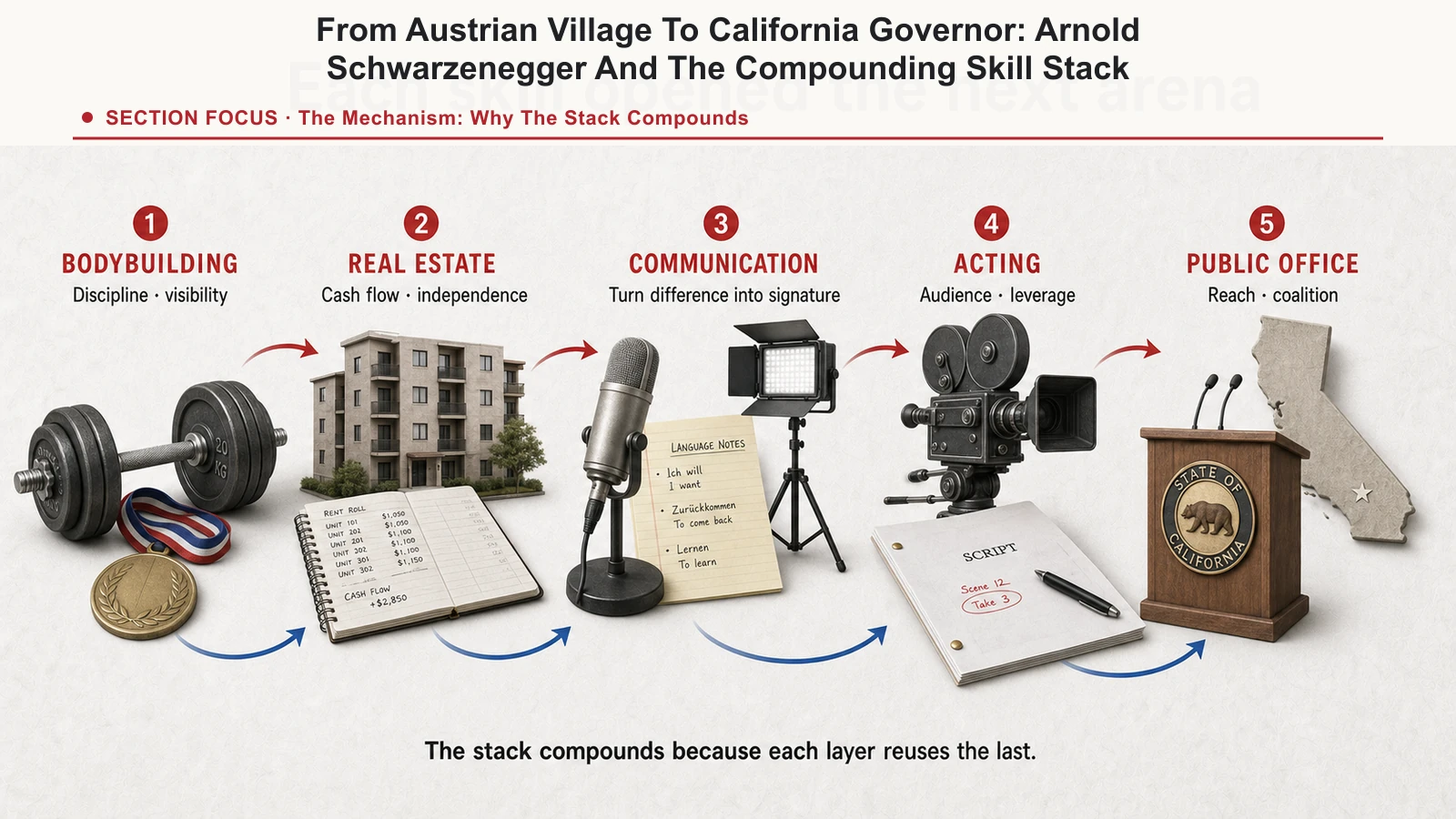
The individual chapters of this story aren't really what make it worth studying. The compounding is.
Each phase ran directly on what the last one had already produced:
- Bodybuilding wins produced fame and prize money.
- Fame and money bought real estate and pried open acting auditions that would otherwise have stayed shut.
- Acting success produced serious wealth, cultural standing, and name recognition worldwide.
- That cultural standing is what made a run for governor possible in the first place.
This is Scott Adams's "talent stack" idea (see our side-hustle post), taken about as far as it can go. Schwarzenegger wasn't the best bodybuilder who ever lived, the best actor, or the best politician of his era. He didn't need to be: he landed in the top tier of all three, and that combination is rare.
In Be Useful (2023), he spells out the formula himself: get a clear vision, work harder than feels reasonable, sell yourself without apology, and never settle for the first draft of anything.
What survives the survivor-bias test
A few lessons hold up well outside of bodybuilding, movies, and politics.
Start with whatever you actually have. Schwarzenegger started in Thal with no money, no English, and nothing but a willingness to work. That stake was enough to compound from.
The order you build skills in matters. Every phase used what came before it, on purpose. Get the sequencing right and recognition in one area can create access to the next.
A liability can become a signature in the right market. The accent, the size, and the name made him unmistakable once he found roles that rewarded them. That is a market-fit lesson, not a guarantee that every disadvantage becomes an asset.
Money earned early buys freedom later. Real-estate wealth meant he didn't have to take the first acting job offered. Acting wealth meant he could risk a political career with no guarantee of winning. Cash in the bank is the ability to say no.
Visualization matters, but only next to the work. Schwarzenegger talks constantly about picturing the outcome years ahead of time: the Mr. Olympia trophy in his mind long before it was in his hands, then the same thing again in acting. The daily training and the daily auditions move the outcome, not the mental picture. Visualization points the compass; the work covers the distance.
There is serious survivor bias here. Thousands of bodybuilders trained hard, moved cities, promoted themselves, and never became wealthy actors or governors. Schwarzenegger also benefited from timing, mentors, a growing fitness-media market, rising California property values, citizenship, celebrity, and opportunities unavailable to most people. His outcome cannot prove that intensity produces the same result for anyone who copies it.
The more transferable pattern is smaller: build an asset, use it to earn access, and keep enough financial or professional slack to choose the next move deliberately.
Test whether your current skill can travel
Pick one skill or asset you already have. Then answer five questions with evidence rather than optimism:
- Proof: What result shows that you can do this reliably?
- Audience: Who already notices or benefits from that result?
- Adjacent door: Which role, client, project, or market values the same proof?
- Missing bridge: What one skill, credential, relationship, or sample would make the move credible?
- Downside protection: What income, savings, or reversible trial lets you test the move without betting your whole life?
Suppose you are a strong internal analyst who wants to consult. Your proof might be a forecasting process that improved a team decision. The audience is currently one employer. The adjacent door is a narrow group of firms with the same decision problem. The bridge is a sanitized case study and five customer interviews. Downside protection could be one small paid project completed before you reduce your hours.
That is a skill stack you can inspect. Each link has evidence, a buyer, and a next experiment.
Map the next bridge
The Goals and Pillars system holds a plan that spans decades: which skill you're building this year, which earlier skill it leans on, and what the next phase should open up once this one pays off. The Vision section in the app is built around exactly this kind of long-range thinking. Almost nobody maps their life out this way, which makes doing it a real edge.
What to carry into your own career
A village in Austria with no indoor plumbing. A Mr. Olympia title. A real-estate portfolio. A Hollywood career. A governorship.
One person lived all of it, each stage built, on purpose, on top of the last. That's what a skill stack compounding across decades looks like.
Nobody's expected to reproduce Schwarzenegger's outcome. What holds up is the option-building logic: sequence skills so that today's credible result lowers the cost of testing tomorrow's direction.
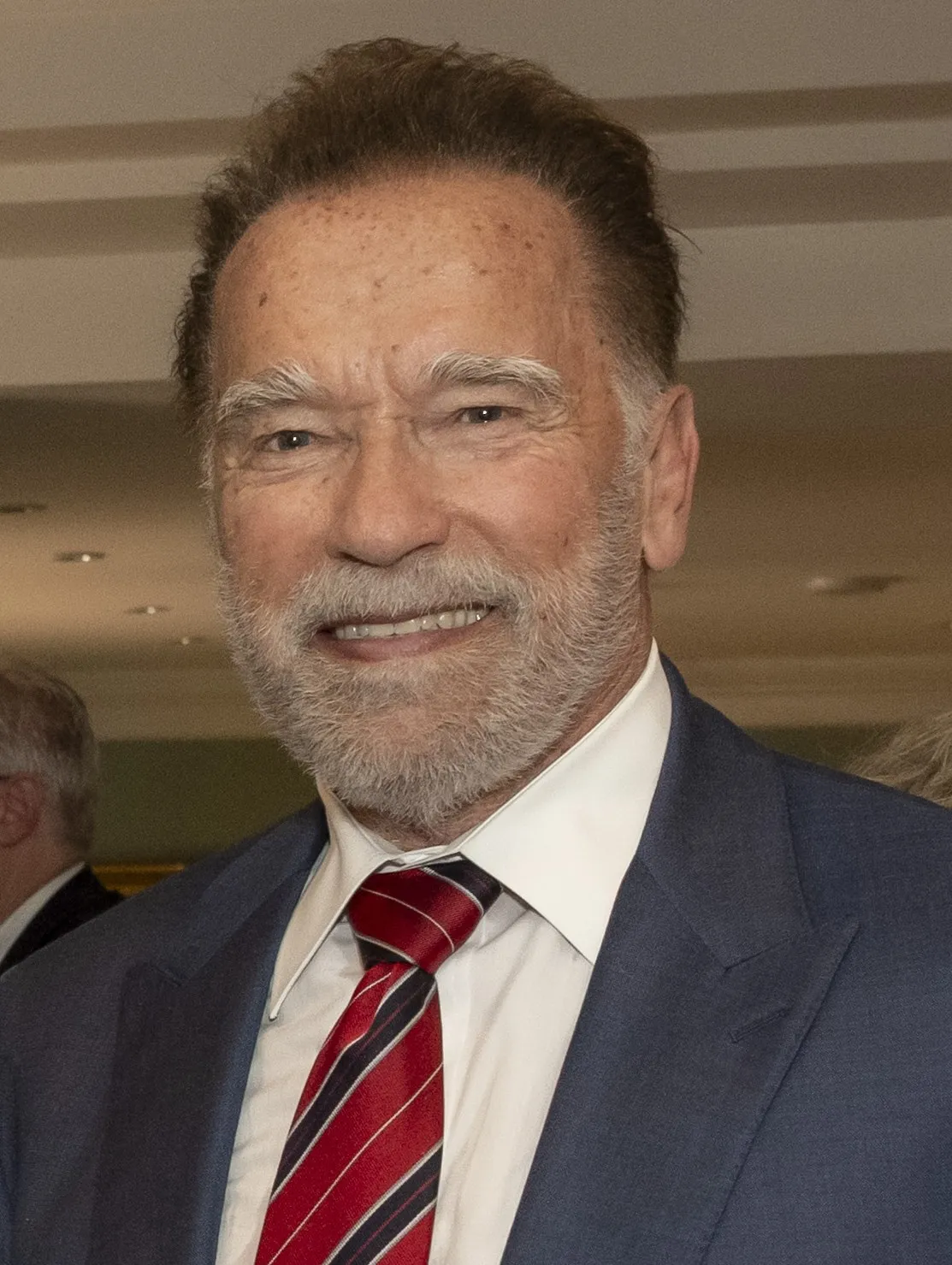
Most people don't think about their own lives in 30-year arcs. Schwarzenegger has, since he was a teenager. That difference in time horizon is most of the story.