Thal, Austria. 1947.
Arnold Schwarzenegger was born in Thal — a village of 800 people in the Austrian state of Styria. Post-WWII rural poverty. His father was a local policeman with PTSD from his Wehrmacht service. The family home had no indoor plumbing until Arnold was 15. They walked to the well each morning for water.
He spoke no English. Had no money. Had no connections outside the village. Showed an interest in bodybuilding at 14 after seeing a magazine featuring Reg Park (a previous Mr. Universe). His parents thought it was strange.
By age 56, Schwarzenegger had been:
- 7-time Mr. Olympia (the youngest ever to win, at 23)
- A real-estate millionaire (before his acting career)
- The highest-paid action movie star of the late 1980s and 1990s
- Married into the Kennedy family
- Elected Governor of California (twice)
The trajectory is one of the most deliberately constructed careers in modern history. It is also documented in detail across his two memoirs.

Phase 1: The Bodybuilding Foundation (1962-1975)
Schwarzenegger started lifting at 15. By 18 he had won Junior Mr. Europe. By 20 he had emigrated to America (1968) with $20 in his pocket.
He won Mr. Olympia in 1970 at age 23 — the youngest ever — and won it seven times total (1970-75, 1980).
The bodybuilding career was the foundation, but it wasn't the goal. In his books he is explicit: he saw bodybuilding as a vehicle to fame, which would unlock the next phase.
The protocol was deliberate:
- Training: 5 hours/day, split sessions (morning + afternoon). For years.
- Nutrition: 200+ grams of protein per day in an era before protein supplements were standard.
- Mental: Visualization. He explicitly states he saw the trophy in his mind for years before holding it.
- Networking: Befriended Joe Weider, who ran the major US bodybuilding magazines. Weider sponsored Arnold's move to America and provided the platform for fame.
The training/nutrition produced the body. The body + Weider's platform produced the fame. The fame was the asset.

Phase 2: Real Estate Before Acting (1968-1975)
This is the under-told part of the Schwarzenegger story.
In the late 1960s and early 1970s, while winning bodybuilding titles, Schwarzenegger was buying real estate in Santa Monica. He bought his first apartment building at age 25 with money from bodybuilding prize purses, posing fees, and a bricklaying business he ran with fellow Austrian Franco Columbu.
The Santa Monica market through the 1970s appreciated significantly. By 27, his real-estate holdings made him a millionaire.
He has stated explicitly in interviews: when he started acting, he didn't need the money. He had already won the financial-independence game through real estate. This freed him to take roles based on long-term career strategy rather than short-term paychecks — which is why he could turn down the kind of typecast roles that would have limited him.
Phase 3: Acting Despite Every Disadvantage (1975-1990)
By conventional Hollywood criteria, Schwarzenegger had every disadvantage for an acting career:
- Heavy Austrian accent
- A name nobody could spell
- A physique that was "too big" for normal roles
- No acting training
- No theatrical background
His first film was Hercules in New York (1969) — his voice was dubbed because his accent was considered unintelligible. His second was a 1976 documentary about himself (Pumping Iron).
The breakthrough was Conan the Barbarian (1982). Director John Milius cast him specifically because of the physique and accent — the role required a foreign-language-speaking warrior, and Arnold's accent became an asset rather than a liability.
The Terminator (1984) sealed the career. Director James Cameron originally cast Arnold as the human protagonist Kyle Reese — Arnold pushed to play the antagonist instead because the limited dialogue ("I'll be back") played to his strengths rather than his weaknesses.
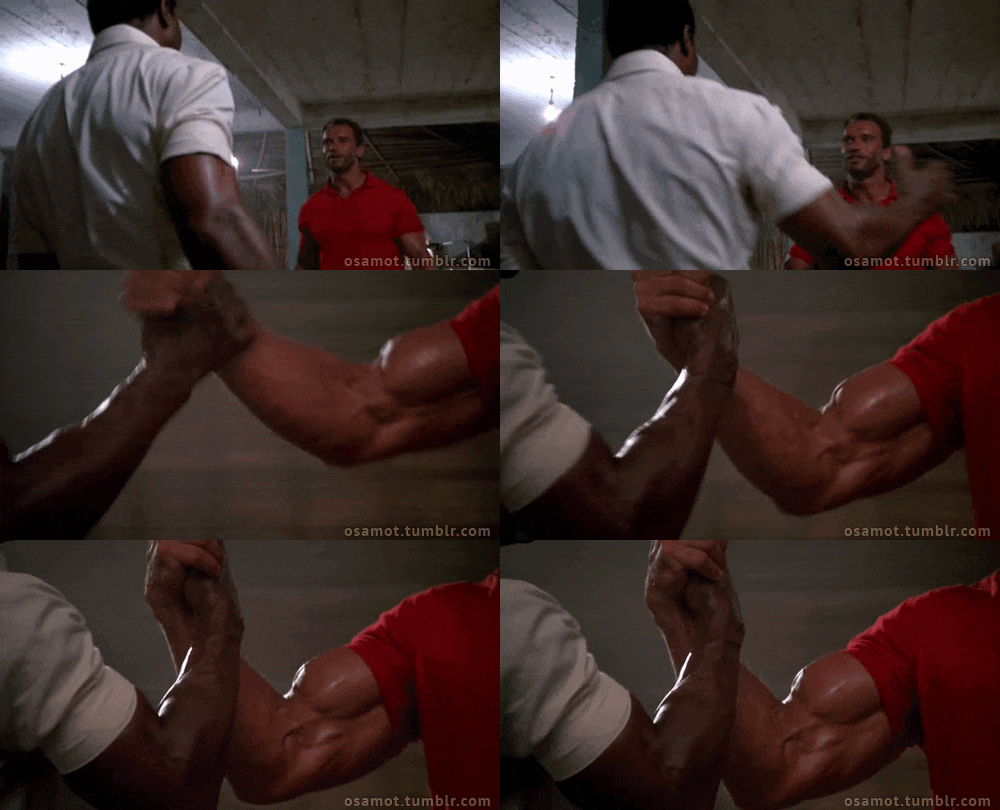
Over the next 15 years he became the highest-paid action star in Hollywood. Terminator 2: Judgment Day (1991) paid him $15M. By the late 1990s he was making $30M per film plus participation.
Phase 4: Politics (2003-2011)
The 2003 California gubernatorial recall election. Gray Davis was being recalled. Schwarzenegger declared his candidacy on The Tonight Show.
Most political observers gave him no chance. He had never held elected office. His policy positions were inconsistent. He had no campaign organization six weeks before the election.
He won.
He served two terms as Governor (2003-2011), navigating the 2008 financial crisis and significant state-budget challenges.
The political career used the acting career's fame, which used the bodybuilding career's foundation, which used Joe Weider's platform, which used the daily training discipline that started in a village in Austria.
The Mechanism: Compounding Skill Stack

What makes this story instructive isn't the individual phases. It's the deliberate compounding.
Each phase explicitly used the previous phase's accumulated assets:
- Bodybuilding success → produced fame + prize money
- Fame + money → enabled real-estate investing + opened acting auditions
- Acting success → produced wealth + cultural capital + global recognition
- Cultural capital → enabled the political pivot
This is Scott Adams's talent stack (see our side-hustle post) in extreme form. Schwarzenegger was not the best bodybuilder, the best actor, or the best politician of his generation. He was top-percentile at all three, and the combination was rare.
In his book Be Useful (2023) he articulates the principle directly: have a clear vision, work brutally hard, sell yourself relentlessly, never settle for the first iteration.
What This Story Suggests

Several reproducible lessons:
1. Start where you are. Thal, Austria. No money. No language. Schwarzenegger started with what he had — physical effort — and compounded from there.
2. Sequence matters. Each phase deliberately used the previous phase's assets. The right sequencing converts "fame from one domain" into "leverage in the next."
3. Liabilities can become assets with the right framing. The accent. The body. The name. Each was reframed from disadvantage to differentiator. Most people optimize away their unusual traits; the right move is often to lean into them.
4. Financial independence early frees later choices. The real-estate wealth before acting let him refuse typecast roles. The acting wealth let him take political risk. Money in the bank is optionality.
5. Visualization plus relentless work. Schwarzenegger is famous for his belief in vivid mental rehearsal. He describes seeing himself as Mr. Olympia for years before he was — same with the acting career. The visualization is necessary but not sufficient; the daily work is the engine.
What TaskCoach.AI Does With This
The Goals + Pillars system can hold the multi-decade compound plan: which skill am I building this year, which previous skill am I leveraging, what's the next phase that will use this phase's outputs. The Vision section in the user guide is built around exactly this kind of multi-decade architecture. Few users explicitly map their life this way; doing so is itself a competitive advantage.
The Bottom Line
A village in Austria. A Mr. Olympia title. A real-estate portfolio. A Hollywood career. A governorship.
One person. One life. Each phase deliberately built on the previous. The skill-stack compounds across decades.
The lesson isn't to be Schwarzenegger. The lesson is that the compounding is real, the sequencing is choosable, and the long-term architecture of a career rewards deliberation more than talent.

Most people don't think in 30-year arcs. Schwarzenegger did, from his teens. The arc is the difference.