The only rule
Here's the one rule that actually matters: eat less energy than your body burns, and keep doing that over time. That's the whole game.
Every diet that's ever worked, keto, intermittent fasting, carnivore, paleo, vegan, Mediterranean, Whole30, or just plain calorie counting, gets you to the same place through the same mechanism: a caloric deficit. The marketing changes from diet to diet. The thermodynamics never do.
Kevin Hall and his team at the NIH tested this directly. They put volunteers in a metabolic ward, a fully controlled environment, and measured exactly how much energy went in and exactly how much came out. The result wasn't ambiguous: when intake drops below what your body burns, body fat goes down. It doesn't matter whether the missing calories came from less fat, fewer carbs, less protein, or just smaller portions across the board. Your body burns what it has access to and doesn't check the label first.
Why every diet "works"
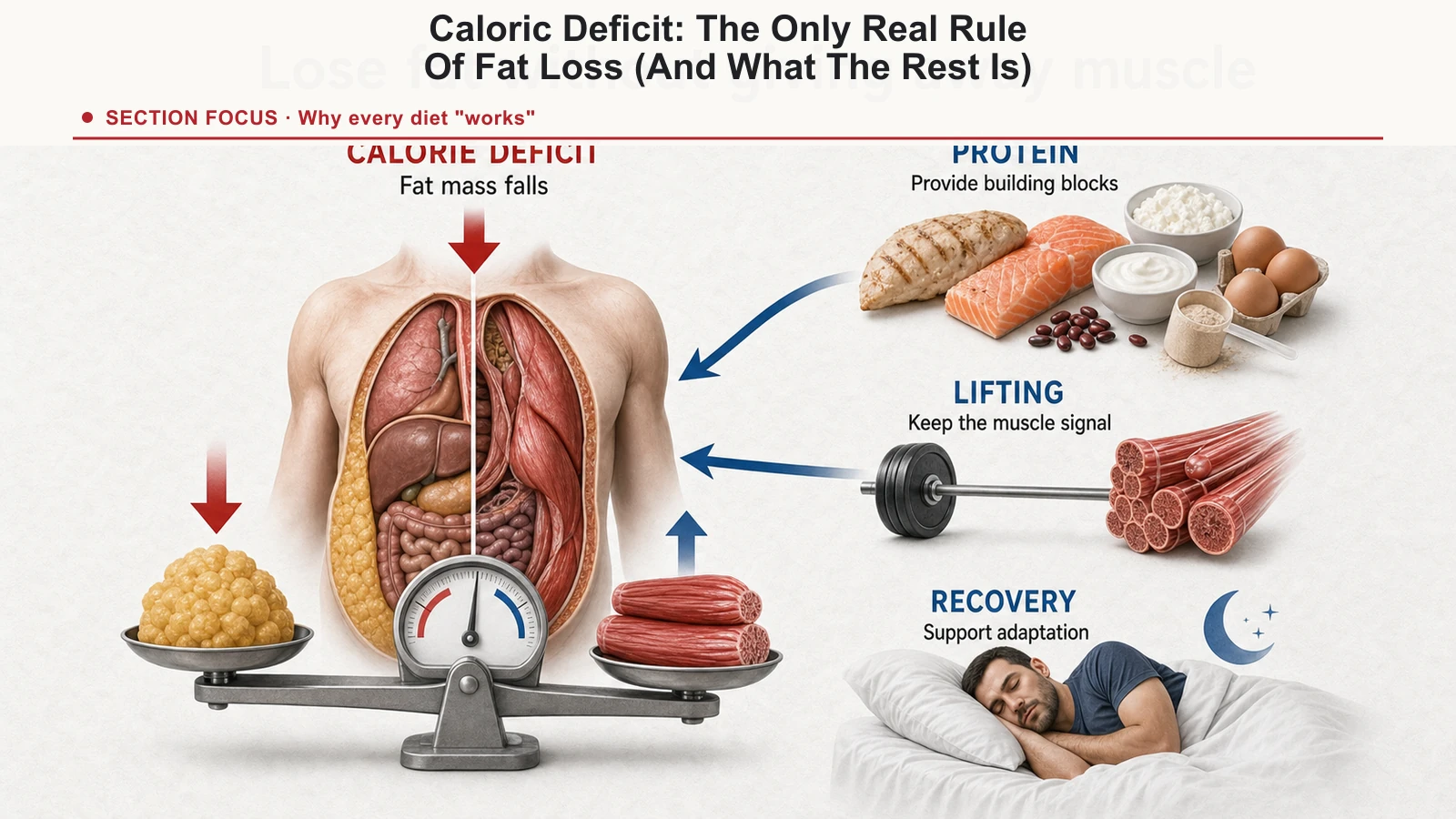
So why does one diet get credit and another doesn't? Because each one is a different, indirect way of forcing that deficit without asking you to count anything.
Keto fills you up fast per calorie, thanks to all that fat and protein, and it quietly removes whole categories of food that are easy to overeat: bread, pasta, anything sweet.
Intermittent fasting shrinks your eating window down to six or eight hours, which makes it mechanically harder to eat as much in a day.
Vegan diets lean on foods that are naturally less calorie-dense once animal products are off the table, so you fill up before you blow your budget.
Paleo and Whole30 remove the ultra-processed, hyper-palatable foods that are practically engineered to make you eat past full.
Four different strategies, one outcome. None of them involve metabolic magic. They're just different roads to eating less than you burn, and the one that works for you is whichever road you can actually stay on.
Macros are a quality knob, not an on/off switch
The deficit decides whether you lose weight at all. Your macro split decides what that weight loss is made of, muscle or fat, and how bearable the process feels along the way.
Protein matters most. A widely cited systematic review by Eric Helms and colleagues, looking specifically at resistance-trained people in a calorie deficit, points to somewhere around 1.6-2.2 grams of protein per kilogram of bodyweight a day as the range that best protects muscle while you cut. Drop much below about 1.2 g/kg and body recomposition gets a lot harder, because your body starts treating muscle as an easy source of backup fuel.
Carbs matter for a different reason: they support how hard you can train. Cutting them aggressively feels fine for the first week or two. Then your lifts start sliding backward, and staying in the deficit gets harder instead of easier.
Fat has a floor, too. Drop below roughly 0.5 g/kg and your hormone production takes the hit; both testosterone and estrogen need dietary fat to be made properly.
Put all three together and you get the template most experienced lifters land on eventually: protein high, fat moderate, carbs filling in whatever's left around your training days.
The rate of loss matters
Cutting fast isn't the flex people think it is. Push weight loss past about 1% of your bodyweight a week (roughly 2 lb a week for someone at 200 lb) and your body starts breaking down muscle right alongside the fat. That threshold is the range sports nutrition researchers Alan Aragon and Brad Schoenfeld point to after reviewing the diet and body-composition literature, not a guess.
The sweet spot for most people looks like this:
- 0.5-1% of bodyweight lost per week
- A 300-500 calorie daily deficit
- High protein, 1.6-2.2 g/kg
- Strength training kept up, not scaled back
Hold that pattern and you'll lose 1-2 lb of fat a week with barely any muscle loss to show for it. It's slower than what gets promised in your feed. It's also a lot faster than the crash-diet-and-rebound cycle that ends up costing people a full year of progress.
The adherence question
Every diet runs into the same ceiling, and it's just how long you can actually keep doing it, not a metabolic one.
Over months and years, the variable that decides how your body actually changes is your retention rate inside whichever diet you picked, not which one is theoretically most efficient. A diet you follow at 80% for eighteen months beats a "perfect" diet you white-knuckle for six weeks and then quit, every single time.
That's also why someone else's protocol might do nothing for you. The mechanism, a deficit, enough protein, consistent training, real sleep, is the same for everyone. Fitting that mechanism into your actual week is personal, and it's worth the extra time it takes to get right.
What TaskCoach.AI does with this
TaskCoach.AI's Body pillar isn't trying to replace a calorie counter. Its habit tracking and daily check-ins cover the variables that actually decide whether your deficit holds up: did you log your food, did you hit your protein target, did you train, how many hours did you sleep. Stay consistent on those four and the scale mostly takes care of itself.
The bottom line
A caloric deficit, sustained, with enough protein, real training, and real sleep. That's the entire formula.
Everything else you've read about fat loss is marketing wearing a lab coat.
The diet that works is the one you're still doing a year from now. Pick the version of the deficit you can actually hold, not the one promising the fastest results on someone's before-and-after post.