1. The three-pound universe
Your skull holds about three pounds of pinkish-gray tissue. By weight, that's not much. By complexity, it's the most intricate object we know of in the universe.
It's a stack, though, not one single thing: three brains layered on top of each other, each one added by evolution over hundreds of millions of years, each running semi-independently and modulating the ones underneath it. The layer reading this sentence right now is the youngest one. The layer keeping your heart beating while you read it is the oldest. They share a skull and a bloodstream, but they don't always agree on what to do next.
The rest of this piece is a tour through every major region: what it actually does, and which animals share the same layer of the stack with you.
2. The reptilian core: what you share with a lizard
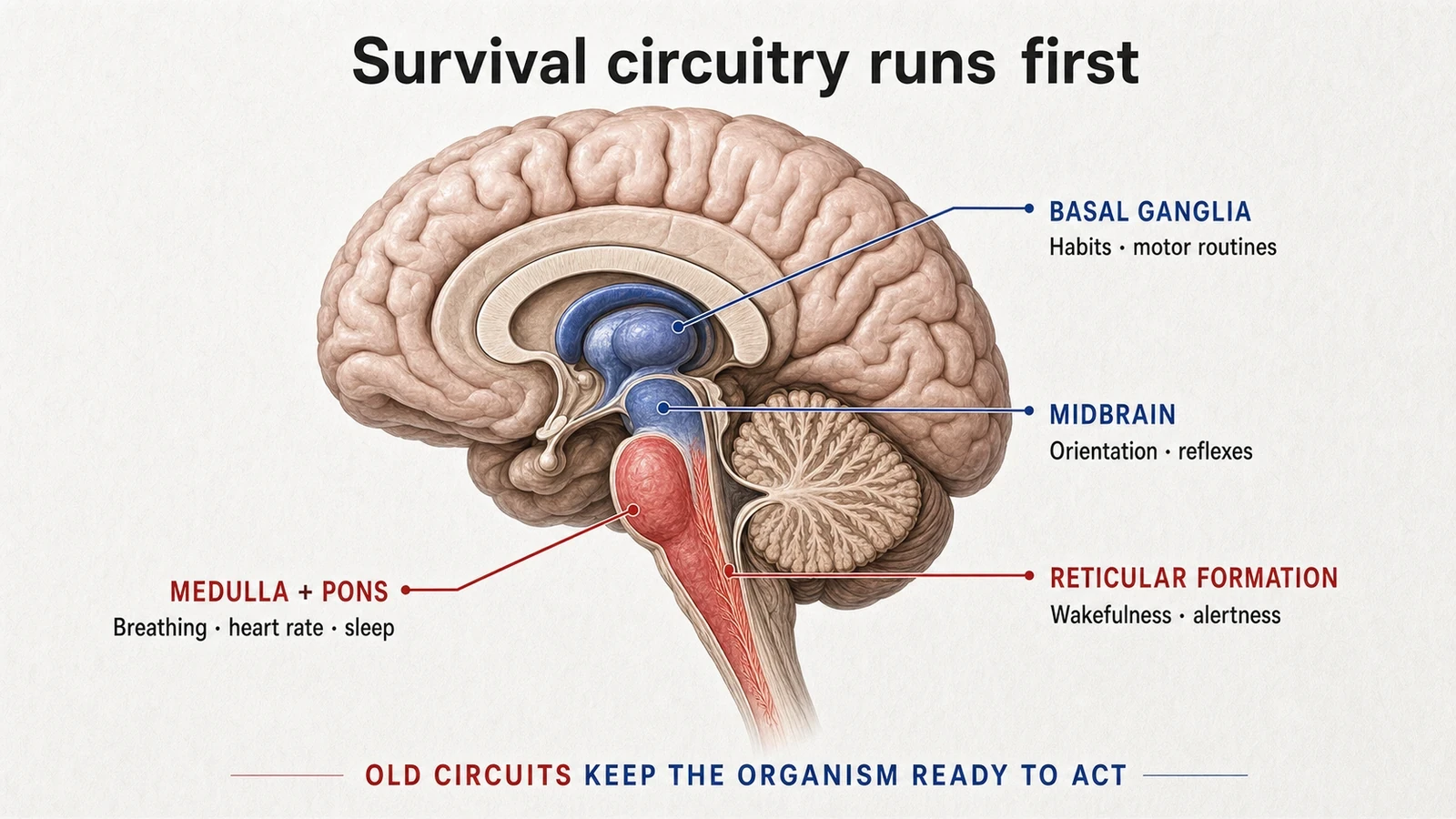
At the base of your skull, right where the spinal cord meets the brain, sits the oldest layer of all. It's been present in some form in every vertebrate for roughly 500 million years, and its job is keeping you alive while the rest of your brain handles everything else.
What this layer actually does
Brainstem (medulla, pons, and midbrain). Heart rate, breathing, blood pressure, swallowing, vomiting, reflexive eye movements. The medulla alone, severed from the rest of the brain, can keep a body alive. Brain-death examinations specifically check brainstem function: when it's gone, the person is gone, even if the heart is still being maintained on machines.
Basal ganglia. Habit and routine live here. This is where well-practiced motor sequences get stored: riding a bike, typing on a keyboard, the route you take to work on autopilot. The basal ganglia is also where addictive behavior gets etched in. When something becomes "automatic," it's because the basal ganglia has quietly taken it over from the conscious cortex.
Reticular formation. A diffuse network that gates wakefulness itself. Damage it badly enough and the person simply doesn't wake up.
The lizard comparison
A lizard's brain is mostly this layer plus a thin overlay on top. It has a brainstem handling breathing and heart rate. It has a basal ganglia running stereotyped behavior: flicking its tongue at an insect, bolting from a shadow, basking on a warm rock at the right time of day. What a lizard lacks is the rich emotional life of a mammal and the planning capacity of a primate.
A lizard doesn't love its young. It basks in the sun because it's tracking a thermal gradient, not because it decided to. It doesn't remember you. Its behavior stays reactive and stereotyped because the layer that would let it be anything else simply isn't there.
You share every structure in your reptilian core with a lizard. The difference is entirely what's built on top of it.
3. The mammalian middle: what you share with a cat
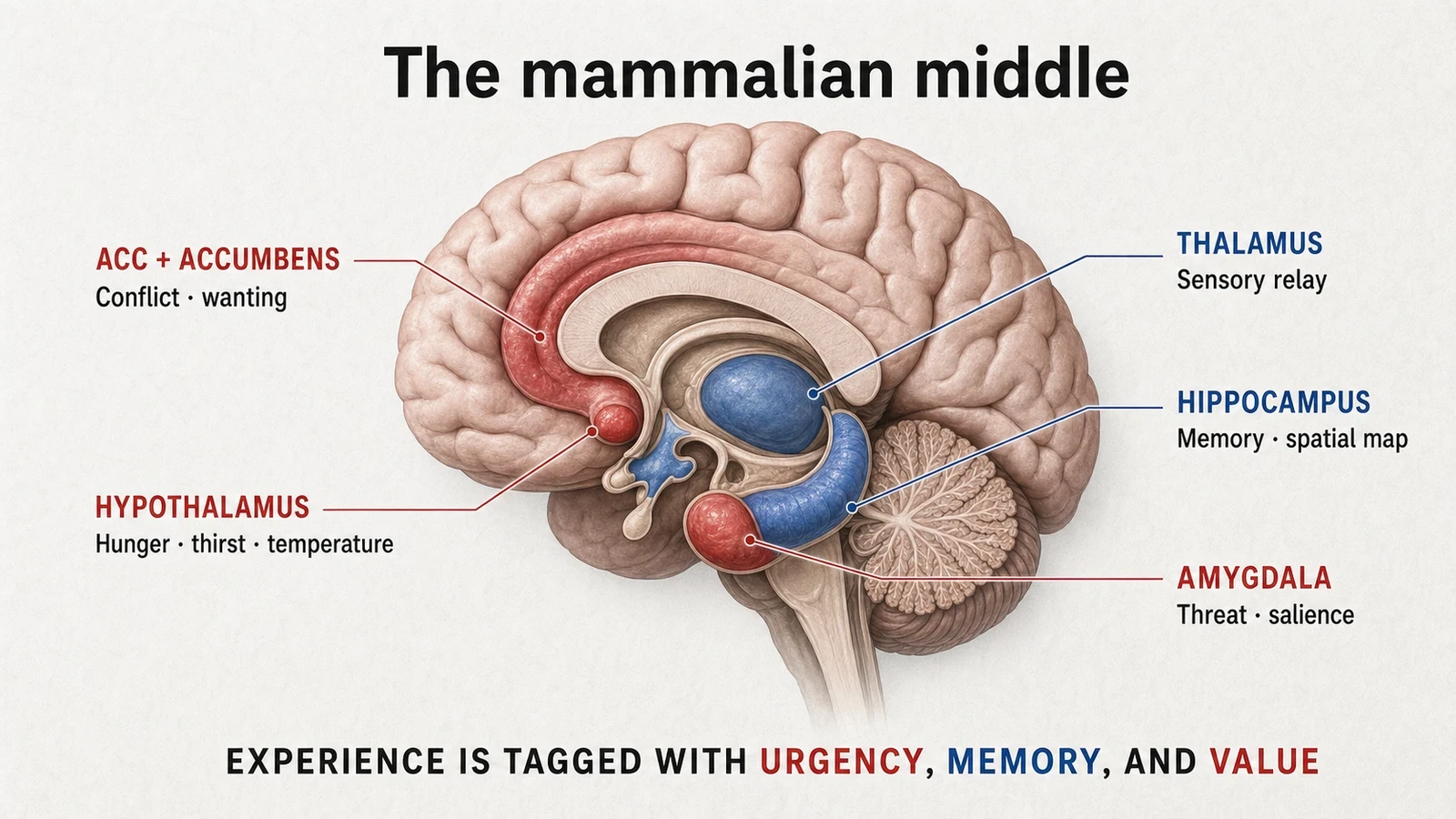
Wrap a layer around the reptilian core and you get the limbic system, the set of structures shared by all mammals. This is the layer that introduces emotion, attachment, fast memory, and motivated behavior.
What this layer actually does
Amygdala. Threat detection. Your amygdala decides something is dangerous roughly 80 milliseconds before your conscious mind catches up, which is why you flinch before you even register what made you flinch. It also handles emotional salience: what stands out, what feels important, what you'll still remember vividly years later.
Hippocampus. Episodic memory and spatial navigation. When you remember what you had for breakfast, that's the hippocampus at work. When you mentally walk through your apartment, same thing. Damage it, as happened to the famous Patient HM, who had both hippocampi surgically removed in the 1950s, and you lose the ability to form new long-term memories, even though older memories and procedural skills stay fully intact.
Hypothalamus. The body's set-point regulator. Hunger, thirst, sex drive, body temperature, sleep cycles, cortisol release: all of it runs through here. The hypothalamus is tiny, about the size of a pea, yet it controls more behavior than any structure of comparable size in your entire body.
Anterior cingulate. Conflict monitoring and emotional pain. When something hurts your feelings, the same region lights up that would light up if something hurt your finger. The cingulate also runs the "wait, this doesn't add up" signal, the part of your brain that notices contradictions before you can even articulate what's wrong.
Nucleus accumbens. Wanting. This is the dopamine hub, the structure that fires when you anticipate a reward: food, sex, social validation, a notification. Note that it's anticipation, not pleasure itself. The pleasure part runs on opioid signaling elsewhere in the brain.
The mammal comparison
A cat has all of the above. It feels fear through its amygdala. It remembers where its food bowl is thanks to its hippocampus. It gets hungry, thirsty, hot, and cold because of its hypothalamus. It wants things and chases them because of its nucleus accumbens. It forms real attachments, and your cat genuinely recognizes you and prefers you over strangers in a way a lizard simply cannot.
What a cat lacks is the cortical layer that would let it abstract, plan more than a few minutes ahead, or reason about its own mental states. A cat does not lie awake at 3am wondering if it should have taken the other job.
4. The primate crown: the neocortex
Wrap one more layer around the limbic system and you get the cerebral cortex, the wrinkled outer shell. In mammals it's present but modest. In primates it expands enormously. In humans it folds in on itself so much that it fits roughly six times more surface area than would fit on a smooth brain of the same volume.
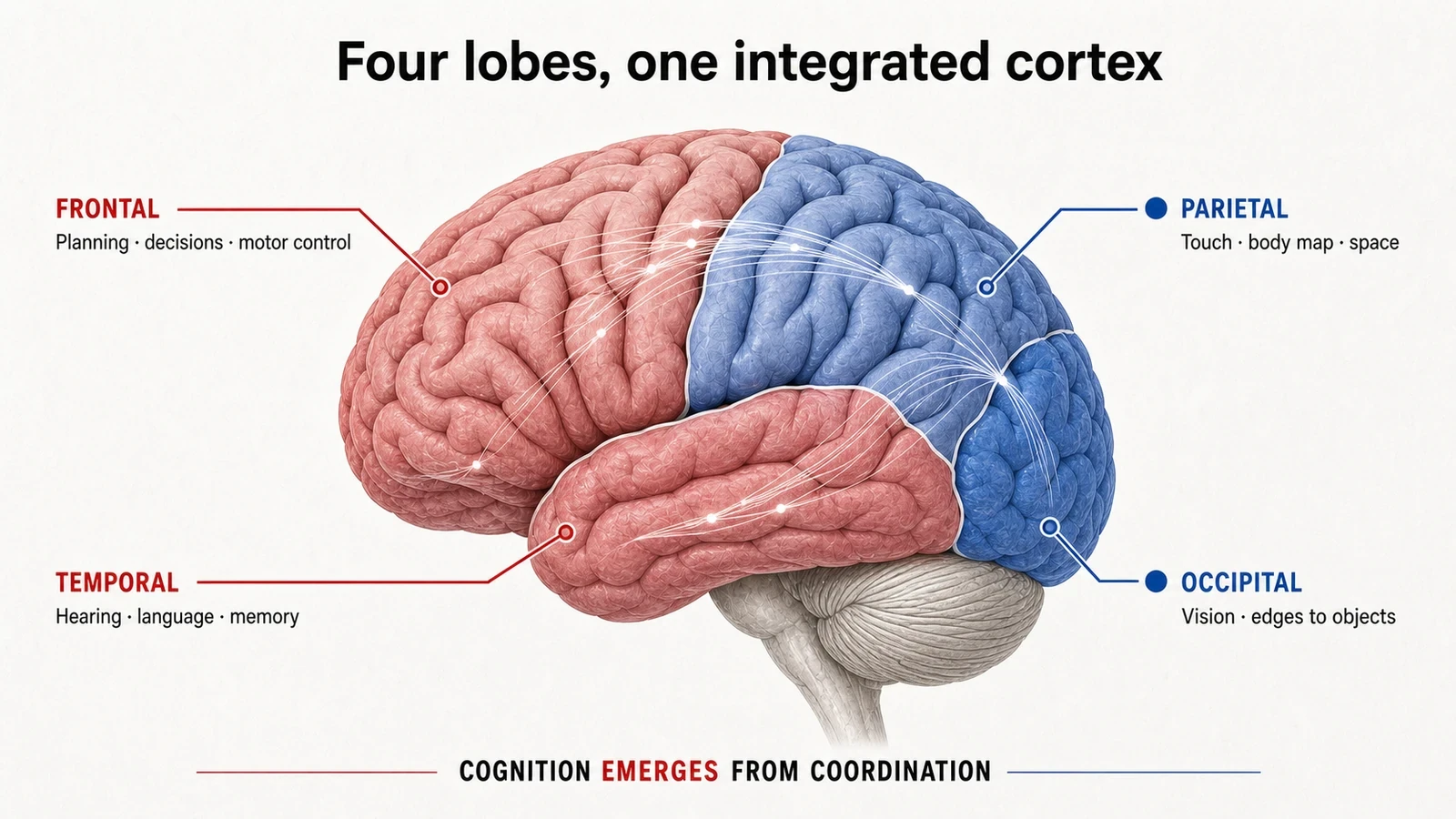
The cortex splits into four lobes per hemisphere:
What this layer actually does
Occipital lobe (vision). The back of your skull is basically a visual processor, six layers deep, each one tuned to a different aspect of what you're seeing: edges, motion, color, faces, objects. Roughly 30% of the cortex is involved in vision in some way. The hierarchy from V1 (raw edges) to the inferotemporal cortex (recognized faces) is so well mapped that modern computer-vision systems are explicitly modeled on it.
Temporal lobe (hearing, language, faces, memory). Auditory cortex processes sound. Wernicke's area, on the left side, handles language comprehension. The fusiform face area is dedicated specifically to recognizing faces. The medial temporal lobe houses the hippocampus and runs memory consolidation.
Parietal lobe (touch, space, attention). Your body has a map inside here, sometimes called a "homunculus," where each body part gets represented in proportion to how sensitive it is (hands and lips are huge, your back barely registers). The parietal lobe is also where spatial reasoning happens: what's near you, where you're headed, how objects relate to each other in space. Damage the right side and patients develop hemispatial neglect, where they literally can't perceive the left half of their visual field.
Frontal lobe (movement, planning, personality). Motor cortex sits toward the back of the frontal lobe. Broca's area, on the left side, handles language production. The premotor cortex plans movement before it happens. And the prefrontal cortex, covered on its own below, handles the highest-order functions of all.
The primate comparison
A macaque monkey or a chimpanzee has all four lobes, with a neocortex that's more expanded than in non-primate mammals. Chimps can plan multi-step tool use, recognize themselves in a mirror, and learn rudimentary sign language. They have the raw substrate for abstraction, just not at human scale.
Where humans diverge most sharply from other primates is in one specific structure: the disproportionate expansion of the prefrontal cortex.
5. The human specialty: the prefrontal cortex
The prefrontal cortex is your brain's executive office. It sits behind your forehead. In a chimpanzee it makes up about 17% of the cortex. In a human, about 29%. That difference accounts for a surprising amount of what makes humans recognizably human.
What the prefrontal cortex does
- Future projection. Simulating yourself in scenarios that don't exist yet.
- Identity and self-model. The sense of being a continuous person across time.
- Ethical reasoning. Weighing competing values, anticipating consequences.
- Override. Saying no to the amygdala's impulse, the basal ganglia's habit, the hypothalamus's hunger.
- Working memory. Holding roughly 4 items in mind at once while operating on them.
- Theory of mind. Modeling what other people are thinking and feeling.
Why it's slow to mature and easy to break
The prefrontal cortex is the last region of the brain to fully myelinate. Its insulation isn't finished until roughly age 25, which is a big part of why teenagers genuinely do have weaker impulse control and worse long-horizon planning than adults: hardware still under construction, not a character flaw.
It's also the first region to degrade under sleep deprivation, alcohol, chronic stress, and aging. The same person who'd never make a particular choice well-rested at 10am might make it anyway, tired, at 11pm, because the override layer has gone offline.
The Phineas Gage case
In 1848, a railroad worker named Phineas Gage took an iron rod straight through the front of his skull. He survived. His prefrontal cortex did not. His friends reported afterward that he was "no longer Gage": his personality, impulse control, and decision-making had changed permanently, even though his intelligence hadn't. He became impulsive, foul-mouthed, and unable to hold down a job. Later analysis of his skull, using modern neuroimaging techniques, confirmed the damage centered on his prefrontal cortex. The case became the founding piece of evidence that this specific region houses the machinery of self-regulation and personality.
This is the most "you" part of your brain. It's also the most fragile.
6. The cerebellum: half the neurons, almost none of the fame
Sitting behind the brainstem, looking like a smaller brain stuck onto the back of the real one, is the cerebellum, Latin for "little brain." It holds roughly half of the brain's total neurons despite taking up only a fraction of its volume, because cerebellar neurons are packed in tiny and dense.
What it actually does
Classically, the cerebellum coordinates movement. It doesn't start motion (that's the motor cortex's job). It refines it. Every smooth, precise movement you make, catching a ball, threading a needle, walking down stairs without looking, is being fine-tuned by the cerebellum down to the millisecond. Damage it and you lose the ability to move smoothly, not the ability to move at all. Patients develop ataxia: jerky, miscoordinated, drunken-looking motion.
What the past two decades of research have shown is that the cerebellum does the same precision-coordination work on thought. Cerebellar damage impairs language fluency, working memory, attention, and emotional regulation, not just balance. It looks like the cerebellum does for cognition what it does for motion: fine-tuning timing, sequence, and prediction across the rest of the cortex.
It's been hiding in plain sight for a century.
7. The two hemispheres
The cortex splits into two roughly mirror-image hemispheres, connected by the corpus callosum, a bundle of about 200 million fibers. The two halves can operate semi-independently. If the corpus callosum is severed, which is rare and occasionally done for intractable epilepsy, the two hemispheres lose access to each other's experience entirely.
The pop-psychology version of "left-brain versus right-brain personality" is wrong. Both hemispheres take part in every task. But the brain genuinely is lateralized in specific, well-documented ways:
- Left hemisphere: sequential processing, language production and comprehension, mathematics, analytical reasoning, controlling the right side of the body.
- Right hemisphere: spatial reasoning, face recognition, big-picture context, music perception, controlling the left side of the body.
The lateralization shows up most sharply in language. Damage to Broca's area (left frontal) impairs speech production. Damage to Wernicke's area (left temporal) impairs comprehension. The right hemisphere can barely manage any language at all in most people.
8. The default mode network: the brain at idle
For most of the 20th century, neuroscientists assumed the brain quieted down whenever you weren't doing anything in particular. In the early 2000s, Marcus Raichle's lab at Washington University found the opposite: a specific network of regions consistently lit up more when subjects were idle than when they were on task.
This is the default mode network, or DMN, the brain's resting-state architecture.
It includes the medial prefrontal cortex, posterior cingulate cortex, precuneus, angular gyrus, and parts of the hippocampus. The moment you stop focusing on the outside world, the DMN comes online. It's what runs when you're:
- Mind-wandering
- Recalling autobiographical memories
- Imagining future scenarios
- Thinking about other people
- Thinking about yourself
The DMN is the substrate behind the felt sense of being you. It's also the architecture behind rumination: when it gets stuck looping on negative self-referential content, you get the kind of inner critic that characterizes depression and anxiety. Meditation, psychedelics, and intense flow states all quiet the DMN down. The "ego dissolution" that meditators and psychedelic users report is, at the neurological level, DMN quiescence.
It's the region most associated with the question "who am I," and, fittingly, the most reliably quiet during the experiences where that question tends to dissolve.
9. Putting the stack together
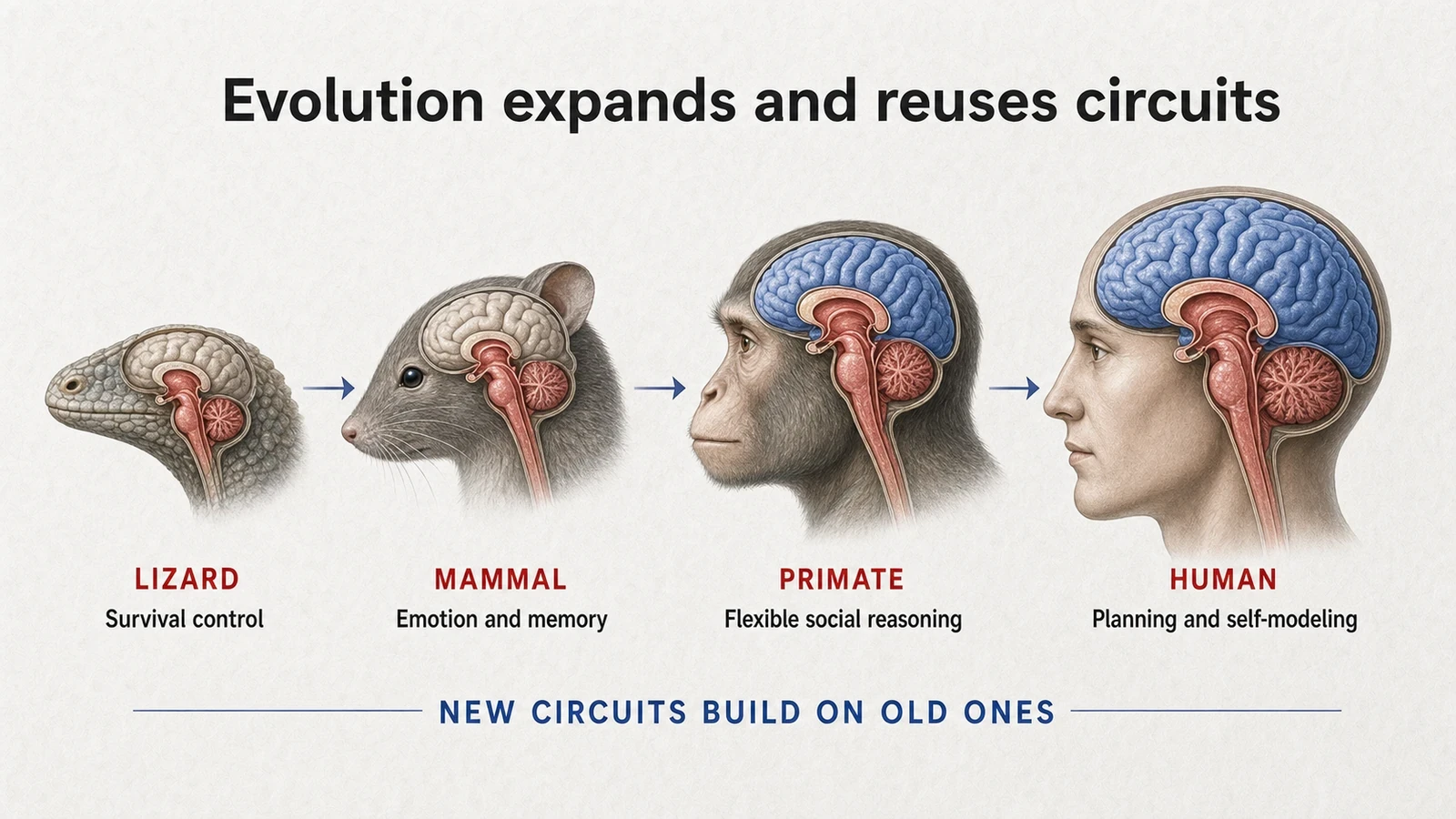
At any given moment, every one of these layers is active at once. The lizard part of you is running your heart. The mammal part is generating your emotional response to whatever's happening around you. The primate part is recognizing the words on this screen. The human part is stitching all of it together into the sense of being a person who's reading this particular sentence right now.
Most of what we call "willpower" is really just the human layer overriding the lizard and mammal layers underneath it. Most of what we call "habit" is the basal ganglia running ahead of conscious control. Most of what we call "emotion" is the limbic system getting there first, before you've had a chance to think. The brain isn't one decision-maker. It's more like a council, with a chair (the prefrontal cortex) who sometimes overrules the room and sometimes gets overruled right back.
10. What this means for daily life
A few practical consequences fall out of seeing the brain this way, as a stack rather than one single thing.
You're not always thinking with the same brain. When you're well rested, the prefrontal cortex is fully online and can override the older layers underneath it. When you're tired, drunk, hungry, or stressed, that override drops out and the lizard and mammal layers start running the show. The same person makes genuinely different decisions at 7am than at 11pm.
Habits are basal ganglia, not character. Once a behavior is etched into the basal ganglia, you don't need conscious effort to run it, and you can't easily stop it with conscious effort either. The fix is installing a new automatic behavior into the same circuit, not summoning more willpower.
Emotion arrives before reason does. The amygdala fires faster than the prefrontal cortex, by tens to hundreds of milliseconds. By the time you consciously "feel" something, the response is already in motion. What conscious reasoning can actually do is interpret and redirect that response, not stop it from happening in the first place.
The DMN is doing more of your thinking than you realize. Most of your sense of self, your rumination, your planning, your nostalgia, all of that is the DMN running quietly while you're not focused on anything else. If your DMN gets stuck on negative content, your "thinking" will be stuck there too, regardless of what you intend.
The cerebellum is precision-coordinating everything. Smooth movement, smooth speech, smooth thought. When it's fatigued or damaged, every output gets a little jerkier. This is part of why sleep matters so much: cerebellar consolidation is one of the things that happens while you're asleep.
11. The punchline
You are a stack of brains. The newest layer is the one telling itself a story about being one continuous person. The older layers don't care about that story. They're too busy keeping you alive, generating your emotions, and running your habits regardless of what the story says.
A lizard sitting on a rock for hours is running its brainstem and basal ganglia exactly as designed, not being lazy or unmotivated. A cat that can't plan past the next meal is running its limbic and cortical layers without the prefrontal extension that would let it do more, not falling short on intelligence. A chimpanzee can plan multi-step tool use because its prefrontal cortex is large enough for that; it can't construct a life story because its prefrontal cortex isn't quite large enough for that.
You have all of it. You also have one layer those animals don't: a hyperdeveloped prefrontal cortex that can model itself, imagine its own future, and override every layer underneath it when it's working the way it should.
It's the most "you" part of your brain. It's also the first one to go offline when you're tired.
Sleep well. The override layer is the one writing your life.