The idea that turns treatment on its head
Here's the folk theory of depression: you feel bad, so you stop doing the things you enjoy, so you feel worse, and eventually treatment, or time, or willpower, makes you feel less bad, and only then can you do things again. Feeling comes first. Doing comes after.
Peter Lewinsohn, working at the University of Oregon in the 1970s, looked at that arrow and flipped it around.
His read: you stop doing the things that used to reward you, so you get less reward, so your mood drops further, so you do even less, and the whole thing spirals. Notice where mood sits in that chain: downstream of what you're doing, not the starting point. Which means treatment doesn't have to touch your mood directly at all. It just has to get you back into the activities that used to pay off, whether or not you feel like it in the moment.
Action first. Mood follows.
That sounds like something printed under a photo of a mountain climber. It belongs in a research journal instead, because the evidence behind it is some of the strongest in clinical psychology.
The 1996 study that took CBT apart
Standard CBT for depression is usually taught as three parts working together: behavioral activation (scheduling rewarding activities), cognitive restructuring (catching and correcting distorted thoughts), and schema work (rewriting deeper beliefs about yourself). For years, the assumption was that you needed all three, and that the thought-work was doing most of the heavy lifting.
In 1996, Neil Jacobson and a team of colleagues tested that assumption by taking CBT apart piece by piece. They randomized 152 depressed adults into three groups: one got the full CBT package, one got behavioral activation plus cognitive restructuring but skipped the schema work, and one got behavioral activation alone and nothing else.
At six months, all three groups landed in the same place. Bare-bones behavioral activation, with none of the thought-correction work CBT is known for, matched the full package.
Which means the behavioral piece was doing most of the work the whole time. Rewriting your "irrational thoughts" turned out to matter less than simply scheduling the activities and showing up for them.
Plenty of CBT researchers did not love this finding. It got replicated anyway.
What the meta-analyses found
The evidence didn't stop growing after Jacobson's study. It kept piling up.
A 2007 analysis pooled 16 randomized controlled trials and found a large effect on depression (d = 0.87), matching or slightly beating cognitive therapy for moderate-to-severe cases, and landing about even with antidepressant medication for most people.
A follow-up analysis in 2014 widened the pool to 25 trials and still found a large effect (d ≈ 0.74 against a control group). Behavioral activation beat supportive therapy by a clear margin and held even with both CBT and medication.
A 2006 trial went further and put BA head-to-head against CBT and antidepressants in people with severe depression. BA matched the medication and actually beat CBT in that harder subgroup.
Add it up and you get a treatment that performs about as well as medication and CBT for depression, costs less, takes less training to deliver, comes with none of the side effects of a prescription, and doesn't require you to believe anything different about yourself before it starts working.
Why action moves mood
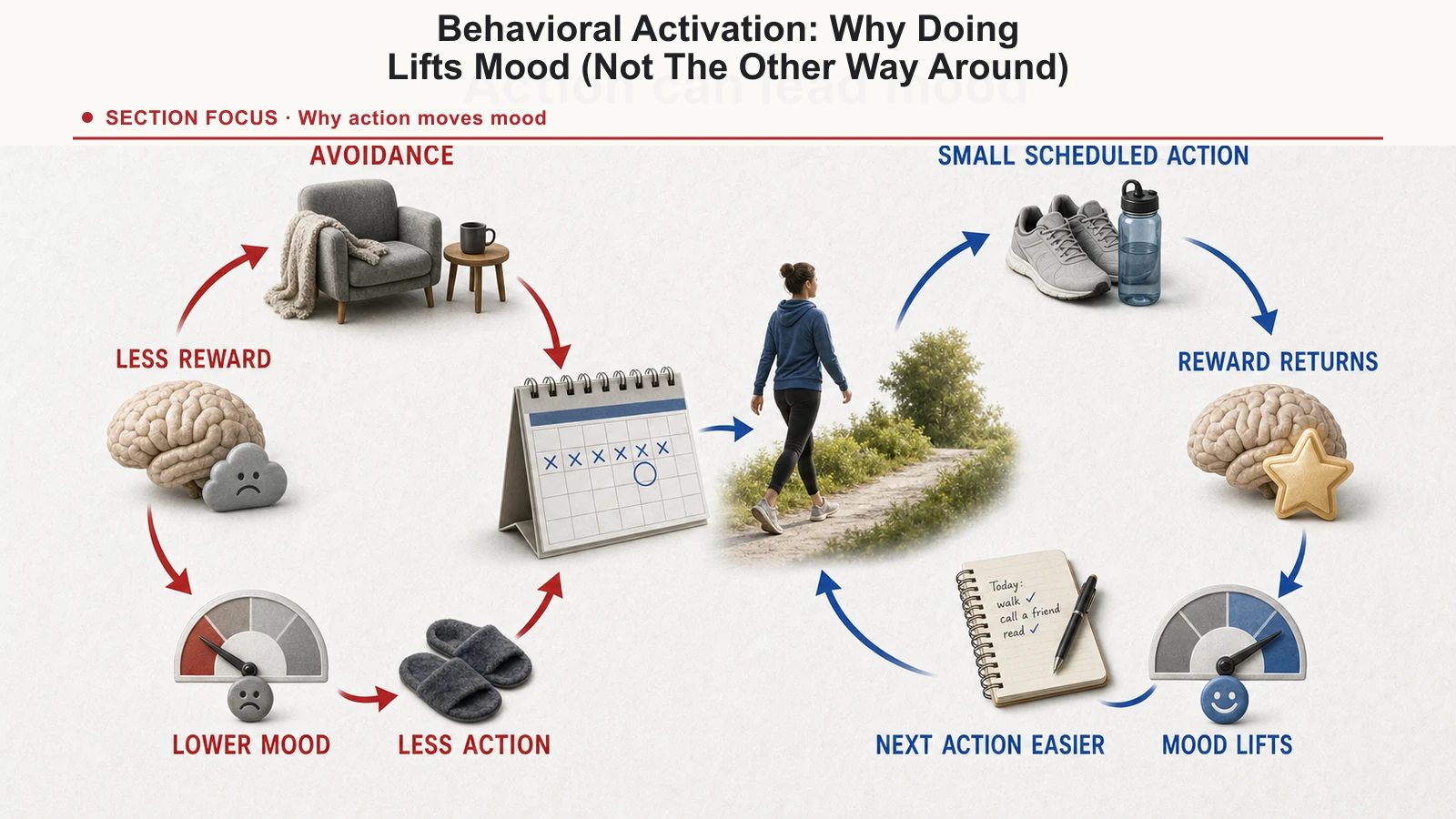
The mechanism can be understood through four interacting processes.
Reward learning. Behavior that pays off happens more often. Behavior that doesn't, fades out. Depression pulls you away from the activities that used to reward you, and once you've stopped doing them long enough, the behavior itself disappears, not just the mood around it. Behavioral activation reintroduces the activity, which reintroduces the reward, which starts rebuilding the behavior from scratch.
Skipping the motivation step. A depressed brain is remarkably reliable at producing "I don't feel like it." Waiting for that feeling to lift before you act means waiting for the depression to resolve on its own, which is exactly the thing that isn't happening. Behavioral activation cuts that link on purpose: do the activity anyway, without checking in on your mood first. That decoupling, action without permission from how you feel, is the actual mechanism.
Momentum. Take one small action (a ten-minute walk will do) and the next action gets slightly easier. The trajectory bends up instead of down. Each thing you finish lowers the resistance on the next one.
Less avoidance. Depression comes with a strong pull toward avoidance: skipping social contact, skipping exercise, skipping sunlight, skipping the work that actually matters to you. In the moment, avoiding feels like protection. Over weeks, it's fuel. Behavioral activation interrupts the pattern by putting the avoided activity on the calendar on purpose, instead of leaving it to chance.
The protocol, in practice
The clinical version of this is short enough to fit on an index card.
Track everything for a week. Every activity, rated on two 1-10 scales: mastery (did it feel like an accomplishment) and pleasure (did you enjoy it). Most people expect this step to be a formality. Most depressed patients are then surprised, sometimes uncomfortably so, by how few activities score above a 2 or 3 on either scale.
Starting week two, schedule small versions of what used to work. Pick the activities that scored well on mastery, pleasure, or both, and put them on the calendar for a specific day and time. Not "sometime this week."
Do them regardless of mood. This is the part that actually does the work. You complete the scheduled activity even when you don't feel like it, and for most people the mood lift shows up one to three days later, not immediately and not never.
Start smaller than feels reasonable. A ten-minute walk. One phone call to a friend. Washing the dishes without also doomscrolling. Once those are reliable, size them up.
Choose activities you actually enjoyed before. Cleaning the garage might give you a sense of accomplishment while offering little pleasure. Walking outside, calling a friend, playing music, or cooking can supply both.
Using this without a diagnosis

You can benefit from the activity experiment without meeting criteria for depression. Reduced access to reward and routine can affect mood across many situations.
If your mood is just low, not clinically depressed, scheduling one small specific activity (a walk, a call, cooking something you like) tends to lift it within hours to a few days for most people. That's Lewinsohn's principle applied directly, no clinical setting required.
If it's motivation rather than mood that's stalled, the same fix applies. Schedule the activity, do it, give it a few days. Motivation tends to show up after, not before.
Turned into a daily habit, small rewarding activities (15 minutes is plenty) act like a floor under your baseline mood. People who keep this up report less swing in how they feel from week to week.
During transitions, a new job, a breakup, a move, or a loss, you lose old reward-producing routines before building new ones. Mood often slides in that gap. Deliberately scheduling small rewarding activities is one practical support for emotional stability.
For clinical depression, use self-guided activity scheduling as a companion to appropriate care. For ordinary low periods, a small activity experiment can show whether contact with reward, mastery, or connection changes the pattern.
Run an activity experiment
An activity list becomes more useful when it captures different kinds of payoff. For seven days, rate each planned activity afterward on three scales from zero to ten:
- Pleasure: did any part feel good?
- Mastery: did it create competence or completion?
- Connection: did it reduce isolation or deepen contact?
Add energy before and after from one to five. Some activities cost energy and still help. A difficult phone call may score low on pleasure, high on mastery, and leave you relieved. A long scrolling session may feel pleasant for three minutes and leave energy lower.
At the end of the week, choose one activity from each useful pattern:
- high pleasure and low effort for rough days;
- high mastery for restoring agency;
- high connection for interrupting withdrawal.
Schedule the smallest workable version. "Talk with someone" becomes "send Alex a message at 6 p.m. asking for a ten-minute call." Specificity lowers the start cost and makes the experiment observable.
Do not use the ratings to punish a low mood. A completed activity can be worthwhile even when mood does not improve immediately. The point is to discover which actions increase contact with reward over time.
Behavioral activation is a treatment used for depression, but a self-guided worksheet is not a substitute for care when symptoms are severe, persistent, or include thoughts of self-harm. Seek professional or emergency support appropriate to your location.
What this means for your mood tracking
The Mood × Habit chart in TaskCoach.AI Analytics is behavioral activation made visible. It shows which of your habits actually correlate with a better mood over time, a personal, data-backed version of "which activities pay off for you specifically."
Treat it as more than a record. The habits with a positive mood delta are your reward-producing activities, the exact thing Lewinsohn's protocol asks you to schedule more of. The habits with a negative delta are worth a second look too: some are obligations you can't drop (laundry doesn't care about your mood chart), and some might be worth reconsidering altogether.
Putting it into practice this week
If you're in a low period right now, clinical or not, here's the version you can start today:
- Audit your week. What have you quietly stopped doing over the last two or three months that used to feel good?
- Pick one to three of them. Choose the smallest version you can manage. A ten-minute walk, not marathon training. One phone call, not hosting a dinner party.
- Schedule them at a specific time. Not "sometime this week." Tuesday, 6 PM.
- Do them regardless of how you feel. This step is the entire mechanism. Don't wait to feel like it.
- Watch for the lag. Mood usually follows one to three days behind the action. The morning you do the thing might feel unremarkable. The third morning often doesn't.
- Add more once it's working. Once one to three activities are running reliably, layer in one or two more.
Waiting to feel better before you act is depression's favorite move, the one that keeps it running. Acting anyway is what breaks the loop.
Action creates new evidence
Action precedes mood. Not the other way around.
Lewinsohn's behavioral activation, dating back to the 1970s, has since been tested in more than 25 randomized controlled trials and backed by multiple meta-analyses, with effect sizes on depression landing between d ≈ 0.74 and 0.87: right in line with medication and CBT.
The protocol itself doesn't need much explaining: schedule small rewarding activities, do them no matter your mood, and let the mood follow within a few days.
That holds both clinically (if you're dealing with severe depression, do this alongside a clinician, not instead of one) and outside the clinic, for the ordinary low periods, motivation slumps, and rough transitions everyone runs into eventually.
Your own Mood × Habit chart is the long-term evidence of this playing out in your own life: which activities actually raise your mood, and which don't. Do more of the first kind.
Waiting to feel motivated before you act gets the order backwards for most people, most of the time. Acting first has fifty years of data behind it. Use the approach that works.