An AI accountability partner is useful when it brings you back to a promise you would otherwise quietly forget. Encouragement feels good. A clear commitment, a check-in, and a decision about what happens next give that encouragement a job.
TaskCoach is our recommendation when you want that commitment connected to goals, tasks, habits, and daily planning. A general chatbot can also help if you maintain a simple record and a reliable reminder. We build TaskCoach; the setup below works without buying it.
Copy the setup · Choose your support · Handle a missed check-in
Start with one commitment
Choose something you control and can report clearly. “Become successful” is too vague for a useful check-in. “Complete two ten-minute Spanish practice sessions this week” gives you both an action and evidence.
Paste this prompt into your preferred AI chat. You can use it unchanged:
Be my accountability partner for one commitment. Ask what I want to finish this week, then ask what could get in the way. Ask one question at a time. Help me choose an action small enough to fit my real schedule. Agree on what evidence will show it happened and when I will check in. Save a short recap I can copy: action, evidence, check-in, fallback. If I miss it, ask what happened before suggesting one adjustment. Be direct and kind. Do not invent progress or promise reminders unless a reminder is actually set up and confirmed.
Here is an example of the record you want to leave with:
| Part | Example |
|---|---|
| Action | Practice a short Spanish introduction Tuesday and Thursday, 7:00–7:10 p.m. |
| Evidence | A short voice recording after each session |
| Check-in | Friday after lunch, using a calendar reminder |
| Fallback | If Tuesday is lost, practice three sentences Wednesday; keep Thursday’s session |
The fallback should preserve a useful start, not pretend the full commitment happened. If another person depends on a deadline, renegotiate it directly rather than silently moving it in your app.
A promise becomes easier to review when “done” has a visible meaning. A task checkmark can record your report; it does not independently verify the work. For important goals, look at the document, practice session, submission, or other result behind it.
Choose the kind of accountability you need
| What keeps happening? | A useful starting point | What you still need to do |
|---|---|---|
| Your goals disappear behind daily tasks | TaskCoach: goals, planning, habits, and Premium coaching in one system | Keep the plan and activity record current |
| You need help thinking through a commitment | ChatGPT or another general AI chat | Keep the latest commitment and confirm reminders separately |
| You need company to begin a work session | A body-doubling session, such as Focusmate | Choose the task before the session |
| You need someone whose judgment matters to you | A friend, colleague, or qualified coach | Agree on a sustainable check-in and boundaries |
| You respond to a formal commitment | A commitment contract or stakes service | Understand the rules and the consequences before signing up |
These options can work together. A human partner can provide the conversation you care about while software holds the schedule and record. If starting a session is your main obstacle, explore body doubling before building a more elaborate coaching system.
The AI's availability does not mean it is watching your day. It only has the information, tools, and permissions available to it. A chat window that waits for your next message is not automatically a proactive check-in service.
Make the check-in short enough to keep
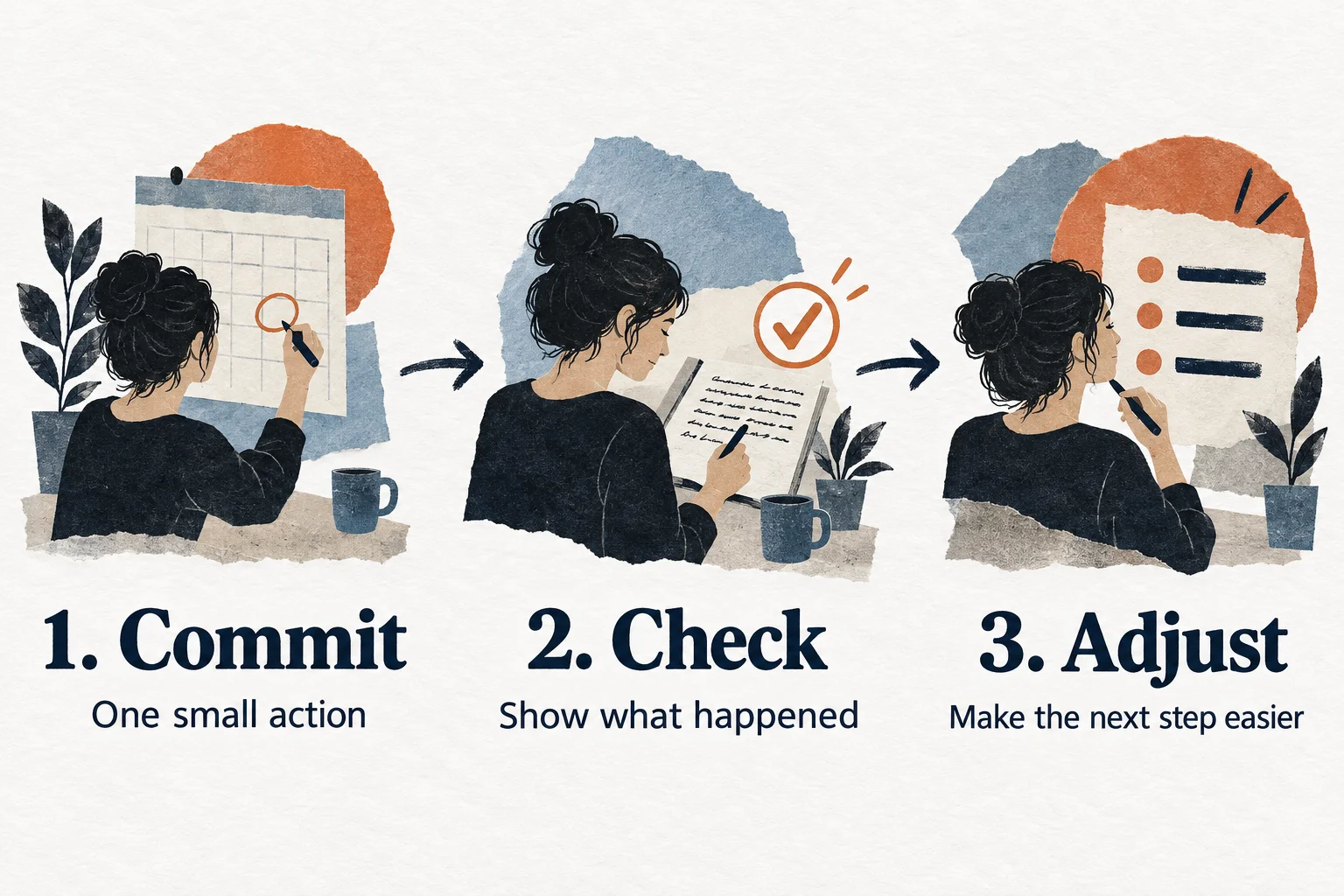
A useful review can start with three questions:
- What did you commit to?
- What actually happened?
- What will you keep or change?
Suppose you planned two sessions and completed one. “I need to be more disciplined” gives you nothing to adjust. “The second session was after a late meeting, and I had not chosen what to practice” gives you two specific problems.
One adjustment is to choose the three sentences before the session, so the next start requires no searching. Change one thing you can observe. If you change the schedule, app, goal, and reward at once, you will struggle to tell what helped.
Research on written goals and progress reporting, including Gail Matthews's work, is one reason to take clear commitments seriously. It does not establish that replacing a human with AI produces the same results. Judge the tool by whether you return, act, and learn from the record.
What to do after a miss
The most valuable check-in is often the one you least want to attend. Keep it small enough that you can return without preparing a defense.
Send this:
I didn't complete the action. What happened was ___. I can realistically do ___ next. Help me choose one adjustment and a new check-in.
If you do not know why you missed it, reconstruct the moment you expected to start. Was the task unclear? Was the time unavailable? Were you waiting for someone? Did the goal stop mattering?
A missed commitment may need a smaller action, a different time, help from another person, or an honest decision to stop pursuing it. Automatic encouragement to “try harder” is not a useful response to all four.
Keep the record accurate. An unbroken streak and your wider progress are different things. For a fuller reflection, use the 20-minute weekly review template.
How TaskCoach keeps the commitment near the work
Give the Spanish practice a recurring habit or scheduled task in TaskCoach. Keep the commitment recap in a note and log the sessions you actually complete. At Friday’s check-in, reopen that record: two planned sessions, one completed, and the reason the other was missed. The coach has something specific to help you change. This is an example setup you can create, not an automatically generated practice program.
Premium Brain Chat and memory can use the context you have recorded. You can correct remembered information and review ordinary proposed changes. AI reports support reflection on recorded activity; they cannot see work you never logged or determine whether every self-report is accurate.
The free core includes manual planning, tasks, habits, notes, journal, and focus tools, with AI in selected features within usage limits. Premium adds broader Brain Chat, memory, reports, and external calendar sync. TaskCoach is an installable PWA for supported phones and computers.
Our ChatGPT versus TaskCoach comparison shows the same missed-week situation in both approaches. Use the one that makes returning to the commitment easiest for you.
Your first week
Choose one commitment today. Set the check-in in a tool that will actually notify you. Keep the action and evidence somewhere you can find in seconds.
At the end of the week, ask whether the support helped you act or make a better decision. More messages are not the goal. A commitment you can return to is the useful result.