Two weeks, same average, wildly different outcomes
Picture two people tracking their mood for a week.
Person A logs a 6 every single day: 6, 6, 6, 6, 6, 6, 6. Person B logs 9, 3, 9, 3, 9, 3, 6.
Same average. Arguably the same total amount of good feeling, if you could sum something like that cleanly. And yet, on nearly every clinical measure that matters, Person A is doing better than Person B.
That's one of the central findings to come out of affective dynamics research, a field that's grown over the past twenty years out of KU Leuven, the University of Pittsburgh, and a handful of other labs. These researchers aren't just asking what people feel on average. They're asking how those feelings move over time.
It turns out that movement is its own variable. So is a second thing: how much one day's mood carries over into the next. Both predict mental health, independent of average mood entirely.
The study that changed how researchers think about mood
In 2015, a team of researchers pooled data from 33 separate studies that had tracked people's emotions over time and linked those patterns to mental health outcomes. Two distinct features of how mood moves turned out to predict wellbeing on their own, above and beyond a person's average mood.
The first is variability: how wide your mood swings are over a week or two of tracking. Even after accounting for average mood, people with wider swings showed higher rates of depression, anxiety, and borderline personality disorder, along with lower overall wellbeing.
The second is inertia: how strongly one day's mood predicts the next day's. High inertia means your mood gets stuck. Sad today usually means sad tomorrow too. This pattern tracked closely with depression and rumination specifically.
The two aren't the same thing, even though they're loosely related (people with high inertia often have moderate variability too). Each one predicts something the other doesn't fully explain.
Why big mood swings wear you down
A few mechanisms seem to be doing the work here.
Predictable moods make planning possible. If your mood tomorrow is roughly your mood today, you can plan around it. If it swings wildly, plans made on a good day tend to collapse the moment a bad one shows up.
Swinging moods are physically taxing. Your stress-response systems, the cortisol axis, your autonomic nervous system, appear to wear down measurably from frequent large emotional shifts. That wear shows up in physical markers of what researchers call allostatic load: the cumulative cost of your body constantly readjusting.
It's harder to know who you are. People with highly variable moods often struggle to fold their emotional life into one coherent story about themselves. Which version is the real one, the person from the great day or the person from the terrible one? That struggle connects to the identity work we cover in our piece on narrative identity.
It strains relationships. Partners and friends have to constantly adjust to a wider range of moods, and over years, that adjustment can quietly wear down the support you're counting on.
Why a "stuck" mood is its own problem
The inertia finding is more nuanced than the variability one. Some inertia is actually healthy: it's what gives your emotional life continuity from one day to the next. Too little, and your mood becomes essentially random. Too much, and you get stuck.
At the unhealthy end, the pattern looks like this: today is bad, so tomorrow is bad too, because today was bad. You can't just wait it out, because tomorrow inherits today's mood instead of starting fresh.
This overlaps heavily with rumination, the kind of looping, repetitive thinking Susan Nolen-Hoeksema spent much of her career studying. When you replay a bad mood in your head, you re-engage the feeling itself and stretch it out longer than it would otherwise last. In the data, that shows up as high emotional inertia.
The healthy middle ground is moderate inertia: yesterday nudges today without controlling it. Today is influenced by yesterday, not enslaved to it.
What the TaskCoach chart is actually showing you
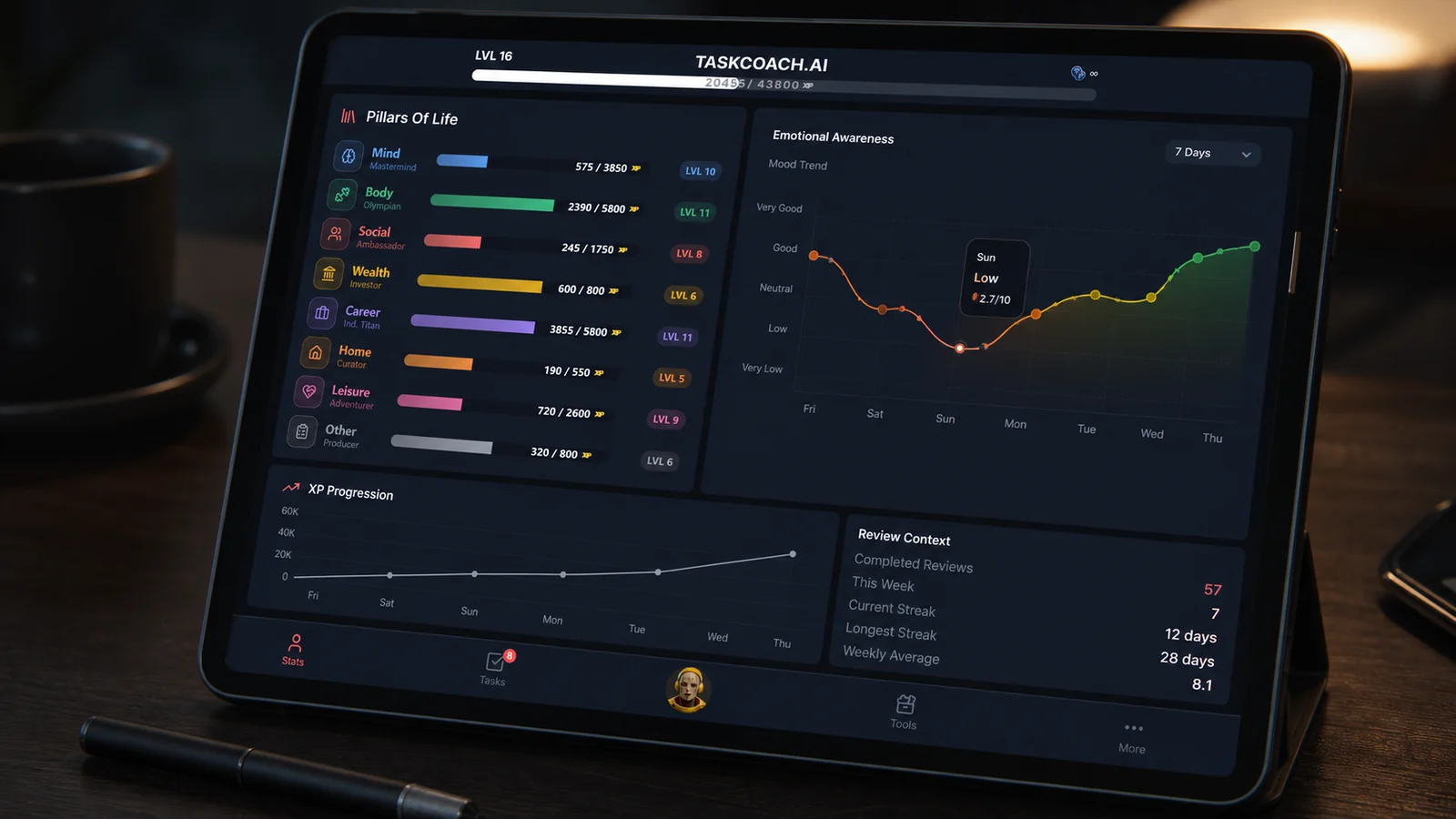
The Affective Stability chart in Mood Vitals plots your rolling 7-day standard deviation of mood scores. That's the variability half of the Houben findings, made visible and trackable.
When the line trends down, your mood is stabilizing, generally a good sign even if your average mood hasn't moved much. When it trends up, your mood is getting less predictable, worth a closer look, especially if there's no obvious reason for it. A single spiky week usually lines up with something specific: a loss, a big change, a deadline, an illness. It's ongoing high variability, not one rough week, that's the more concerning pattern.
The chart doesn't capture inertia directly (that needs longer time-series modeling to measure properly), but the rolling standard deviation still captures most of what's practically useful.
What actually lowers mood variability
A handful of interventions have shown real effects here:
Regular sleep. Inconsistent sleep is one of the strongest predictors of mood swings. Anchoring your wake time across all seven days of the week (see our piece on chronotypes) measurably reduces variability within about a month.
Regular exercise. Aerobic activity three to five times a week reduces mood variability beyond whatever it does for your average mood, likely through its effect on your stress-response system.
Behavioral activation. Counterintuitively, scheduling specific positive activities in advance smooths out the curve. Regular small rewards flatten the swings.
Mindfulness and meditation. Multiple randomized trials, including a well-known 2010 meta-analysis, found meditation reduces mood variability alongside reducing distress generally.
Treating what's underneath. Bipolar disorder, borderline personality disorder, and severe depression all drive high variability. Treating those conditions effectively tends to lower variability as a side effect.
What doesn't move the needle much: one incredible weekend (it can mask variability briefly without changing the underlying pattern), or simply trying to "think positive" (variability is driven mostly by physiology and behavior, not by what you're telling yourself).
Chase stability, not just peaks
Most people optimize for feeling great as often as possible. The research suggests a second target matters just as much: not feeling terrible. Lowering your variability is a mental-health intervention in its own right.
That reframes a few everyday decisions. A daily 30-minute walk that reliably lifts your mood a little is worth more, over time, than one incredible weekly experience that lifts it a lot and then vanishes. Boring, stable evenings carry more long-term value than people tend to give them credit for. And chasing "peak experiences" can actually cost you something if it comes at the expense of stability.
This isn't a new idea, exactly. Buddhist thought has been making a version of this argument for 2,500 years: equanimity over peak ecstasy. Affective-dynamics research just gives it a modern, measurable backing.
What TaskCoach.AI does with this
The Affective Stability chart in Mood Vitals is built directly on this research. The rolling standard deviation makes your variability visible week over week, shown alongside your average mood score but tracked separately, so a stable, moderate week gets recognized as a genuinely healthy week even when your average isn't at its peak.
The habit and sleep tracking elsewhere in the app quietly target the same thing: regular sleep, regular movement, and regular small rewards are exactly the inputs the research points to for reducing variability.
The bottom line
Your average mood isn't the only signal that matters for your mental health. It might not even be the most important one.
Across 33 studies, researchers found that emotional variability and emotional inertia each predict mental health on their own, separately from average mood. A stable, moderate week beats a wide-swinging week with the same average, on nearly every outcome that matters.
"Chase the peaks" is bad advice on its own, without stability as a counterweight. The same habits that lower variability, regular sleep, regular exercise, scheduled positive activities, treating whatever's underneath, are the habits that improve wellbeing generally. They just happen to hit the variability question directly.
If you've only ever tracked your average mood, you've been looking at half the picture. The other half is sitting on your Affective Stability chart.